Autor Cointelegraph By Arijit Sarkar

Congress demands crypto payments notification from DOS when helping Ukraine

A new bill demanding a congressional notification prior to payments of the United States Department of State (DOS) rewards using cryptocurrencies surfaced as the U.S. Congress raised concerns about the evasion of sanctions.The Rewards for Justice Program, a counterterrorism rewards program run by the Secretary of State, offers rewards for information that prevents international terrorism. Citing examples of Russia and Belarus as previously sanctioned regimes that have used cryptocurrencies to circumvent sanctions, the bill H. R. 7338 demands that:“The Secretary of State shall notify the appropriate congressional committees not later than 15 days before paying out a reward in cryptocurrency.”Congress highlighted the United Nations’ findings that 12 million Ukrainian residents would need humanitarian assistance and that cryptocurrencies have “been used as an effective cross-border payment tool to send millions to the Ukrainian Government, Ukrainian army, and Ukrainian refugees with limited access to financial services.”The bill amendment demands the Secretary of State submit reports to congressional committees explaining why the DOS made the decision to pay out rewards in cryptocurrency. If signed into law, the bill will require the DOS to list each crypto payments that were previously provided. Moreover, the federal department will also need to provide evidence as to why cryptocurrency payments would encourage whistleblowers to share intel when compared to rewarding with U.S. dollar or other prizes.In doing so, the DOS must showcase an analysis of how crypto rewards could undermine USD’s dominance as the global reserve currency.Related: White House OSTP department analyzes 18 CBDC design choices for the USFollowing U.S. President Joe Biden’s executive order on Ensuring Responsible Development of Digital Assets, federal agencies joined hands in publishing a fact sheet to articulate a clear framework for responsible digital asset development.The “first-ever” fact sheet published by the White House consisted of seven sections, namely (1) Protecting Consumers, Investors, and Businesses; (2) Promoting Access to Safe, Affordable Financial Services; (3) Fostering Financial Stability; (4) Advancing Responsible Innovation; (5) Reinforcing Our Global Financial Leadership and Competitiveness; (6) Fighting Illicit Finance and (7) Exploring a U.S. Central Bank Digital Currency (CBDC).While some of the sections don’t contain any particularly new information, federal agencies recommend the creation of a federal framework for nonbank payment providers in addition to encouraging the adoption of instant payment systems like FedNow, which is expected to launch in 2023.

Čítaj viac

Solana outperforms Ethereum in daily transactions in Q2: Nansen report

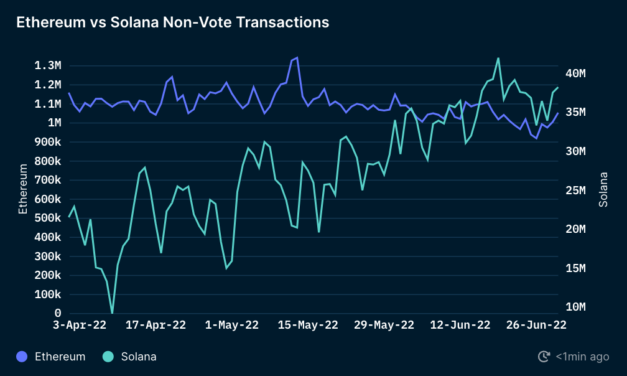
Hype does not always equate to greater adoption, as the on-chain data from the second quarter of 2022 shows Solana (SOL) surpassing Ethereum (ETH) in users’ daily transactions despite various drawbacks from both macroeconomic conditions and network outages. Throughout the second quarter, Solana’s daily transactions consistently increased, ending with more than 40 million daily transactions compared to Ethereum’s 1 million daily transactions between April and June, confirmed Nansen’s State of the Quarter Report. Solana vs. Ethereum daily transaction data. Source: NansenSolana’s significant increase in daily transactions was observed on daily non-vote transactions when compared to Ethereum — despite sporting higher volatility. On-chain data revealed that decentralized exchanges (DEX) such as Mango Markets and Serum and Solana-based decentralized oracle network Switchboard were among the top decentralized apps (DApps) contributing to the spike in daily transactions.Top Solana DApps by transactions. Source: NansenWhen considering vote transactions, Solana recorded a range of roughly 100 million to 200 million transactions per day, which was supported by a spike in the total number of wallets — from around 400,000 wallets to nearly 1 million toward the end of May 2022. Daily transactions on Solana. Source: NansenSolana’s explosive growth can be attributed to a series of funding from mid-2022 made to support the GameFi, decentralized finance (DeFi) and nonfungible token (NFT) ecosystems. On an end note, Mega Septiandara, a research analyst at Nansen, stated that “Whether it’s the establishment of the Korea grant and investment fund, or the numerous upcoming events that welcome new builders and users, the Solana ecosystem is thriving.”Related: Network outages have been Solana’s ‘curse,’ says co-founderA recent governance proposal from Oct. 2022 highlighted the possibility of Helium, an Internet of Things (IoT) blockchain network, transitioning to Solana.As Cointelegraph reported, Helium developers recommended the shift to “improve operational efficiency and scalability.” Emphasizing the need to fix a number of technical issues to improve the network’s capabilities, the developer community stated:“In the last several months of the network, both have been challenging for network participants with much reduced proof-of-coverage activity due to network size and blockchain/validator load, and packet delivery issues.”If passed, Helium-based HNT, IOT and MOBILE tokens and Data Credits (DCs) would also be transferred to the Solana blockchain.

Čítaj viac

Influential celebrities that joined the crypto club over the past year

The inclusive crypto ecosystem has become home to numerous A-list celebrities over the years — primarily driven by the nonfungible tokens (NFT) hype of 2021. However, despite the prolonged bear market and an evident dip in cryptocurrency prices, celebrities continue to pour in support for the crypto market. Over the past year, celebrities have started exploring sub-ecosystems beyond NFTs, trying to diversify their presence across trading, gaming and other investment avenues. In this light, here’s an overview of some of the most influential celebrities that got into crypto over the past year and how well-prepared they are for the next bull run.Connor McGregor partners with Tiger.TradeUFC superstar Connor McGregor, one of the highest-paid athletes, recently partnered with Tiger.Trade, a crypto trading app. A part of the deal involves McGregor featuring in an in-house game that users can play to win exclusive prizes. Who wants to play?!!! The only rule is to play #SmarterNotHarder Conor McGregor in the game! Are you ready to win with @tiger_trade? https://t.co/FlJX5prxHf pic.twitter.com/9ZCrRizxWC— Conor McGregor (@TheNotoriousMMA) September 12, 2022Prior to signing as an ambassador for Tiger.Trade, McGregor’s involvement in crypto has been indirect via UFC partnerships with Crypto.com, wherein bonuses were paid to the fighters in cryptocurrencies.The recent game launch, while well-received by fans for its graphics and prizes, was also subject to criticism related to the lack of story. Unlike the majority of top UFC fighters, McGregor has not linked his name with now-defunct NFT projects and continues to maintain secrecy around his investment choices in cryptocurrency.Eminem purchases Bored Ape NFT for $460,000Marshall Mathers, aka Eminem, is one of the rare celebrities to make headlines for investing in NFT rather than trying to sell their collections. The fifteen-time Grammy winner purchased Bored Ape ‘EminApe’ NFT for $460,000, which depicts a gold chain necklace and khaki army cap that Eminem wears in real life.Eminem’s connection with crypto dates back to 2018, when the rapper mentioned Bitcoin (BTC) in his newly released album Kamikaze. However, the subsequent NFT purchase established his interest in crypto investments. In June 2022, Eminem released a Bored Ape Yacht Club (BAYC) NFT-themed music video featuring rap legend and fellow crypto enthusiast Snoop Dogg.While Eminem hasn’t publicly shared affinity toward any particular crypto asset for investments, the rapper continues to collaborate with BAYC for live performances.Maria Sharapova became a strategic investor in MoonpayTennis legend Maria Sharapova, along with other A-list celebrities such as Gal Gadot, Bruce Willis and Justin Beiber, invested in crypto payment solution, Moonpay. The company revealed that more than 60 public figures and celebrities in the music, sports, media and entertainment industries joined hands to invest $87 million in a Series A funding from November 2021.Excited to transform the way creatives, artists & athletes approach ArtFan engagement ‍⚖️Intellectual property management With the help of our new strategic investors. pic.twitter.com/sfeH1Hhibh— MoonPay (@moonpay) April 13, 2022

The investment marked Sharapova’s entry into the crypto world. However, the superstar is yet to reveal her plans for investments in crypto assets. Snoop Dogg: The face of Web3 and NFTsSnoop Dogg position as an OG stands true in the world of crypto considering his proactive involvement in the space for many years. Snoop’s first interaction with the crypto community started off with him warning against impersonators marketing fake Snoop Dogg-branded tokens and NFTs. After acquiring knowledge about the industry, the rapper collaborated with numerous crypto projects, including crypto exchanges, Web3, games, and NFTs, effectively catalyzing the mainstream adoption of crypto.Announcing the newest member on the Food Fighters Universe team @SnoopDogg AKA Dr. Bombay pic.twitter.com/itZqpG3neQ— Food Fighters Universe | MINTING NOW (@FoodFightersU) June 3, 2022

Most recently, Snoop Dogg announced the launch of a new restaurant in Los Angeles inspired by BAYC NFTs, named Bored and Hungry. Despite the dimming down of the hype around NFTs, the smoke king continues to show love for the ecosystem. Floyd Mayweather makes a crypto comebackLegendary boxing champion Floyd Mayweather marked his entry into the cryptoverse in 2018, promoting a high-profile crypto scam called Centra Tech. Legal implications of promoting unvetted crypto projects required Mayweather and co-promoter DJ Khaled to pay fines of $600,000 and $150,000, respectively.After many months of hard workI’m launching my new NFT Project @mayweverse⁰The collection will have 5,000 NFTs (5 different NFTs cards of 1,000 each).Each card has a different rarity, utilities & prizes.More information on the roadmap will be announced soon. Stay Tuned pic.twitter.com/SxZ916p0HP— Floyd Mayweather (@FloydMayweather) March 21, 2022

Learning from his previous mistakes, Mayweather launched a new NFT project Mayweverse — consisting of a collection of 5,000 NFTs. The boxer’s track record in being involved with projects that have rug-pulled investors has left his fans and the general public with mixed feelings about the new crypto project.Matt Damon opts for philanthropy via crypto donations Hollywood superstar Matt Damon received $1 million in donations from crypto exchange Crypto.com for Water.org, a clean-water initiative co-founded by Damon and Gary White in 2009. As part of the deal, Crypto.com recommended its user base chip in for the cause. Matt Damon starring in Crypto.com commercial. Source: YouTubeAlthough Damon hasn’t disclosed his crypto investments, his participation in a Cypto.com commercial attracted criticism from a majority of the crypto community. Investors retaliated against Damon’s suggestion of “Fortune favors the brave” as the bear market resulted in massive losses across the industry.Related: Celebrity NFT brands: How celebrities can advance the NFT spaceGoing against the rising trend of celebrity-backed NFT projects, consumer watchdog group Truth in Advertising (TINA.org) called out 19 celebrities promoting NFTs without disclosing their connection to the projects. The non-profit consumer advocacy company revealed its intent to investigate celebrities that promote “deceptive” crypto investments. The website states:“The promoter often fails to disclose material connection to the endorsed NFT company.”Responding to TINA.org’s letters related to the promotion of NFTs on their social media accounts without disclosing their connection to the projects, Justin Bieber’s legal team responded by denying any wrongdoing. However, the team confirmed to update the posts on social media.

Čítaj viac

Profanity tool vulnerability drains $3.3M despite 1Inch warning

Decentralized exchange aggregator 1inch Network issued a warning to crypto investors after identifying a vulnerability in Profanity, an Ethereum (ETH) vanity address generating tool. Despite the proactive warning, apparently, hackers were able to make away with $3.3 million worth of cryptocurrencies.On Sept. 15, 1Inch revealed the lack of safety in using Profanity as it used a random 32-bit vector to seed 256-bit private keys. Further investigations pointed out the ambiguity in the creation of vanity addresses, suggesting that Profanity wallets were secretly hacked. The warning came in the form of a tweet, as shown below. RUN, YOU FOOLS ⚠️ Spoiler: Your money is NOT SAFU if your wallet address was generated with the Profanity tool. Transfer all of your assets to a different wallet ASAP!➡️ Read more: https://t.co/oczK6tlEqG#Ethereum #crypto #vulnerability #1inch— 1inch Network (@1inch) September 15, 2022A subsequent investigation by blockchain investigator ZachXBT showed that a successful exploit of the vulnerability allowed hackers to drain $3.3 million in crypto.Appears $3.3m worth of crypto has been exploited by 0x6ae from this vulnerability. Interestingly the Indexed Finance Exploiter was the first address drained by 0x6ae. Attackers address:0x6AE09AC63487FCf63117A6D6FAFa894473d47b93 https://t.co/gnQHHytI1m pic.twitter.com/5TYccNIpdq— ZachXBT (@zachxbt) September 17, 2022

Moreover, ZachXBT helped a user save over $1.2 million in crypto and nonfungible tokens (NFTs) after alerting them about the hacker who had access to the user’s wallet. Following the revelation, numerous users confirmed that their funds were safe, as one stated:“Wtf 6h after the attack my addresses was still vuln but the attacker didnt drained me? had 55k at risk lol”However, hackers tend to attack the bigger wallets before moving over to wallets with lesser value. Users owning wallet addresses generated with the Profanity tool have been advised to “Transfer all of your assets to a different wallet ASAP!” by 1Inch.Related: Law enforcement recovers $30 million from Ronin Bridge hack with the help of ChainalysisWhile some hackers prefer the traditional method of draining users’ funds after illegally accessing the crypto wallets, others try out new ways to fool investors into sharing their private keys.One of the recent innovative scams involved the hacking of a YouTube channel for playing fabricated videos of Elon Musk discussing cryptocurrencies. On Sept. 3, the South Korean government’s YouTube channel was momentarily hacked and renamed for sharing live broadcasts of crypto-related videos. The compromised ID and password of the YouTube channel were identified as the root cause of the hack.

Čítaj viac

Flashbots build over 82% relay blocks, adding to Ethereum centralization

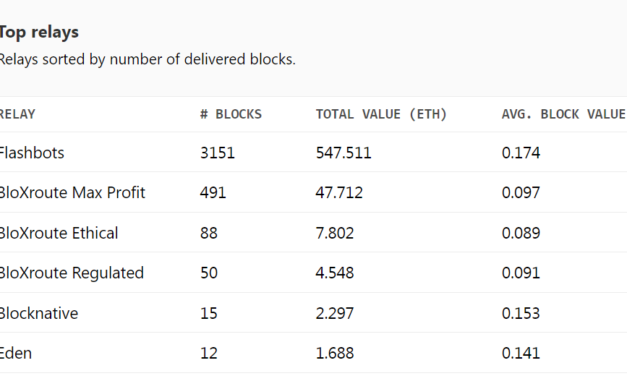
Following the completion of The Merge upgrade, Ethereum (ETH) transitioned into a proof-of-stake (PoS) consensus mechanism, helping the blockchain become energy efficient and secure. However, mining data reveals Ethereum’s heavy reliance on Flashbots — a single server — for building blocks, raising concerns over a single point of failure for the ecosystem.Flashbots is a centralized entity dedicated to transparent and efficient Maximal Extractable Value (MEV) extraction, which acts as a relay for delivering Ethereum blocks. Data from mevboost.org show that there are six active relays currently delivering at least one block in Ethereum, namely Flashbots, BloXroute Max Profit, BloXroute Ethical, BloXroute Regulated, Blocknative and Eden. Relays sorted by number of delivered blocks. Source: mevboost.orgAs shown above, out of the lot, 82.77% of all relay blocks have been found to be built by Flashbots alone — contributing heavily to Ethereum centralization. A related blog from BitMEX highlighted the need for a complete redevelopment of Flashbots or a similar system to mitigate unforeseen complications in an era after the Merge. However, Flashbots proponents argue that the system is a decentralized autonomous organization (DAO) and will eventually become decentralized itself. Related: Ethereum Merge: Community reacts with memes, GIFs and tributesComplementing the data related to Flashbots’ dominance, an analysis from Santiment indicated that 46.15% of Ethereum’s PoS nodes are controlled by only two addresses. According to our #Ethereum Post Merge Inflation dashboard, 46.15% of the #proofofstake nodes for storing data, processing transactions, and adding new #blockchain blocks can be attributed to just two addresses. This heavy dominance by these addresses is something to watch. pic.twitter.com/KQdFNgGloD— Santiment (@santimentfeed) September 15, 2022″Since the successful completion of the Merge, the majority of the blocks — somewhere around 40% or more — have been built by two addresses belonging to Lido and Coinbase. It isn’t ideal to see more than 40% of blocks being settled by two providers, particularly one that is a centralized service provider (Coinbase),” explained Ryan Rasmussen, crypto research analyst at Bitwise.

Čítaj viac

Získaj BONUS 8 € v Bitcoinoch

nakup bitcoin z karty

Registrácia Binance

Burza Binance

Aktuálne kurzy