
Autor Cointelegraph By Arijit Sarkar

LUNC investors react to CZ's 1.2% trading tax recommendation on Binance

The infamous collapse of the Terra ecosystem, which erased market prices of TerraUSD (UST) and LUNA tokens, continues to trouble anxious investors as co-founder Do Kwon, crypto exchanges and the community together tries to identify the best route for a sustainable price recovery.Most recently, Changpeng ‘CZ’ Zhao, the CEO of crypto exchange Binance, recommended a flat 1.2% trading tax on LUNC trades that could be burned to reduce the token’s total supply and improve its price performance. Addressing the community, CZ stated:“We will implement an opt-in button (on the Binance exchange), for people to opt-in to pay a 1.2% tax for their LUNC trading.”However, the exchange would begin the taxation for opt-in traders following the consensus of 25% of the LUNC investors, making sure that early adopters “are not the only few paying an extra 1.2%.”A blanket trading tax of 1.2% will be implemented for all LUNC trading only after opt-in traders reach 50% of the total LUNC trading volume on the exchange.I answered the question about LUNC in my Twitter Space AMA just now.Another option is to implement a feature to let users opt-in for a 1.2% trading fee themselves for burn. And see how many of the voting community do that first. Vote with your fees.— CZ Binance (@cz_binance) September 23, 2022The recommendation split up the LUNA community as some supported CZ’s decision to implement the opt-in button while others interpreted it as market manipulation from a centralized entity.CZ backed LUNC burning but believes in community voting, allowing traders on the platform to finalize the suggestion, adding, “We listen to and protect our users.” However, the entrepreneur is aware that unless the change is implemented across all exchanges and on-chain, LUNC traders would prefer moving assets to other exchanges that don’t have the burn.Related: South Korean authorities ask Interpol to issue ‘Red Notice’ for Do Kwon: ReportOn the other end of the spectrum, South Korean authorities are trying to track down and arrest Kwon for the Terra collapse. On Sept. 14, a court in Seoul, South Korea, issued an arrest warrant for Kwon and five other people for violating the country’s capital markets law.

Čítaj viac
NFT ecosystem attempts a bounce back amid bearish market sentiment

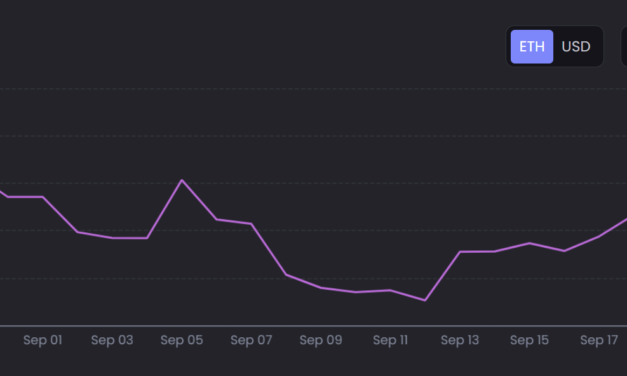
Over the past two years, nonfungible tokens (NFTs) gave the crypto ecosystem the boost it needed to grab mainstream attention — owing to the involvement of prominent artists and celebrities. However, despite the enormous losses suffered by NFT investors following the ongoing, 10-month-long bear market, the ecosystem showed sustainable signs of a comeback in the last two weeks.Since Sept. 12, the performance of blue-chip NFT collections witnessed a steady growth, inching back toward the 10,000 Ether (ETH) that was lost in mid-August 2022, according to data by NFTGo. The performance of blue-chip NFT collections. Source: NFTGoOn Sept. 20, the market capitalization, which is derived from the floor price and the trading price of NFTs, spiked nearly 16.5% at roughly 11.25 million ETH. Market capitalization of NFT collections. Source: NFTGoReciprocating the market cap breach of the 11 million ETH mark for the first time in three months, the number of NFT holders grew 32.24% along the same timeline, as shown above.Ethereum Name Service (ENS) currently contributes the highest volume at 9.25%, which is followed by popular NFT collections such as Bored Ape Yacht Club and Otherdeed. NFT market sentiment. Source: NFTGoHowever, current market sentiment — calculated based on volatility, trading volume, social media and Google trends — remains cold as investors try to recoup their previous losses.Related: Post offices adopting NFTs leads to a philately renaissanceNFT marketplace OpenSea launched the OpenRarity protocol to verify the rarity of NFTs within its platform. The protocol aims to provide a reliable “rarity ranking” that would assist investors when considering purchasing NFTs.

Čítaj viac

MEVbots backdoor drains users’ Ethereum funds via arbitrage trading bot

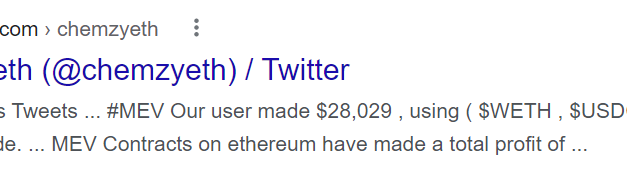
MEV gain, an Ethereum (ETH) arbitrage trading bot built by MEVbots, which claims to provide stress-free passive income, has been actively draining its users’ funds via a fund-stealing backdoor. Arbitrage bots are programs that automate trading for profits based on historical market information. An investigation of MEVbots’ contract revealed a backdoor that allows the creators to drain Ether from its users’ wallets. Our analysis confirms what the @mevbots promotes for the so-called “MEV gain” has a fund-stealing backdoor. Do *NOT* fall prey to it https://t.co/z2eDqMF36b. And thanks @monkwithchaos for the heads-up https://t.co/dhSNGljoH0 pic.twitter.com/HWfCAwbae4— PeckShield Inc. (@peckshield) September 23, 2022The scam was first pointed out by Crypto Twitter’s @monkwithchaos and later confirmed by blockchain investigator Peckshield. Suspect account @chemzyeth promoting MEV services. Source: Google cacheFollowing the revelation, primary promoter of MEV @chemzyeth disappeared from the internet.@chemzyeth’s Twitter account deleted after community callout. Source: TwitterPeckshield further confirmed that at least six users had fallen victim to the backdoor attack.Transaction of stolen funds from MEV gain’s fund-stealing backdoor. Source: Peckshield However, considering that the contract is still active, at least 13,000 unwary followers of MEVbots on Twitter remain at risk of losing their funds.Related: ETHW confirms contract vulnerability exploit, dismisses replay attack claimsCarrying forward the success of scalability-focused layer-2 solutions, Ethereum co-founder Vitalik Buterin shared his vision for layer-3 protocols. He stated:“A three-layer scaling architecture that consists of stacking the same scaling scheme on top of itself generally does not work well. Rollups on top of rollups, where the two layers of rollups use the same technology, certainly do not.”One of the use cases for layer-3 protocols, according to Buterin, is “customized functionality” — aimed at privacy-based applications which would utilize zk proofs to submit privacy-preserving transactions to layer 2.

Čítaj viac

Bitcoin was almost named Netcoin by Satoshi Nakamoto, hints domain data

Coming up with a good name is often one of the most challenging decisions one needs to make when launching a new service or business. Historical data of domain name purchases suggest that Satoshi Nakamoto, the creator of Bitcoin (BTC), had an alternate naming option in mind that did not make it to the whitepaper.Bitcoin.org, the website domain linked to the original Bitcoin, was created on Aug. 18, 2008, under AnonymousSpeech, a service in Japan that allowed users to buy domain names anonymously. Domain purchases under AnonymousSpeech around similar timelines revealed the creation of Netcoin.org on Aug. 17, 2008 — just a day prior to the creation of Bitcoin.org.Did you know? A day before the https://t.co/oDfOFzFVNi domain was first registered, someone purchased https://t.co/KLzoDxJjrz using the same registrar. Looks like Satoshi was contemplating between the two names and later dropped https://t.co/KLzoDxJjrz#Bitcoin pic.twitter.com/yqwZYRefvX— Or Weinberger (@orweinberger) September 23, 2022After further research, crypto locksmith Or Weinberger confirmed that no content was ever present on the Netcoin.org domain “except only after it was repurchased by another person later on.”The decision to stick with Bitcoin may have been crucial to its success due to the fact that numerous members of the crypto community highlighted their dislike for the name Netcoin, as one stated:“That’s interesting. I’m glad they stuck with Bitcoin, sounds way better.”The finding further helps Bitcoin distance itself from the people that have previously claimed to be Satoshi Nakamoto. The Netcoin.org domain was later deleted and re-registered to a subsidiary of Web.com in 2010.Related: El Salvador’s Bitcoin decision: Tracking adoption a year laterDespite the mysteries behind the creation of Bitcoin, the asset continues to dominate the financial markets. BitPay confirms this notion as its data showed Bitcoin to be a major payment tool despite huge price volatility.Speaking to Cointelegraph, BitPay’s vice president of marketing Merrick Theobald stated that the sales volumes of Bitcoin-based payments on BitPay accounted for as much as 52% in the first quarter of 2022.

Čítaj viac

GEM Digital commits $50M to ParallelChain Lab for L1 protocol development

Digital asset investment firm GEM Digital Limited (GEM) has committed $50 million to finance ParallelChain Lab following the launch of its mainnet and native token listing, XPLL, in Q4 2022.As a proof-of-stake (PoS) layer-1 protocol, ParallelChain aims to bridge the infrastructure divide between centralized (CeFi) and decentralized finance (DeFi). The soon-to-be-launched ParallelChain Mainnet is open source and based on a PoS consensus mechanism dedicated to maintaining a fair distribution of power. The permissioned ParallelChain Enterprise, on the other hand, will ensure the secrecy of transactions using a patented Proof-of-Immutability mechanism. The two platforms, together, intend to deliver an architecture that operates in confidentiality while allowing to validate transactions. Speaking about the innovation, ParallelChain CEO Ian Huang stated:“We see this solution as the answer to enterprises’ privacy and compliance demands while simultaneously addressing the need for scalability across many public applications, namely DeFi.”GEM’s $50 million investment in ParallelChain is planned to be redirected to market expansion, community development, research and development and funding of decentralized projects and decentralized app (DApp) developers.Related: Sports metaverse company secures $200M fundingShowcasing the diverse interest of crypto investors, institutional crypto lending protocol Maple Finance announced its commitment of up to $300 million in secured debt financing to public and private Bitcoin (BTC) mining firms.Today, @IcebreakerDeFi joins Maple and opens a $300M capacity pool to provide secured debt financing to blue-chip Bitcoin mining and digital asset infrastructure companies. pic.twitter.com/ZWyLV2P9hr— Maple (@maplefinance) September 20, 2022Mining firms from North America and Australia that meet the treasury management and power strategies standards are eligible to apply for the funding. Sidney Powell, CEO and co-founder of Maple Finance, highlighted the recent pullback from lenders, adding that:“Miners play an essential role in growing the crypto ecosystem and local economies, and we are proud to extend a new financing vehicle to direct capital where it is needed the most.”As Cointelegraph reported, Maple currently holds 50% of the institutional crypto lending market as measured by total loans outstanding.

Čítaj viac

Získaj BONUS 8 € v Bitcoinoch

nakup bitcoin z karty

Registrácia Binance

Burza Binance

Aktuálne kurzy