Autor Cointelegraph By Arijit Sarkar

FTX CEO dissects Mark Zuckerberg's intent to pump $10B/year into Meta

Facebook’s rebranding into Meta was Mark Zukerberg’s latest attempt to retain dominance in the social media world of Web3, specifically, the Metaverse. On the occasion of Meta completing one year on the rebrand, Sam Bankman-Fried (SBF), the CEO of the crypto exchange FTX, shared his thoughts on the rebranding and what it means for the future of Meta.Zuckerberg’s $100 billion Metaverse experiment first raised eyebrows when the CEO released the avatar for Meta’s Horizon Worlds VR platform. Subsequent releases of the Zuckerberg avatar fell prey to internet memes, although each new iteration seemed visually better than its predecessor.According to Bankman-Fried, Facebook’s growth was not impacted by newer rivals such as TikTok. Rather, he argued that the company “stopped growing because, well, there was no more room to grow.”SBF suspected that rebranding to Meta was a way for Facebook to improve its reputation through distraction. Moreover, the move would strengthen Meta’s narrative for generating high income upon its success.However, SBF highlighted “the vague Meta guidance” and how the investors have decided to spend $10 billion per year in the Metaverse. The intent to infuse $10 billion yearly strengthens Zuckerberg’s position as a believer in the Metaverse. On an end note, SBF reiterated that Facebook had already won by becoming the largest social media network. “So what’s next? Start building Social Media 3.0,” concluded SBF.Related: Facebook is on a quest to destroy the Metaverse and Web3The city of Toda, Saitama, adopted a metaverse-schooling service to curb the rising absenteeism across Japan, allowing students to explore the campus and study in virtual classrooms.  

Čítaj viac

Vitalik Buterin ‘kinda happy’ with ETF delays, backs maturity over attention

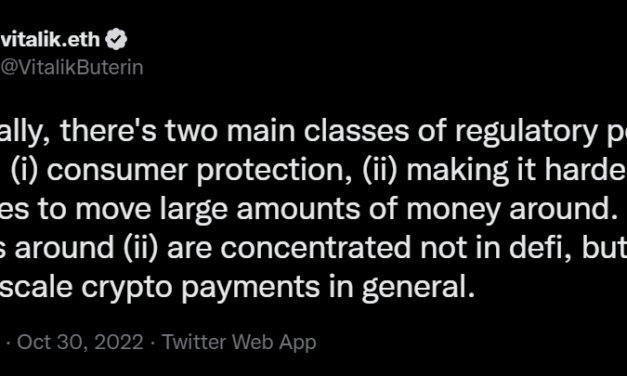
The co-founder of Ethereum (ETH), Vitalik Buterin, believes that the crypto ecosystem needs to mature and be in tune with the regulatory policies that allow crypto projects to operate internally freely.Sharing his opinion around crypto regulations, Buterin spoke against the regulations that have an impact on the inner workings of a crypto ecosystem. Considering the current circumstances, he believed it was better to have regulations that allow inner independence to crypto projects, even if it hampers mainstream adoption. Buterin opined:“I’m actually kinda happy a lot of the exchange-traded funds (ETFs) are getting delayed. The ecosystem needs time to mature before we get even more attention.”The use of know-your-customer (KYC) on decentralized finance (DeFi) frontends was another concern pointed out by Buterin. However, he highlighted the need for KYC on crypto exchanges, which has seen wide-scale implementations. According to the entrepreneur:“It (KYC on DeFi frontends) would annoy users but do nothing against hackers. Hackers write custom code to interact with contracts already.”In this regard, Buterin made three recommendations, as shown below.On an end note, Buterin recommended using zero-knowledge proofs to meet regulatory requirements while preserving users’ privacy, stating that “I would love to see rules written in such a way that requirements can be satisfied by zero knowledge proofs as much as possible.”Related: The Merge brings down Ethereum’s network power consumption by over 99.9% Google recently added a search feature that allows users to view ETH wallet balances by searching their addresses.Acknowledging the recent Ethereum Merge upgrade, Google embedded a countdown ticker dedicated to Ethereum’s transition from proof-of-work (PoW) to proof-of-stake (PoS) consensus mechanism.

Čítaj viac

Metaverse schooling to help Japanese city combat growing absenteeism

The Japanese city of Toda, Saitama, adopted a metaverse-schooling service to encourage students — especially those staying far away from school — to attend their classes. The metaverse schooling service opted for by the city of Toda allows students to explore the campus and study in virtual classrooms. However, the students must get approval from respective school principals for attendance via metaverse schooling, confirms local media NHK.Government data showed that 244,940 Japanese elementary and junior high school students were absent for at least 30 days in FY 2021. NHK’s report highlighted a fifth grader’s interest in chatting online instead of attending school in person. While the child has not physically attended school in over two years, they shared an interest in meeting up with friends to play outdoor games, such as tag.While ongoing efforts to improve school attendance remain a challenge, Japanese officials are placing their bets on metaverse schooling to help students connect with the people around them.Sugimori Masayuki, the head of Toda’s education center, hopes to see metaverse students grow up and eventually live independently in society.Related: Japan’s International Payments System will test plastic cards for CBDCThe city of Fukuoka announced a collaboration with Astar Japan Labs as it strives to become the Web3 hub of Japan.The mayor of Fukuoka, Soichiro Takashima, confirmed the city’s aspirations to lead the Web3 drive, as he stated:“We have to do in the context of Web3 what large companies did for the world when Japan was strong.”Astar Network founder Sota Watanabe revealed his intentions to “work closely with Fukuoka City to attract more developers and more entrepreneurs.”

Čítaj viac

The Merge brings down Ethereum’s network power consumption by over 99.9%

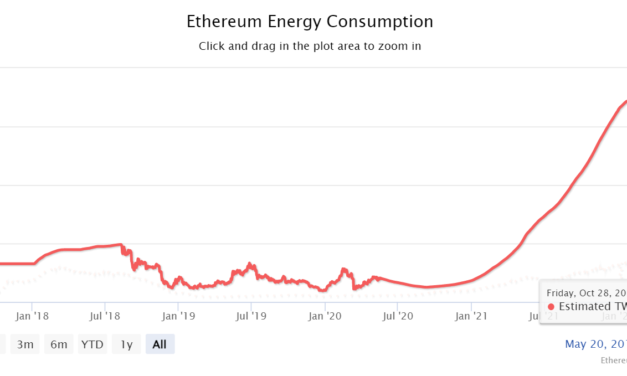
The Merge, which is considered one of the most significant blockchain upgrades on Ethereum (ETH) to date, brought down the network’s energy consumption by 99.9% immediately.On Sept. 15, the Ethereum blockchain migrated from proof-of-work (PoW) to a proof-of-stake (PoS) consensus mechanism in an effort to transition into a green blockchain. What followed was an immediate and steep drop in total energy consumption of the Ethereum network.The Ethereum Energy Consumption Index. Source: digiconomist.netBefore the Merge upgrade, in 2022, the energy consumption of Ethereum ranged between 46.31 terawatt hour (TWh) per year to 93.98 TWh per year. The lowest energy consumption for Ethereum was recorded on Dec. 26, 2019, at 4.75 TWh per year.The estimated annual energy consumption in TWh/yr for various industries. Source: ethereum.orgStarting from Oct. 15, the day of the Ethereum Merge, Ethereum’s energy dropped down by over 99.9% and continues to maintain low energy usage. As a result, the network’s carbon footprint currently stands at 0.1 million tonnes of CO2 (MtCO2) per year.When translated to single Ethereum transactions, the electrical consumption is as low as 0.03 kilowatt hour (kWh) and the carbon footprint stands at 0.01 kgCO2, which according to digiconomist, is equivalent to the energy used when watching two hours of YouTube.Related: Ethereum sets record ETH short liquidations, wiping out $500 billion in 2 daysDespite the celebrations around Ethereum’s transition to PoS, community members raised concerns related to the blockchain’s centralization and higher regulatory scrutiny.The centralization aspect became evident right after the Merge, as 46.15% of the nodes for storing data, processing transactions and adding new blockchain blocks could be attributed to just two addresses.While Ethereum proponents claim that anyone with 32 ETH can become a validator, it is important to note that 32 ETH, or around $41,416, is not a small amount for a newbie or common trader.

Čítaj viac

Binance Oracle network to bridge Web3 and blockchains via smart contracts

Crypto exchange Binance announced the launch of a new data feed network — Binance Oracle — that allows blockchain smart contracts to connect with real-world data, starting with its in-house blockchain offering, BNB Chain. For starters, Binance Oracle will allow existing decentralized applications (DApps) and Web3 ecosystem partners on BNB Chain to access existing data sources and advanced computations. “Over ten BNB Chain projects have already integrated with the Binance Oracle network,” confirmed Binance.The ability to connect smart contracts with off-chain data will be made available for other blockchains in due time. Explaining the network’s importance, investment director at BNB Chain, Gwendolyn Regina stated:“Using oracles to dramatically increase the smart contract’s knowledge of what’s going on outside of the blockchain, allowing it to respond to external events with specified actions will be crucial.”Furthermore, Binance revealed the use of regional domains to ensure the system’s uptime amid unpredictable global calamities. The network uses components such as an internal Threshold Signature Scheme (TSS) for each data feed and price aggregation using an algorithm, which according to Binance, ensures high reliability.Related: How CZ built Binance and became the richest person in cryptoBinance continues to delve into numerous crypto businesses, taking advantage of its unique position as the biggest crypto exchange in terms of trading volume.On Oct. 17, Binance Pool, a mining subsidiary of Binance, launched a $500 million fund to support the crypto mining industry through loans. Speaking to Cointelegraph, a Binance spokesperson further clarified the criteria for a potential borrower:“One of the requirements is that the applicant must be classified as a Binance VIP user and connect at least 500 PH/s to the Binance Pool for a minimum of 24 months after the loan is issued.”The announcement revealed certain conditions against the loans, including 18-to-24-month terms, 5% to 10% interest rates and some physical or digital assets as a security.

Čítaj viac

Získaj BONUS 8 € v Bitcoinoch

nakup bitcoin z karty

Registrácia Binance

Burza Binance

Aktuálne kurzy