Autor Cointelegraph By Arijit Sarkar

Ethereum inches even closer to total censorship due to OFAC compliance

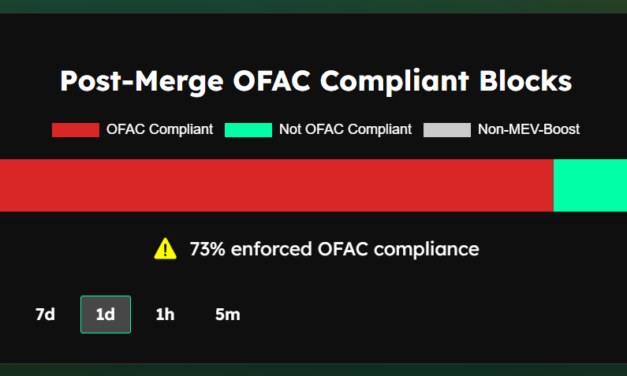
Considering that protocol-level censorship is deterrent to the crypto ecosystem’s goal of highly open and accessible finance, the community has been keeping track of Ethereum’s growing compliance with standards laid down by the Office of Foreign Assets Control (OFAC). Over the last 24 hours, the Ethereum network was found to enforce OFAC compliance on over 73% of its blocks.Ethereum sporting 73% OFAC-compliant blocks. Source: mevwatch.info In Oct. 2022, Cointelegraph reported on the rising censorship concerns after 51% of Ethereum blocks were found compliant with OFAC standards. However, data from mevWatch confirmed that the minting of OFAC-compliant blocks on a daily basis has grown to 73% as of Nov. 3. Ethereum’s PFAC compliance trend. Source: mevwatch.infoSome MEV-Boost relays — that are regulated under OFAC — will censor certain transactions. As a result, to ensure the neutrality of Ethereum (ETH), the network needs to adopt a non-censoring MEV-Boost relay. Ethereum validators can reduce OFAC compliance by discarding relays in their MEV-Boost configuration that censor transactions, such as BloXroute Max Profit, BloxRoute Ethical, Manifold and Relayooor.Compliance with OFAC allows the US government agency to enforce economic and trade sanctions. Previously, the agency sanctioned Tornado Cash and several Ethereum addresses.As of today, 45% of all Ethereum blocks are considered compliant with OFAC.Related: Ethereum sets record ETH short liquidations, wiping out $500 million in 2 daysThe mainstream adoption of Bitcoin (BTC) and Ethereum sped up after UnionBank, one of the largest universal banks in the Philippines, debuted cryptocurrency trading in partnership with a Swiss crypto firm Metaco.“We are proud to continue UnionBank’s series of industry firsts, this time being the first regulated bank in the country allowing digital currency exchange features for clients,” said Henry Aguda, chief technology officer and chief transformation officer at UnionBank.

Čítaj viac
BNB Chain DeFi ecosystem recovers almost one-third in three months

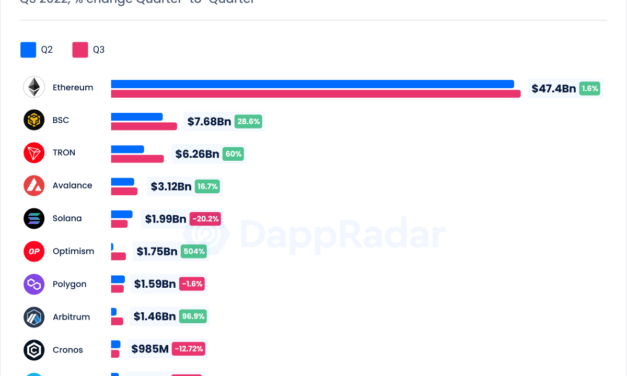
After a year-long struggle to fend off the market bears, parts of the crypto ecosystem started showing signs of recovery in the third quarter of 2022. BNB Chain’s Q3 report confirms significant growth in crypto trading volumes and decentralized finance (DeFi) but a drop in nonfungible token (NFT) trading.According to DappRadar BNB Chain Report Q3, BNB Chain retained its position as the second biggest DeFi blockchain after Ethereum (ETH), with a Total Value locked (TVL) of $7.6 billion.On the DeFi side of things, BNB Chain suffered a 93% decrease from Q3 of 2021 but has since shown signs of steady recovery. The TVL of $7.6 billion represents a 28.67% increase from BNB Chain’s Q2 performance. The blockchain also represents 36.6% of the market share for GameFi ecosystems, which is followed by Ethereum at 20.2% and Polygon (MATIC) at 11.8%.PancakeSwap, Venus and Alpaca Finance are among the largest in the pool of over 300 DeFi decentralized apps (DApps) hosted over BNB Chain. “BNB chain owes this relative success to the performance of PancakeSwap,” reads the report, as the ecosystem represents 68.2% or $4.1 billion in TVL, followed by Venus at 16.3% ($995 million) and Alpaca Finance at 8.7% ($530 million).NFT trading volumes continue to dip, with BNB Chain recording an almost 33% drop this year — from $276,000 in Q1 to $185,000 in Q3. According to the report, the unique trader’s count decreased by 45% in just three months.While the metrics shared in the DappRadar report showcase an overall positive movement for the quarter, it also revealed the need for crypto projects to achieve sustainable growth.Related: $100M drained from Solana DeFi platform Mango Markets, token plunges 52%The idea of DeFi took off in Singapore as major finserve DBS Bank decided to implement the technology for the Singaporean central bank.On Nov. 2, DBS announced the commencement of testing trading of foreign exchange (FX) and government securities using permissioned, or private, DeFi liquidity pools. Speaking to Cointelegraph about Project Guardian, a government initiative to explore digital asset tokenization on public chains, a DBS spokesperson confirmed the use of Polygon mainnet using a fork of Uniswap v2 protocol.

Čítaj viac

El Salvador's Bitcoin purchase information can't be made public: Trustee

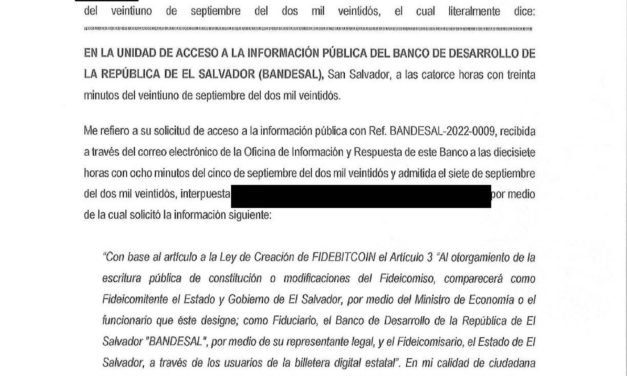
Ever since El Salvador legalized Bitcoin (BTC) as mainstream tender, President Nayib Bukele used Twitter on numerous occasions to announce the country’s BTC acquisitions. However, ALAC El Salvador — a non-governmental anti-corruption bureau — was recently denied information from a state development bank, BANDESAL, regarding El Salvador’s Bitcoin purchases and sales.As a development bank for El Salvador, BANDESAL created a $150 million trust fund to guarantee the convertibility to dollars for citizens and merchants. The request for disclosure of El Salvador’s Bitcoin acquisition was denied on the grounds of confidentiality. Snippet of BANDSEL’s response to ALAC El Salvador — a non-governmental anti-corruption bureau. Source: ALAC El SalvadorALAC El Salvador refuted the denial by highlighting that the BTC purchases were made using public funds. Their official statement translated to:“The confidentiality limits the possibility for citizens to access and receive information on the operations carried out with public funds by BANDESAL.”In its refusal statement, BANDESAL said that no information related to the Bitcoin Trust (FIDEBITCOIN) could be shared by the trustee or its board of directors to safeguard national interests.Publicly available information hints that El Salvador purchased 2,301 BTC to date, which has fallen in value over the past year from $103.9 million to roughly $45 million. Related: Pro-crypto city of Lugano and El Salvador sign economic agreement based on adoptionAdding on to the country’s piling pressure to suffice its year-long Bitcoin purchases, Spain took over El Salvador’s spot to become the third-largest crypto ATM hub in the world.El Salvador attained the third spot after installing 205 ATMs to support the country’s thriving Bitcoin economy, amounting to a network of 212 crypto ATMs. However, Spain recently recorded 215 active ATMs, representing 14.65% of European installations.

Čítaj viac

Happy Halloween: The five spookiest stories in crypto in 2022

After over 13 years of ups and downs, this year stands out for having the most turbulent bear market in the history of crypto. Owing to a mix of factors — that include regulatory clearances across the globe and improved credibility among projects that survived the bear market — the world of crypto marked numerous milestones this year. However, certain events in 2022 could raise goosebumps on the toughest diamond hands out there. Moreover, it was impressive to see crypto projects, in many cases helping each other, bounce back through an era of uncertainty.Acknowledging the spookiest events this Halloween, we list the scariest events that shook the crypto ecosystem, leaving a significant impact on investors, businesses, entrepreneurs, miners and developers.The key driver for the following list is widely attributed to the highly volatile time frame and geopolitical uncertainties, which saw the price fall across all sectors.The extended crypto crash: Fear of the bearsThe year 2022 inherited a turbulent crypto market, which started off slowly crashing in November 2021. As a result, immense fear and uncertainty gloomed across the crypto ecosystem right from the start of the year.The bear market ate away more than $1 trillion from the crypto market — bringing down the overall market cap from over $2.5 trillion to under $1 trillion in a few months. The 2022 crypto crash scared investors as it drained out profits from all sub-ecosystems, including Bitcoin (BTC), cryptocurrencies, nonfungible tokens (NFTs), and decentralized finance (DeFi), among others.The loss was felt both ways. While the price depreciation translated to investors losing a part of their life savings, businesses were struggling to stay open amid massive sell-outs and a lack of investments.The scary instability of algorithmic stablecoinsThe Terra ecosystem collapse is widely considered to be the biggest financial catastrophe ever witnessed in crypto by a single entity, and rightfully so. The two in-house offerings from Terra Labs destabilized and almost instantaneously lost their market value. In the early days of the crash, Terra co-founder Do Kwon was found publicly discussing ways to help investors recoup losses. Binance CEO Changpeng Zhao suggested burning LUNC tokens to reduce the token’s total supply and improve its price performance.Shortly after, as regulatory scrutiny started building up against Terra’s operations, Kwon decided to go incognito, with his exact whereabouts unknown.Numerous entities — including disgruntled investors, South Korean authorities and a Singaporean lawsuit — are still in pursuit of Kwon, despite his comments to the contrary.I am not “on the run” or anything similar – for any government agency that has shown interest to communicate, we are in full cooperation and we don’t have anything to hide— Do Kwon (@stablekwon) September 17, 2022However, Kwon maintains that he’s not “on the run” and plans to come out with the truth in the near future. The whole incident highlighted the risks related to the peg mechanisms of algorithmic stablecoins. Similarly, stablecoin Acala USD (aUSD) lost its peg in August 2022 after a protocol exploit caused an erroneous minting of 3.022 billion aUSD. A subsequent decision to burn the tainted tokens was made in order to regain their dollar value. Given the numerous other examples of stablecoin crashes, draft legislation in the United States House of Representatives called to criminalize the creation or issuance of “endogenously collateralized stablecoins.”Sweeping layoffs and job cuts The burden of losses was also shared by some crypto companies’ ex-employees. Prominent players including Robinhood, Bitpanda and OpenSea announced massive layoffs, owing to reasons that circle back to surviving the bear market.Today is a hard day for OpenSea, as we’re letting go of ~20% of our team. Here’s the note I shared with our team earlier this morning: pic.twitter.com/E5k6gIegH7— Devin Finzer (dfinzer.eth) (@dfinzer) July 14, 2022

On the other hand, crypto exchanges such as FTX and Binance showcased resilience to price volatility and continued their hiring spree to support the ongoing expansion drive.We are hiring, aggressively. Find where to apply yourself. It’s the first test/filter. — CZ Binance (@cz_binance) May 17, 2022

Crypto organizations that chose to lay off employees did it to cut operational costs and wind down loss-making components.More recently, it was found that over 700 tech startups have experienced layoffs this year, impacting at least 93,519 employees globally. However, the tech community — from both crypto and non-crypto sectors — has been found migrating into Web3.Crypto hacks: Humans are the real monsters One of the more visible problems engulfing crypto such as hacks and scams just got bigger in 2022. Hackers drained out millions of dollars worth of crypto by exploiting vulnerabilities present in poorly vetted crypto projects.A strategy that was widely opted by the hacked projects this year was to offer the hacker a pink slip for returning a part of the loot. In the case of Transit Swap, a decentralized exchange aggregator, the hacker agreed to return around 70% (roughly $16.2 million) of the stolen $23 million fund.Updates about TransitFinance1/5 We are here to update the latest news about TransitFinance Hacking Event. With the joint efforts of all parties, the hacker has returned about 70% of the stolen assets to the following two addresses:— Transit Swap | Transit Buy | NFT (@TransitFinance) October 2, 2022

While some hackers chose to return a part of the funds in exchange for immunity against prosecution, other projects such as Kyber Network and Rari Fuze have not been successful in pursuing their respective hackers to return the stolen funds.This year also was witness to a spike in the number of phishing attempts, where hackers managed to access social media accounts of prominent figures, such as the South Korean government’s YouTube channel, Indian Prime Minister Narendra Modi’s Twitter account, and PwC Venezuela’s Twitter account to shill fake giveaways to millions of followers.Governments across the world consistently issued warnings against phishing attempts involving fraudulent apps and websites impersonating prominent crypto exchanges like Binance.Resurrection overdue: NFTs, Web3 and the metaverseTalks around nonfungible tokens (NFTs), Web3 and the metaverse took over the crypto ecosystem by storm, promising virtual use cases that extend into the real world. Celebrities, actors, musicians and artists catalyzed adoption by using the budding technologies as tools to reconnect with fans or simply inflate their own wealth.The NFT hype was officially declared dead in July 2022 when daily sales recorded yearly lows as investors that recently suffered losses refrained from stepping on the seemingly sinking ship. Despite the nosedive statistics, the NFT ecosystem saw support from some of the biggest celebrities, which include musicians Snoop Dogg and Eminem, tennis legend Maria Sharapova and professional fighters Connor McGregor and Floyd Mayweather.The decreasing interest in NFTs translated into a lack of investments in newer projects building use cases around Web3 and the metaverse. Meta, arguably the biggest contender in the metaverse, has plans to pump $10 billion every year into its project. However, an unclear roadmap and uncertain revenue streams plague the ecosystem from attaining mainstream acceptance.Setting aside the fear, the biggest lesson that the spookiest events in the crypto showcase is the need to do independent research before making any investments. Past mistakes — such as investing in an unvetted project, trusting unknown sources and sharing private information over the web — will come back to haunt you.This Halloween, Cointelegraph wishes you pumpkin spice and everything nice. Visit Cointelegraph to stay up-to-date with the most important developments in crypto.

Čítaj viac

Boo! Halloween-themed shitcoins materialize to haunt crypto Twitter

The crypto community never shies away from deploying new cryptocurrencies that are themed on current events, and Halloween was no exception. The industry saw an influx of Halloween-themed cryptocurrencies hoping to cash in on the hype around the festivities.Halloween-themed cryptocurrencies have taken over the crypto ecosystem on Twitter, typically offering no real use case or future for investors. Projects like these have a track record of being sourced as an off-the-shelf product, which can be quickly renamed and deployed in the free market for trading. Our target is 50 millions market cap an 0.01$ price— Halloween Token (@CyberMetaWorld) October 28, 2022Projects like Halloween Token, as shown above, came up just days before the occasion with the sole purpose of amassing $50 million in market cap. Halloween Spook, a project that cropped up on Sept. 2022, claims the status of being the “scariest meme token on Binance Smart Chain (BSC).” The project promotes Halloween Elon (SINK) token, which is based on a recent “let that sink in” meme sported by Elon Musk.ELON CHANGE HIS PROFILE PICTURE ! LFG ! ENJOY ! #Halloween #Binance #KuCoin #bscgemsx100 #crypto #Halloweentoken #meme #SINK #elonmusk#elonmusktwitter #ShibaArmy #QOM #LUNACLASSSIC @shitcorpnews#halloweenfloki #saninu #efloki #twigeinu #twige pic.twitter.com/bIOx5diaCJ— Halloween Elon (@halloweenelonn) October 29, 2022

Found again on the BSC network was Halloween Wars Token, which blatantly shares its intent to “ride the hype of what many claim is the most exciting time of the year: halloween.” Despite no attempt to market the project, the project gained 17 followers who remain at risk of losing their assets to market capitulation. Halloween wars Halloween wars is a community-centric and community-driven cryptocurrency project launched in the Binance Smart Chain network that aims to ride the hype of what many claim is the most exciting time of the year: halloween. millions Mc Goal Before Halloween pic.twitter.com/ONQWsFGDkT— Halloween Wars Token (@HalloweenWar) October 8, 2022

One of the stronger contenders this year was halloween bsc, yet another BSC-hosted project with no apparent goal set for the investors.Solid chart for us! spread the word and join us https://t.co/ExEahBwk4r pic.twitter.com/fVlbBhuR57— halloween bsc (@HalloweenToken) October 10, 2022

As shown above, the project recently celebrated a temporary bull run but a reverse search showed no existence of an ENDS/BNB (BNB) trading pair on Binance or any other trading platform.While cryptocurrencies themed on current trends tend to spike in market price, the surge is often limited to a few days until the owner decides to cash out and rug investors from making profits. As a result, it becomes paramount for investors to do their research (DYOR). Related: Cointelegraph Store introduces Halloween Crypto Monsters merchTwitter is home to a majority of the crypto world, and with Elon Musk taking over the social media platform, crypto exchange Binance decided to lend support to developing crypto and blockchain solutions for Twitter.As Cointelegraph reported, Binance CEO Changpeng Zhao committed to back Musk’s Twitter acquisition with a $500 million fund.

Čítaj viac

Získaj BONUS 8 € v Bitcoinoch

nakup bitcoin z karty

Registrácia Binance

Burza Binance

Aktuálne kurzy