Autor Cointelegraph By Arijit Sarkar

FTX collapse drives curiosity around Sam Bankman-Fried, Google data shows

The fall of FTX seemingly had the biggest impact on the crypto ecosystem as Google searches for the CEO Sam Bankman-Fried (SBF) hit the roof over in November 2022. Some of the biggest drivers for this trend include mainstream media attention, colossal losses and political ties.On Nov. 2, SBF lost his credibility after his company Alameda Research was found holding a large amount of FTX Token (FTT), an asset issued by FTX. Over the following two weeks, the crypto community investigated and found SBF guilty of manipulating and misappropriating users’ funds, ultimately leading to the fall of the empire of roughly 130 companies built by SBF.On the one hand, the crypto community openly criticized SBF and his accomplices, including Caroline Ellison. But, on the other hand, mainstream media published ‘puff pieces’ to water down SBF’s wrongdoings, which Tesla CEO Elon Musk and Binance CEO Changpeng Zhao, among others, called out.The blatant attempts by the mainstream media to change the narrative around SBF saw massive resistance from Crypto Twitter, further fueling the curiosity and forcing the general public to do their own research (DYOR) about the subject.Google search data of infamous crypto personalities. Source: Google TrendsAs a result, Google searches for the term ‘Sam Bankman-Fried’ surged in November. The curiosity around SBF overpowered the other infamous personalities in the space, including co-founder and CEO of Terraform Labs Do Kwon, co-founder and CEO of Three Arrows Capital Su Zhu and Satoshi Nakamoto impersonator Craig Wright.Google Trends data show that searches for SBF are 185.7% more than they were for Do Kwon when Terra (LUNA) collapsed in May 2022. The collapse of LUNA was considered the biggest blunder in crypto history until SBF took the spot six months later.Related: FTX fall was ‘incredibly damaging,’ crypto must foster real utility: Ripple policy leadThe FTX dust is far from settling as Turkey’s Financial Crimes Investigation Board, MASAK, seized SBF’s assets amid ongoing investigations.The seizure was made after finding “criminal suspicion” of FTX failing to safely store user funds, embezzlement of customer assets and market manipulation.

Čítaj viac

Fenix Games raises $150M to fuel next-generation blockchain gaming

Web3 game publisher Fenix Games raised $150 million in funding to acquire, invest and distribute blockchain games. The fund will be used to create a game publishing company specifically for mainstreaming blockchain games.Fenix Games’ latest funding round saw participation from investors, including Phoenix Group and Dubai-based venture capital firm Cypher Capital, reported local news media Jinse. Chris Ko, CEO and co-founder of Fenix Games, who previously led Mythical Games, considers Fenix Games “like a VC fund” for fueling the next generation of blockchain games.Sharing details into the post-funding gameplan, Ko stated:“We’re actually going to start off with a huge base of capital to invest in those (next-generation gaming) studios. We’re also looking to use our balance sheet to acquire a bunch of existing games in the Web2 space to build a portfolio.” Ko also highlighted that the market for blockchain gaming does not exist as it did for traditional video games such as gaming consoles and mobile gaming. Fenix Games’ strategy going forward is to develop the gaming ecosystem through publishing initiatives.Related: Crypto gaming needs to be fun to be successful — Money doesn’t matterGameFi’s constantly evolving model could make “today’s AAA game companies look like peanuts,” said Jack O’Holleran, CEO of Skale, a multichain Ethereum-native network that powers Web3 games.Finding a sustainable GameFi model, however, remains a challenge. User experience ranks amid the top struggles in the industry owing to high gas fees and technical complexity around buying, owning and trading nonfungible tokens (NFTs).

Čítaj viac

Bitcoin mining revenue lowest in two years, hash rate on the decline

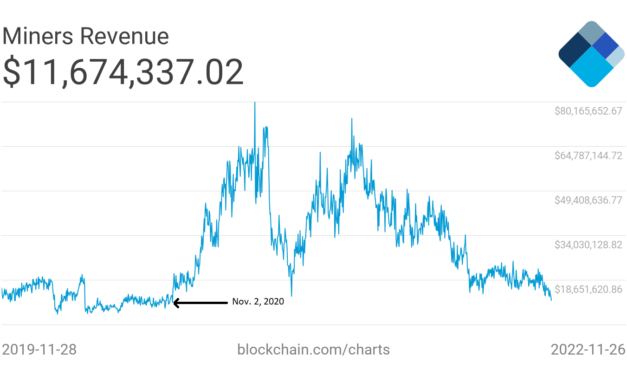
The revenue earned by Bitcoin (BTC) miners fell to two-year lows owing to poor market performance and a heavier computational demand amid rising network difficulty. However, an ongoing downturn in the Bitcoin hash rate over the past month has allowed miners to recoup losses.The total Bitcoin mining revenue — block rewards and transaction fees — in U.S. dollars fell down to $11.67 million, a number last seen on Nov. 2, 2020, when Bitcoin’s trading price was around $13,500.While the current market price of around $16,500 suggests an obvious increase in mining revenue, factors including greater mining difficulty and rising energy prices contribute to lower income in dollar terms.Adding to the above, the difficulty of mining a Bitcoin block has skyrocketed to an all-time high of almost 37 trillion — forcing Bitcoin miners to spend more energy and computational power to stay competitive. However, over the past three months, the hash rate of the Bitcoin network witnessed a steady decline. The hash rate stands at 225.9 exahash per second (EH/s), which fell 28.6% from its all-time of 316,7 EH/s on Oct. 31, 2022.The hash rate is a security metric that helps protect the Bitcoin network from double-spending attacks. However, considering the grand scheme of things, temporary measures taken by the community include acquiring cheaper mining hardware and resettling in jurisdictions with low energy prices.Related: Bitcoin miners look to software to help balance the Texas gridNew York City mayor Eric Adams believes that goal to make New York a crypto hub can be combined with statewide efforts to curb environmental costs related to crypto mining.“I’m going to work with the legislators who are in support and those who have concerns, and I believe we are going to come to a great meeting place,” said Adams while revealing that the city will work with legislators to find a balance between the crypto industry development and legislative needs.

Čítaj viac

IIROC-registered Canadian crypto exchange Coinsquare suffers data breach

Just a month after becoming the first Canadian crypto trading platform to get registered by the Investment Industry Regulatory Organization of Canada (IIROC), Coinsquare suffered a data breach that compromised users’ personal information. On Nov. 19, Coinsquare had to temporarily shut down operations to investigate an unusual activity on its platform. However, several days of proactive measures allowed Coinsquare to resume operations gradually. We will be re-enabling crypto deposits shortly after the maintenance window with crypto withdrawals to follow shortly after.— Coinsquare (@Coinsquare) November 22, 2022In a follow-up email to investors, Coinsquare admitted that their customer database with personal information was exposed during the incident, which a third party most likely accessed. The leaked database included users’ personal information, such as names, email addresses, residential addresses, phone numbers, dates of birth, device IDs, public wallet addresses, transaction history, and account balances. Coinsquare further confirmed that no passwords were exposed, adding that:“We note that your assets have always been, and remain, secure in cold storage and are not at risk.”While the exchange has not detected any bad actors from accessing the breached information, the official communication cautions users to change their passwords, enable 2-Factor Authentication (2FA) and use different credentials for different platforms.Coinsquare has not yet responded to Cointelegraph’s request for comment.Related: Coinsquare becomes first Canadian crypto exchange to receive IIROC registrationCanadian crypto exchange Bitvo was able to back off its acquisition agreement with FTX thanks to the deal’s long approval process by local regulators.The firm emphasized that its operations have not been affected, as Bitvo has no material exposure to FTX or any of its affiliated entities.

Čítaj viac

SEC chair's crypto oversight strategy in question as ecosystems collapse

While regulations are often aimed at protecting citizens from bad actors, the effectiveness of crypto regulations in the United States is in question owing to the colossal fall of major exchanges and ecosystems over the past year — FTX, Celsius, Voyager, and Terra (LUNA).Congressman Tom Emmer showed concerns about the oversight strategy implemented by Gary Gensler, the chair of the U.S. Securities and Exchange Commission (SEC) for the crypto ecosystem. Emmer has been vocal against Gensler’s “indiscriminate and inconsistent approach” toward crypto oversight. On March 16, the Congressman revealed being approached by numerous crypto and blockchain firms that believed Gensler’s reporting requests to be overburdensome and stifling innovation.We are even more concerned now as we’ve seen his strategy miss Celsius, Voyager, Terra/Luna– and now FTX.— Tom Emmer (@RepTomEmmer) November 25, 2022Congressman Emmer had previously asked the SEC to comply with the standards established in the Paperwork Reduction Act of 1980, which was designed to reduce the total amount of paperwork burden the federal government imposes on private businesses and citizens. On an end note, Emmer said that “Congress shouldn’t have to learn the details about the SEC’s oversight agenda through planted stories in progressive publications,” adding that he was looking forward to Gensler’s public testimony before the Financial Services Committee.Related: My story of telling the SEC ‘I told you so’ on FTXAmerican CryptoFed DAO, the first official DAO in the U.S., began a litigation battle with the SEC over 2021 token registrations and opted not to have attorneys in its fight for registration.American CryptoFed also indicated its plans to file a motion for extending the deadline for its answer to the SEC’s Order Instituting Administrative Proceedings.

Čítaj viac

Získaj BONUS 8 € v Bitcoinoch

nakup bitcoin z karty

Registrácia Binance

Burza Binance

Aktuálne kurzy