
Autor Cointelegraph By Ariel Shapira

Fighting economic warfare with crypto’s double-edged sword

In his monthly crypto tech column, Israeli serial entrepreneur Ariel Shapira covers emerging technologies within the crypto, decentralized finance and blockchain space, as well as their roles in shaping the economy of the 21st century.Economic warfare can’t be separated from geopolitical conflict, and just like in the violence of physical war, innocent civilians often fall in the crosshairs. The advent of cryptocurrency, however, is slightly transforming the dynamic this time around. As Russia’s invasion of Ukraine sends shockwaves across the global markets, many are championing digital assets as a safe haven during destruction and unrest. Indeed, Russians and Ukrainians are taking advantage of the traditional-finance alternative.On the Ukrainian front, crypto has been leveraged as a tool to raise funds for millions of fleeing refugees and citizens remaining to defend their homeland. The narrative gets more complicated on the Russian front. Some predict that oligarchs could bypass NATO sanctions with crypto. On the other hand, 17.3 million Russians hold crypto. Most of those people certainly aren’t oligarchs. One can reasonably conclude most of them are innocent citizens using digital assets to save their livelihoods.So, it’s time to clear up the narrative here: The Ukraine crisis has shown crypto as a powerful tool that empowers ordinary people across the globe to assist others in their darkest hour. Crypto has previously been intertwined with charity, with companies like XMANNA, a metaverse gaming platform, giving back 40% of its profits to users via rewards. Now, crypto’s once low-key charitable side is being weaponized publicly to support Ukrainian refugees and innocent Russians alike.Related: Crypto offers Russia no way out from Western sanctions The Ukrainian frontUkrainians are utilizing crypto as a financial lifeline as they are forced to abandon life as they know it. Outside of the war, many are donating crypto such as Bitcoin (BTC) and Ether (ETH) to the Ukrainian government and NGOs, amounting to $108 million. And, thanks to the transparency of blockchain, we’re now able to better track how these donations are being spent than we would have just 15 years ago — Ukraine has already spent $15 million of the amount raised on military equipment.The speed and ease with which more traditional donation platforms like GoFundMe and Fundly transfer money from donor to recipient pale compared with crypto donations. While conventional fundraising options can take up to five days to process wire transfers, crypto transactions are instantaneous. Even Bitcoin’s notoriously slow transaction speed (up to six minutes) puts older methods to shame.Indeed, the initiatives to assist Ukraine are only the most recent and perhaps publicly mainstream iterations of blockchain’s potential to transform fundraising. Projects like SeedOn leverage a smart-contract escrow model to ensure that funds are only accessed in stages, preventing misuse. Such models are likely to become much more prevalent in fundraising well beyond the current Ukraine crisis.With Ukrainian financial institutions limiting customer access to their finances, crypto is one of the surest ways for ordinary Ukrainians to access their money without fear of frozen accounts. This is essential for those who need access to cash immediately, whether to purchase necessities or to secure access to personal funds before fleeing the country.If someone is suffering the insurmountable effects of war, downloading a MetaMask wallet might not be the first thing that occurs to them, especially if they haven’t used crypto before. Nevertheless, Ukraine ranks fourth on the global list of countries that have already adopted crypto, meaning a significant number of Ukrainian citizens at least have the option to utilize this alternative finance method in order to survive. While access might not be expansive, the option is potentially lifesaving for those who have it.Related: NFT philanthropy demonstrates new ways of giving backThe other edge of the swordMultiple Russian banks have been disconnected from SWIFT, the global messaging system connecting financial institutions. While this sanction cuts off affected banks from the global economy, it also impacts individuals domestically by disrupting transactions made on any card issued by major credit card networks like Visa, Mastercard or American Express. With only 20-25% of domestic transactions and messaging existing outside of SWIFT, Russian citizens appropriately flocked to ATMs, withdrawing a total of almost three trillion rubles, or $23 billion at the time of writing.These sanctions have caused the value of the Russian ruble to plummet, teetering around a 30% drop relative to its value just a week ago. While traditional Russian banks suffer the consequences of sanctions, crypto remains an option for people to convert their deteriorating fiat to crypto to preserve their wealth and ensure liquidity when bank access is less secure. According to Reuters, trading volumes between the ruble and Tether (USDT) have tripled since just last week.While Russian crypto holders are making use of their digital assets, critics have shrugged them off as a way for Russians to bypass sanctions. This is rooted more in skepticism than in fact. If anything, the blockchain provides a greater record of money transfer than any other asset or commodity. Brian Armstrong, CEO of Coinbase, confirmed that the exchange has not seen an uptick in oligarchs trading crypto. He was only able to make such a statement thanks to the sheer traceability of digital asset exchanges.On a macro level, the sanctions enacted by the European Union and the western world, which are at the core of this conflict, are meant to work against Russian President Vladimir Putin and his circle. But, viewed on a more individual and personal level, it is clear that Russian bystanders are suffering. To vilify the only tool at their disposal to escape that suffering is misguided.This article does not contain investment advice or recommendations. Every investment and trading move involves risk, and readers should conduct their own research when making a decision.The views, thoughts and opinions expressed here are the author’s alone and do not necessarily reflect or represent the views and opinions of Cointelegraph.Ariel Shapira is a father, entrepreneur, speaker, cyclist and serves as founder and CEO of Social-Wisdom, a consulting agency working with Israeli startups and helping them to establish connections with international markets.

Čítaj viac
No, Jack Dorsey, venture capital will not run Web3

In his monthly crypto tech column, Israeli serial entrepreneur Ariel Shapira covers emerging technologies within the crypto, decentralized finance and blockchain space, as well as their roles in shaping the economy of the 21st century.Jack Dorsey, Twitter’s ex-CEO and Bitcoin (BTC) aficionado, is not a big fan of Web3 — or at least of what its grand vision is shaping up to be. Users won’t own the next iteration of the internet, he asserts again and again. Instead, venture capital funds pumping millions into blockchain and Web3 projects will be the ones to hold the reins. But, will they, though?The reality, as usual, is not as partial as either side would have you believe. In essence, Web3 is the dream of an internet free from the grasp of centralized platforms such as, well, Twitter. Different commentators also include other features such as an end to pervasive surveillance, more decentralization, data that’s understandable to both people and machines and AR/VR functionality. But, at the core, it seems, the Web3 movement is about bringing down the big fish.In its current shape and form, after all, the internet is indeed quite centralized in a lot of ways. Just four companies run almost 70 percent of the global cloud infrastructure that is home to millions of web pages and applications. All the familiar faces are also encroaching on the crucial infrastructure making up the web’s backbone. And, platforms like Twitter and Facebook have largely centralized the way we consume content, becoming the window into the wider web for many — just look at Facebook’s standoff with Australian news publications.Jack argues that the whole Web 3.0 brouhaha is ultimately a lot like a coup. A group of upstarts comes together, striking up a plot to overthrow the royalty, but they are only doing that out of self-interest. They have no thoughts to spare for the layman out there. And, should they win, little would change in the kingdom other than the banners flying over the capital.Related: A letter to Zuckerberg: The Metaverse is not what you think it isIn code we trustSo, is there anything in Web3 for the laypeople of the centralized kingdom? The reality is, as usual, complicated.It is undeniably true that Web3 is a hot topic in the VC world. It’s not just a16z bringing forth this vision. There’s also Iconium, a private investment fund focused on digital assets and decentralized projects, investing in networks like Secret and Terra and dozens of other funds large and small. All in all, VCs pumped $33 billion into blockchain startups in 2021 and this figure speaks for itself — but not necessarily with the implication of control. In the digital world, you reap what you code. Code is the law, blockchain enthusiasts like to say, and even though the crypto community itself didn’t always live by this principle, it is a rallying cry for some of its more purist advocates. The idea behind it is that the code is a more unbiased judge than any centralized entity could ever be, and so, in code we trust.While the sentiment may be a bit naive, this focus on the code is worthy of further discussion. Things like the pervasive surveillance that users deal with today stem from the code powering the platforms they use. The reason why Facebook and Twitter services pull in your data is that they were coded that way. This design, for its part, stems from a specific business model from the Web2 era: You pay for the free service with your privacy.Related: The data economy is a dystopian nightmareBy extension, though, an app without hard-coded consumer surveillance is fundamentally incapable of spying on the users. Neither is it capable of exercising any form of control over anything it’s not built to control in the first place. And, as long as it happens to sit on a public blockchain where its code is open for review, users will be able to inspect its limitations themselves. Those who don’t speak Solidity will still be able to hear from those who do, as the open-source community is generally always abuzz with insightful discussions and opinion-sharing.The changing tides of investingDon’t be mistaken: VCs are not charities, they are very much interested in returns on their investment. The question is, though, where do these returns come from? In this respect, things are different from project to project, but in most general economic terms, blockchain projects are all about tokens. Sometimes, it’s not positive, as victims of any of the recent rug pulls may testify, but for VCs, that’s essentially how they cash out. They invest by buying tokens from the project and profit from selling it when it takes off. More often than not, it’s that simple. A VC investing in an invasive app taking a jab at the established giants fits into Dorsey’s argument. And, yes, a decentralized application (DApp) can hypothetically be as invasive as a centralized one. A VC investing in a privacy-first open-source project in hopes of cashing out on its token does not. Neither can accrue any kind of outsized power in the hypothetical decentralized internet of tomorrow unless projects they invest into explicitly hand them this power — which is something the community can keep tabs on.Furthermore, the face of investing is changing. The push for decentralization has given rise to decentralized autonomous organizations, or DAOs, which often come together around a specific vision or an investment. In a somewhat similar vein, projects like dHEDGE, a social asset management protocol, give retail investors a chance to pool their assets together under the guidance of a skilled manager or algorithm and put them to work. Both approaches will ultimately lead to more democratized and more conscious investing, which also runs against what Dorsey is charging.Related: DAOs are the foundation of Web3, the creator economy and the future of workAll in all, the tale of Web3, as it often happens with big ambitions and big words, is now marketing buzz and speculation as much as it is genuine technological ingenuity and a push for a better web for all. Something like this inevitably takes a bit of cynicism to process without falling into any of its many caveats, but it is just as important to look out for the diamonds in the rough. That is exactly what investors are doing. There may never be a single tectonic shift in the Web3 foundations, but as more and more decentralized projects take off that offer users genuine value beyond purely financial terms, the Big Tech grasp on the Internet may indeed give way to a new paradigm, one that won’t ultimately give us more of the same. This article does not contain investment advice or recommendations. Every investment and trading move involves risk, and readers should conduct their own research when making a decision.The views, thoughts and opinions expressed here are the author’s alone and do not necessarily reflect or represent the views and opinions of Cointelegraph.Ariel Shapira is a father, entrepreneur, speaker, cyclist and serves as founder and CEO of Social-Wisdom, a consulting agency working with Israeli startups and helping them to establish connections with international markets.

Čítaj viac
Smart contracts can redefine business — But this doesn’t imply wide openness

In his monthly crypto tech column, Israeli serial entrepreneur Ariel Shapira covers emerging technologies within the crypto, decentralized finance and blockchain space, as well as their roles in shaping the economy of the 21st century.The contract, an obligation that party A will do something party B desires at a price both agreed to be fair, is in many ways foundational for a functioning human society. As a testament to that, even King Hammurabi, credited as the author of one of the oldest legal codes in the world, saw it fit to codify regulations on the ties and contractual obligations between merchants and their agents.While in the great ruler’s time, merchants trusted their agreements to clay tablets, today’s counterparts are increasingly trusting their contracts on the blockchain. They look to tap smart contracts, decentralized applications (DApps) stored on-chain as executable code, that can be set off by any network user. Once an innovation brought along by Ethereum, smart contracts now find themselves powering hundreds of decentralized finance (DeFi) services where users trust the code instead of a centralized entity. While centralized entities can perform many of the same functions, DeFi is built around the idea that centralization fosters censorship and inefficiency while decentralized services are more open, transparent and secure.All of this translates quite nicely into the corporate world. Any business operation often incorporates a specific sequence of actions that the company loops through again and again. Sounds a bit like a computer algorithm, doesn’t it? The same goes for a contract, especially with its terms and conditions easy to imagine as a set of constants with if-else terms and conditions. An automated and self-enforcing contract greatly reduces operational uncertainty. By making it decentralized, companies keep the balance of power intact, avoiding the need to trust a centralized middleman. It is perhaps blockchain’s most important gift to the business community.It is, thus, no surprise that more and more companies are bringing smart contracts to the business world. Watr Foundation, an institutional blockchain project, is moving commodities trading on-chain, with smart contracts managing the bulk of the associated processes. ClearX taps smart contracts to help companies settle complex agreements such as roaming disputes between telecom providers. SEIF applies a similar logic to legaltech, providing clients with a plethora of templates to use. The momentum is there and further down the line, we will likely see more major companies embracing smart contracts.Related: Blockchain technology can change the world, and not just via crypto Crypto enthusiasts might see this as a promising trend at first glance. More companies using blockchain means more cash and liquidity for the cryptocurrency ecosystem, and that means more fuel for the Moon voyage, right? Not necessarily.Building walls, not bridgesLet’s imagine a future where enterprises have marched on-chain and entire ensembles of smart contracts now manage their day-to-day interactions. This gargantuan digital infrastructure relies on millions of data streams from sensor-ridden automated production lines to smart shipments beaming out updates on their location and status, and with everything validated, authenticated and paid for with little to no human input. The payments are in tokens, of course, and “blockchain” is written all over the picture.But, here is the first catch: Nobody said any of the blockchains powering this have to be public. If anything, it only makes sense for enterprises to opt for private and permissioned blockchains, which would be closed for everyday investors and traders. This sort of crowd would only ruin the party by bringing a speculative element into a system where all major actors are actually interested in having a stable unit of value. Otherwise, transacting within this ecosystem gets much harder. A public blockchain does not place the burden of funding and maintaining it on its members, but enterprise-grade companies will hardly find themselves encumbered by that. Stablecoin issuers should not get too enthusiastic about this picture either. It’s true that now they are positioned much better for enabling all things business-to-business since they do offer tentative stability, which is what businesses need. Those of them who manage to get into B2B blockchain projects right now might as well turn in a nice profit. Further down the line, though, they may end up dethroned by central bank digital currencies (CBDCs).From a business standpoint, a CBDC — a “wrapped” one, perhaps, i.e. brought on-chain like wrapped Bitcoin (wBTC) on the Ethereum network — works nicely for on-chain payments because it takes away a huge assortment of uncertainties associated with crypto. Besides being as stable as fiat can be, it is hardly marred by any sort of regulatory plights and is very much legal tender, as opposed to the native tokens that their private blockchains could use.Related: Private, public and consortium blockchains: The differences explainedA corporate embrace of the blockchain may make for an interesting — if not epochal — event, but there’s more to it for a technology geek than for a speculative trader. Keeping things public hardly makes that much sense if what you’re after is a stable and smooth-operating system and not a free-for-all race to the Moon.The other side of the coinYes, much of our vision for the future of business is powered by private blockchains, walled-off from the white noise of the larger world. It’s just as easy, however, to envision a more public-facing business-focused ecosystem — but one focused on smaller-size players who stand just as much to gain as giants from this transformation. From trustless operations based on smart contracts to opportunities for fund-raising via token offerings, or even promo events tapping nonfungible tokens (NFTs) for customer loyalty, many options are on the cards. The difference is small and medium-size companies may prefer to tap public blockchains instead of walling off in their private ones simply because they bring so many resources to the table without placing any extra costs on them. This includes thousands of nodes already in operation, as well as an array of services up and running courtesy of independent dev teams. So, anyone looking to simplify blockchain for small and medium-sized enterprises could be in for a nice niche market.As innovative as Bitcoin (BTC) was on its own back in the day, the technological evolution it set into motion is moving ahead, slowly but surely. It may be true that you cannot solve any problem by simply putting it on-chain, as some of the most fervent evangelists seem to believe, but it’s just as true that there are spheres and tasks that can benefit from decentralized solutions. Business is one of these spheres, and while its biggest players will likely choose to stick to their own lot, the others will be more open to the public, bringing more opportunities for retail investors as well.This article does not contain investment advice or recommendations. Every investment and trading move involves risk, and readers should conduct their own research when making a decision.The views, thoughts and opinions expressed here are the author’s alone and do not necessarily reflect or represent the views and opinions of Cointelegraph.Ariel Shapira is a father, entrepreneur, speaker, cyclist and serves as founder and CEO of Social-Wisdom, a consulting agency working with Israeli startups and helping them to establish connections with international markets.

Čítaj viac
On heritage and NFT: Challenging the meaning of legacy itself

In his monthly crypto tech column, Israeli serial entrepreneur Ariel Shapira covers emerging technologies within the crypto, decentralized finance (DeFi) and blockchain space, as well as their roles in shaping the economy of the 21st century.When trying to examine the nonfungible token (NFT) economy as it has been shaping in recent months, two main trends can be discerned. On the one hand, a completely new market that allows various artists to join a new creator economy — the creators of Bored Ape Yacht Club, various types of pixel art creators and creative flickers such as the creator of long-necked women’s paintings, the sale of which brought the artist, only 12 years old, close to 1,394 Ether (ETH), equal at the time of writing $6 million.But the truth is that an NFT is much more than that. Take, for example, one of the first significant NFT sales, when Jack Dorsey sold the first tweet that appeared on Twitter in exchange for an amount that was then worth about $2.9 million. This NFT gained value, but in fact, its very assimilation as an NFT preserved a kind of heritage.The day Twitter goes down the web, or the outdated text platform disappears, like many sites that were part of the web’s annals and simply disappeared, the only things left will be those for which someone has created economic value, beyond the symbolic value. A unique value, which stands on its own, and which makes the preservation of tradition and heritage a sustainable operation.Garry Kasparov does NFTsGarry Kasparov, the former world chess champion, the man who has held that title for more years than anyone else, has decided to turn his legacy digital, and turn extensive chapters of his past into an NFT.”My NFT venture with 1Kind reflects my lifelong desire to take on new challenges and work with exciting new technologies,” says Kasparov. “From artificial intelligence to cryptocurrencies and the blockchain, I’ve always believed that innovation is the only way forward. We’ve worked together closely from the start to create not just unique items, but a completely new way of using NFTs to tell a story, one with real history behind it. “One of the interesting things about Kasparov is his interest in human-machine interfaces. Kasparov is perhaps the most famous chess player of all time, the youngest to win the world championship as well as the longest-reigning world chess champion of all time. But, in fact, his matches against supercomputers bought him his worldwide fame. Kasparov has repeatedly won state-of-the-art chess computers, but his loss, in 1997, to IBM’s Deep Blue computer marked the watershed and symbolized the fact that artificial intelligence manages to match and even achieve human intelligence. On the symbolic level, it was precisely this loss that linked Kasparov’s fate to the development of the digital age.Related: Without quantum security, our blockchain future is uncertainNow, with the NFT project that Kasparov is launching together with the 1Kind platform, he is once again shaking up basic concepts — of heritage, legacy and history. Kasparov seeks to create a digital presence for various chapters in his past, thus creating a legacy that does not depend on exhibits, display cabinets or history books. The objects, pictures and paintings depicting his past, he drops through NFTs, not to support some creator economy but like that Dorsey tweet, to preserve a legacy before it vanishes, and to bring in more people as interested in preserving that heritage. As Kasparov explains: “This is the first time an entire life will be turned into NFTs — my life. I wanted to share not only my chess games and successes but everything that formed me and my legacy on and off the chessboard.”A new chapter of heritage perseverance To this day, to document a heritage, one needs unique books, museums or tours. But all of this requires massive, long-standing support — after all, a museum cannot own itself and needs the support of taxpayer money or unique funds. But when Kasparov makes his legacy public in the NFT, he is decentralizing the preservation of the heritage. He calls on collectors to take part not only in his legacy but also in its preservation. At the simplest level — if Kasparov himself disappears from human consciousness, even these heritage objects will lose their value. So that the interest of the person taking part in the sale becomes the same as that of Kasparov himself. Preserve the heritage and expose it to as many people as possible.”The deeply personal nature of this project is apparent in every NFT. My family and childhood, my rise as a chess champion and conquest of the world title, and my explorations into politics, education, writing and speaking. Documents and artifacts never before seen by the public include my personal notebooks and family photos. The cast includes the coaches that shaped my chess, my fresh start with a new career and family after chess, and, through it all, my greatest champion from the very beginning, my mother.””Garry, how do you want to be remembered?” I admit I thought about such things even as a young world champion, but back then I only considered my legacy at the chessboard. Decades later, this third drop of NFTs is my answer. https://t.co/dpqqNvnVJD pic.twitter.com/OGtaKMkOex— Garry Kasparov (@Kasparov63) December 16, 2021In practice, this is an interesting experiment. After all, this sale includes not only digital art, or representations of past moments, such as the Moments of the NBA, but also digital representations of real objects such as notebooks, cards, physical photographs from Kasparov’s past and others. That is, the buyer will have digital ownership of objects, which someone else may have physical ownership of. Related: Gen Z and the NFT: Redefining ownership for digital nativesBut in fact, it is possible that in the world we are heading towards, it is not clear who will have the more equal ownership — the one who holds a paper copy of a game card in the safe, or the one who holds the digital representation, which can be displayed to the world without fear of being damaged or gone. Kasparov himself also admits that this is no small challenge, but perhaps this is again his way of breaking down barriers and concepts, in the transition to the Web 3.0 era.”I admit to being a little nervous, like sitting down in my first world championship match, playing against a supercomputer, or when I left behind the familiar world of chess to fight for democracy in Russia and beyond. But what are we without new challenges? Without taking risks? The status quo was never good enough for me, and in that spirit I’m delighted to share this ambitious and unmatched collection. I hope people would enjoy it and I can not wait to see what comes next,” says Kasparov. This article does not contain investment advice or recommendations. Every investment and trading move involves risk, and readers should conduct their own research when making a decision.The views, thoughts and opinions expressed here are the author’s alone and do not necessarily reflect or represent the views and opinions of Cointelegraph.Ariel Shapira is a father, entrepreneur, speaker, cyclist and serves as founder and CEO of Social-Wisdom, a consulting agency working with Israeli startups and helping them to establish connections with international markets.

Čítaj viac

What Facebook’s rebranding tells us about Big Tech’s ‘Game of Platforms’

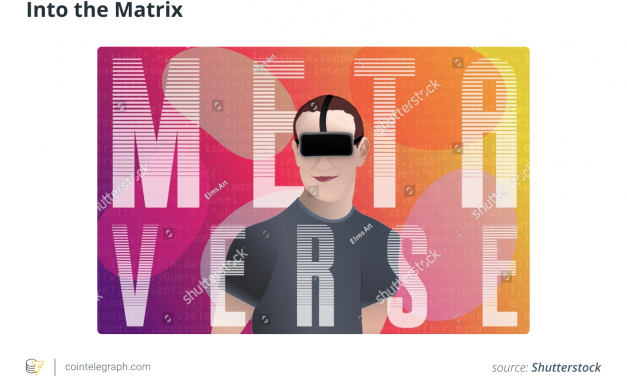
In his monthly crypto tech column, Israeli serial entrepreneur Ariel Shapira covers emerging technologies within the crypto, decentralized finance (DeFi) and blockchain space, as well as their roles in shaping the economy of the 21st century.Sometimes a project’s name tells you all you need to know about it, no matter how niche. Take Kryptomon, for example, the NFT game that recently completed a 24-hour sale in one second. You understand, based on its name, that some kinds of cutesy monstrosities evolving and fighting one another must be involved, and you know it must be blockchain-based. Clear, concise and to the point.Facebook’s new name, Meta, doesn’t exactly fit on the same shelf. Granted, it does make clear that the company is setting sail for the Metaverse, but this destination still remains unclear. As many commentators have pointed out that at this point, the Metaverse is as vague as it is enticing or dystopian, depending on who you ask. The hint at a heavy virtual reality (VR)/augmented reality (AR) component from gadgets like the haptic gloves still only tells us not much of what the future holds.The one thing that is clear about Meta’s name game is that it represents a statement of ambition. The company has already tried this trick with Libra, its prospective stablecoin backed by other tech giants when it found itself under some of the same scrutinies Meta has now. Renaming the coin into Diem was meant to highlight its ambition of independence, and it didn’t fly considering the project was still ultimately scrapped. Just like with Google and Alphabet or Snapchat and Snap Inc, Facebook’s rebranding proclaims its intent of reaching beyond — meta in Greek, by the way — the initial platform.Related: One currency to rule them all: Facebook’s Diem has global ambitionsBut, there is something else at play here: an echo of a larger tech-world trend that could have serious implications for the internet itself, as well as for us, its users.Rules for me and for theeEarlier this year, we saw Epic Games, one of the world’s largest gaming companies, brandishing its own metaverse ambitions, take on Apple by accusing it of monopolist practices over its App Store rules. Though the monopoly charge did not stick, the court did approve Epic’s bid for directing users to its own in-app payment methods. Epic Games also clashed with Google in a case that similarly revolved around the latter’s app market. Facebook itself had more than a few angry words with Apple regarding its own feud with the tech giant that focused on the privacy rules update of the latter’s platform.You’ve probably picked up the central theme here. Being locked into a specific ecosystem of products and services comes with its limitations — just think of Apple removing the standard 3.5 mm audio jack in 2016. Sure, it may have helped with water protection, but it was just as much about promoting its own connector to amp up its revenues. Incidentally, this rule also holds for small devs releasing their products on others’ platforms, and to giants like Epic and Facebook, too. You get the convenient distribution, but it comes with more than a few strings attached. To assume that the terms and conditions remain the same in the long term would be unwise, to say the least.These days, few would realistically expect Big Tech to make a stand for a more free and open digital ecosystem where interoperability is the law, and users are free to select the best gadgets and services without any vendor lock-ins. They’d rather ensure that users are locked into their respective platforms while they themselves have the maximum versatility that comes with running your own ecosystem — and setting all the rules. This makes sense from a business perspective, but is hardly conducive for cooperation which requires trust, and one of the main reasons to build your own platform is that you don’t trust anyone. This is also exactly what I see in Facebook’s name change into Meta as an aspiration to build up its own all-around ecosystem that would most likely incorporate a plethora of components, from all the VR/AR gadgets to its own operating system. It does make me wonder, though, whether other giants bidding for the Metaverse will follow suit with building out entire technological stacks, possibly for the internet itself because if they do, things could turn ugly.Related: The metaverse: Mark Zuckerberg’s Brave New WorldCaught up in the netThe concern is that this “Game of Platforms,” if brought out into the web, could foster its stratification and segregation. When you are visiting a website, your device downloads its building blocks from a remote server, ideally with a set of instructions tailoring its design and functionality to different types of devices like a desktop or mobile. Adding metaverse functionality does not seem like that much of a stretch. You will just need to download more data so that your haptic shoes, smells generator and other thingamajigs know what sensory experiences you are in for. But, the devil lives in the details.In line with the good ol’ product support cycle, we may end up in situations where some services eventually drop support for their non-metaverse versions. This is especially true for projects run by conglomerates that offer metaverse hardware. Why wouldn’t they want to incentivize more consumers and businesses to buy their stuff? By the same account, we could get a web that is stratified into metaverse and non-metaverse portals, and if search-engine algorithms begin favoring the latter, this would again amp up costs for developers and consumers alike. If the push for own platforms goes far enough with different sections of the Metaverse powered by different and non-interoperable protocols (good ol’ vendor lock-in, remember?), this could result in web segregation. There is no telling how far things could go on this front. On the one hand, a segregated Metaverse would be downright self-defeating as a concept. On the other hand, at least some friction between rival protocols and networks is not unheard of. Yes, you may want to pop into an Ariana Grande concert on Epic’s Fortnite with your 3D avatar from the Facebook-verse, but for that, it has to be fully compatible with the game in the first place. For that to happen, Meta and Epic must first reach product compatibility, and for that, they should have a more or less trustful relationship.Trust, but blockchain-ifyMoving forward, one of the ways that could be conducive to building bridges and not walls in the tech world is by doing business on the blockchain. Yes, the idea that you can fix something broken by putting it on the blockchain is a bit overdone, but the argument holds in this case. The reality is that blockchain-based smart contracts are very effective in fostering trust. The reason for that is that instead of having to trust the other party whose internal processes may be a mystery to you, you must trust the contract, a fully auditable piece of software that will automate your business interactions. It executes all by itself under the right conditions, making sure that your interests will remain intact regardless of the actions of your partner.We are unlikely to see all business activities moved to the blockchain any time soon, but Big Tech, with its endless supply of know-how and experience, is uniquely positioned to be the leader in this sphere. By investing in the field, tech giants could set the new business paradigm for every other industry to follow, removing trust out of the equation and setting the foundation for future cooperation. This is ever more important at a pivotal moment like an emergence of what could be the new iteration of the internet, a technology that has transformed our daily and professional ways in too many ways to even count.Granted, things may not necessarily be as dramatic. Maybe the Metaverse will boil down to a batch of VR/AR solutions doomed to remain a very niche market for the well-endowed crowd. But, judging by the sheer number of multiverse projects, something bigger than that is on its way, and blockchain technology could make sure that, in the long run, our venture into the Metaverse will be a bit more egalitarian than it shapes up to be.This article does not contain investment advice or recommendations. Every investment and trading move involves risk, and readers should conduct their own research when making a decision.The views, thoughts and opinions expressed here are the author’s alone and do not necessarily reflect or represent the views and opinions of Cointelegraph.Ariel Shapira is a father, entrepreneur, speaker, cyclist and serves as founder and CEO of Social-Wisdom, a consulting agency working with Israeli startups and helping them to establish connections with international markets.

Čítaj viac

Získaj BONUS 8 € v Bitcoinoch

nakup bitcoin z karty

Registrácia Binance

Burza Binance

Aktuálne kurzy