Autor Cointelegraph By Andrew Singer

Has New York State gone astray in its pursuit of crypto fraud?

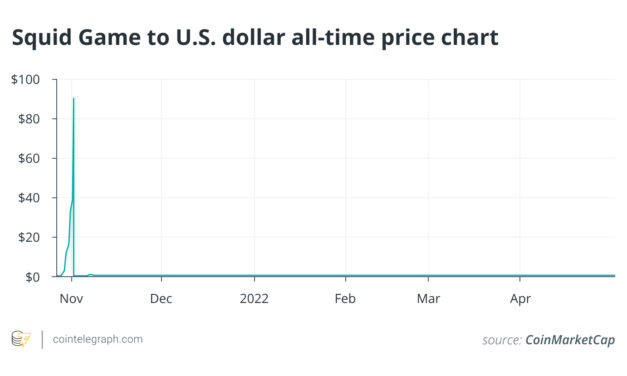
The Empire State made two appearances on the regulatory stage last week, and neither was entirely reassuring. On April 25, bill S8839 was proposed in the New York State (NYS) Senate that would criminalize “rug pulls” and other crypto frauds, while two days later, the state’s Assembly passed a ban on non-green Bitcoin (BTC) mining. The first event was met with some ire from industry representatives, while the second drew negative reviews, too. However, this may have been more of a reflex response given that the “ban” was temporary and principally aimed at energy providers. The fraud bill, sponsored by State Senator Kevin Thomas, looked to steer a middle course between protecting the public from scam artists while encouraging continued innovation in the crypto and blockchain sector. It would criminalize specific acts of crypto-based chicanery including “private key fraud,” “illegal rug pulls” and “virtual token fraud.” According to the bill’s summary:“With the advancement of this new technology, it is vital to enact regulations that both align with the spirit of the blockchain and the necessity to combat fraud.” Critics were quick to pounce, however, assailing the bill’s relevance, usability, overly broad language and even its constitutionality. The Blockchain Association, for instance, told Cointelegraph that the bill as currently written is “unworkable,” with “the biggest nonstarter being the provision obligating software developers to publish their personal investments online, and making it a crime not to do so. There’s nothing remotely like this in any traditional industry, finance or otherwise, even for major shareholders of public companies.”The association further added that all the specified offenses were already covered under New York State and federal law. “There’s no good reason to create new offenses for ‘rug pulls.’” Stephen Palley, partner in the Washington D.C. office of law firm Anderson Kill, seemed to agree, telling Cointelegraph that New York State already has the Martin Act. This is “an existing statutory scheme that is one of the broadest in the country that, in my view, likely already covers much of what this bill purports to criminalize.” A threat to trustOn the other hand, it’s hard to deny that fraud dogs the cryptocurrency and blockchain sector — and it doesn’t seem to be going away. “Rug pulls put 2021 cryptocurrency scam revenue close to all-time highs,” headlined a Chainalysis December report. The analytics firm went on to declare these activities a major threat to trust in cryptocurrency and crypto adoption. The Thomas bill concurred, noting that “rug pulls are now wreaking havoc on the cryptocurrency industry.” It described a process in which a developer creates virtual tokens, advertises them to the public as investments and then waits for their price to rise steeply, “often hundreds of thousands of percent.” Meanwhile, these malefactors have stashed away a huge supply of tokens for themselves before “selling them all at once, causing the price to plummet instantly.”The summary went on to describe a recent rug pull that involved the Squid Game Coin (SQUID). The token began life at a price of $0.016 per coin, “soared to roughly $2,861.80 per coin in only one week and then crashed to a price of $0.0007926 in less than five minutes following the rug pull:” “In other words, the SQUID creators received a 23,000,000% return on their investment and their investors were swindled out of millions. This bill will provide prosecutors with a clear legal framework in which to pursue these types of criminals.”Are the proposed fixes workable?Some were baffled by some of the remedies proposed in the bill, however, including a provision that token developers who sell “more than 10% of such tokens within five years from the date of the last sale of such tokens” should be charged with a crime.“The provision that makes it a fraud for developers to sell more than 10% of tokens within five years is preposterous,” Jason Gottlieb, partner at Morrison Cohen LLP and chair of its White Collar and Regulatory Enforcement practice, told Cointelegraph. Why should such activity be considered fraudulent if conducted openly, legitimately and without deception, he asked, adding:“Worse, it’s sloppy legislative drafting. The rule is easily circumvented by creating a massive amount of ‘not for sale’ tokens that simply get locked in a vault, to prevent any sale from crossing the 10% threshold.”Others criticized the bill’s lack of precision. With regard to stablecoins, the bill would require an issuer “not” to advertise, for example, said David Rosenfield, partner at Warren Law Group. By comparison, most bills of this type “will mandate certain disclosures or prohibit certain language.” The legislation’s vague and overbroad language “permeates and infects the bill fatally, in my view,” he told Cointelegraph.The bill also stipulates that a trier of fact must “take into account the developer’s notoriety,” he added. Again, it isn’t really clear what this means. Ask 10 people to define notoriety, and one might receive 10 different answers. Or, take the provision that software developers publish their personal investments. “This unconstitutionally stigmatizes a class of citizens and developers without a compelling reason that would pass constitutional muster,” Rosenfield said. “This whole bill will not pass Constitutional requirements.” Cointelegraph asked Clyde Vanel, who chairs the New York State Assembly’s Subcommittee on Internet and New Technologies — and who introduced a companion bill to S8839 in the lower house — about the criticism that rug pulls and other sorts of crypto fraud are already covered by existing statutes, including the state’s Martin Law. He answered:“While the Martin Act provides some jurisdiction for the Attorney General to address fraud, we must provide clear authority for New York prosecutors in the cryptocurrency space. This bill provides clear authority regarding cryptocurrency fraud.”When asked for an example of how the bill aligns with “the spirit of blockchain,” as claimed in the summary, Vanel answered, “Interestingly, one of the main tenets of blockchain technology is trust. This bill will provide the much-needed trust for certain cryptocurrency investments and transactions.”Was Vanel — a self-described entrepreneur — worried that the legislation might discourage software developers, in particular, the requirement that software developers publish their personal investments online? “I want to make sure that New York is a place with a free, open and fair marketplace for entrepreneurs, investors and all to participate,” Vanel told Cointelegraph. “The disclosure obligation applies exclusively to a developer’s interest in the specific token created. It does not apply to other investments outside of the specific token in question.”Gottlieb took issue with some of this characterization, though. “The bill is not aligned with the spirit of blockchain,” he declared. The bill might use some blockchain terminology, like rug pull, but that doesn’t mean it has grasped the true nature of blockchain. “The bill has serious flaws that would impede legitimate developers, and the true spirit of blockchain is to encourage development while protecting participants,” he said.What is driving the state’s legislators?One suspects this bill may have been hurriedly drafted, given some of the imprecise language cited above. It bears asking, then: What is motivating New York’s lawmakers? A need to catch up with a new technology that many still don’t understand? A desire not to be outdone by other states and locales like Wyoming, Texas and Miami that are busy staking their claims in the crypto territory?“Read the 20-page criminal complaint in the recent charges against Ilya Lichtenstein and his wife, Heather Morgan,” answered Rosenfield. He referenced the recently arrested couple charged with stealing crypto valued at $4.5 billion at the time of writing from the Bitfinex exchange in 2016, “and you will appreciate what a challenge legislators and regulators have in combating the ever-increasing level of cryptocurrency fraud, especially in New York State.” More regulation is arguably needed, he added, “but this bill certainly isn’t it.”On the matter of the lawmakers’ motivation, Palley said, “A generous view is that the market is in fact rife with misconduct and in some cases outright fraud, and that legislators wish to make a mark and add laws to the books to address that behavior.” On the other hand, a cynic might hazard that it’s nothing more than legislative theater. “The truth probably lies somewhere in between,” Palley told Cointelegraph, adding: “Regardless, I’m just not sure that the new nature of the asset class really calls for new laws to address behaviors that are as old as commerce itself.” Wherefore crypto mining?As noted, S8839 was closely followed last week by the passage in the NYS Assembly of a two-year ban on non-green Bitcoin mining. Is the state’s long-simmering crypto wariness beginning to boil over?Gottlieb suggested the two events really weren’t comparable. “The Bitcoin mining legislation, while misguided and faulty, at least comes from an understandable desire to safeguard our environment in interactions with a new technology,” he said. The new rug pull legislation, in comparison, may also come from a desire to safeguard investors and prevent fraud, but it offers nothing new. “Existing law covers that concern perfectly well.” The Bitcoin mining “ban” seemed to have attracted more attention than the rug pull bill last week, but this may have been partly due to a misapprehension. “This [mining] bill has been framed in the media as a ban on crypto mining. It is not that,” declared NYDIG Research Weekly in its April 29 newsletter. Rather, it is a two-year suspension on some kinds of crypto mining principally aimed at power companies, not Bitcoin miners, said NYDIG, adding:“The New York State Assembly voted to put a 2-year moratorium on issuing air permits to fossil fuel-based electric generating facilities that supply behind-the-meter energy to cryptocurrency mining.”All told, it may be no surprise that New York State seems to be forging its own path on the matter of blockchain and cryptocurrency regulation. After all, “New York State is the financial engine of the country,” commented Gottlieb. On blockchain-based finance, however, “New York’s legislative regime has greatly hampered responsible development in the industry.” He cited the state’s BitLicense requirement as an example of one “onerous” and “largely ornamental” requirement. Overall, Gottlieb told Cointelegraph: “New York lawmakers need to consider whether they want New York to attract and nurture a burgeoning fintech industry, or whether they want to pass more ill-conceived laws that serve little purpose other than to scare away companies.”

Čítaj viac


Quantum computing to run economic models on crypto adoption

By many accounts, quantum computing (QC), which uses atomic “spin” instead of an electrical charge to represent its binary 1’s and 0’s, is evolving at an exponential rate. If QC is ever realized at scale, it could be a boon for human society, helping to improve crop yields, design better medicines and engineer safer airplanes, among other benefits. The crypto sector could profit too. Just last week, for instance, a Bank of Canada-commissioned project simulated cryptocurrency adoption among Canadian financial organizations using quantum computing. “We wanted to test the power of quantum computing on a research case that is hard to solve using classical computing techniques,” said Maryam Haghighi, director of data science at the Bank of Canada, in a press release. But, others worry that quantum computing, given its extraordinary “brute force” power, could also crack blockchain’s cryptographic structure, which has served Bitcoin (BTC) so well since its inception. Indeed, some say it is only a matter of time before quantum computers will be able to identify the enormous prime numbers that are key constituents of a BTC private key — assuming no countermeasures are developed. Along these lines, a recently published paper calculated just how much quantum power would be needed to duplicate a BTC private key, i.e., “the number of physical qubits required to break the 256-bit elliptic curve encryption of keys in the Bitcoin network,” as explained by the paper’s authors, who are associated with the University of Sussex. To be sure, this will be no easy task. Bitcoin’s algorithm that converts public keys to private keys is “one way,” which means that it is easy to generate a public key from a private key but virtually impossible to derive a private key from a public key using present-day computers. In addition, this would all have to be done in about 10 minutes, the average amount of time that a public key is exposed or vulnerable on the Bitcoin network. It also assumes that the public key is identical to the BTC address, as were most in Bitcoin’s early days before it became common practice to use the KECCAK algorithm to “hash” public keys to generate BTC addresses. It’s estimated that about one-quarter of existing Bitcoin is using unhashed public keys.Given these constraints, the authors estimate that 1.9 billion qubits would be needed to penetrate a single Bitcoin private key within 10 minutes. Qubits, or quantum bits, are the analog to “bits” in classical computing. By comparison, most proto-QC computers today can summon up 50–100 qubits, though IBM’s state-of-the-art Eagle quantum processor can manage 127 qubits. IBM Q System One, the first circuit-based commercial quantum computer. Source: IBM ResearchPut another way, that’s 127 qubits against the 1.9 billion needed to crack Bitcoin’s security using a large-scale trapped ion quantum computer, as proposed in the AVS Quantum Science paper.Mark Webber, quantum architect at Universal Quantum, a University of Sussex spin-out firm, and the paper’s lead author, said, “Our estimated requirement […] suggests Bitcoin should be considered safe from a quantum attack for now, but quantum computing technologies are scaling quickly with regular breakthroughs affecting such estimates and making them a very possible scenario within the next 10 years.” Is the threat real?Could Bitcoin’s security really be cracked? “I think that quantum computers could break cryptocurrency,” Takaya Miyano, a professor of mechanical engineering at Japan’s Ritsumeikan University, told Cointelegraph, “Though, not in a few years time, but in 10–20 years time.”Miyano recently lead a team that developed a chaos-based stream cipher designed to withstand attacks from large-scale quantum computers.David Chaum, writing last year for Cointelegraph, also sounded the alarm — not only for crypto but for wider society as well:“Perhaps most terrifying for a society so reliant on the internet, quantum-level computing puts all of our digital infrastructures at risk. Our contemporary internet is built on cryptography⁠ — the use of codes and keys to secure private communication and storage of data.”Meanwhile, for cryptocurrencies like Bitcoin and Ether (ETH), “for whom this concept is fundamental, one sufficiently powerful quantum computer could mean the theft of billions of dollars of value or the destruction of an entire blockchain altogether,” continued Chaum.There are more than 4 million BTC “that are potentially vulnerable to a quantum attack,” consulting firm Deloitte estimates, a number that comprises owners using un-hashed public keys or who are reusing BTC addresses, another unwise practice. At current market prices, that amounts to about $171 billion at risk. Recent: Is asymmetric information driving crypto’s wild price swings?“Personally, I think that we are unable at the moment to make a good estimation” of the time it will take before quantum computers can break BTC’s encryption, Itan Barmes, quantum security lead at Deloitte Netherlands and project fellow at the World Economic Forum, told Cointelegraph. But, many experts today estimate 10-15 years, he said. Many of these estimates, too, are for breaking the encryption without time constraints. Doing it all within 10 minutes will be more difficult.Other cryptocurrencies, not just Bitcoin, could be vulnerable too, including those with proof-of-stake (PoS) validation mechanisms; Bitcoin uses a proof-of-work (PoW) protocol. “If blockchain protocol exposes public keys for a sufficiently long time, it automatically becomes vulnerable under quantum attacks,” Marek Narozniak, a physicist and member of Tim Byrnes’ quantum research group at New York University, told Cointelegraph. “It could allow an attacker to forge transactions or impersonate block producers’ identity for PoS systems.” Time to prepareIt seems the crypto industry might have about a decade to get ready for a potential QC onslaught, and this is crucial. Narozniak noted:“There is more than enough time to develop quantum-safe cryptography standards and work out adequate forks to currently used blockchain protocols.”When asked if he was confident that post-quantum cryptography will be developed in time to thwart hackers before the 10-minute barrier is broken, Deloitte’s Barmes referenced a more recent paper he co-authored on quantum risks to the Ethereum blockchain that describes two types of attacks: a storage attack and a transit attack. The first “is less complicated to execute, but to defend against it, you don’t necessarily need to replace the cryptography algorithm.” On the other hand, he told Cointelegraph:“The transit attack is much more difficult to execute and is also much more difficult to protect against. There are some candidate algorithms that are believed to be resistant to quantum attacks. However, they all have performance drawbacks that can be detrimental to the applicability and scalability to the blockchain.”An arm’s race?What is unfolding in this area, then, appears to be a sort of arms race — as computers grow more powerful, defensive algorithms will have to be developed to meet the threat. “This overall pattern is really nothing new to us,” said Narozniak. “We see it in other industries as well.” Innovations are introduced, and others try to steal them, so piracy protection mechanisms are developed, which provoke even more clever theft devices. “What makes this quantum-safe cryptography case a little bit different is that the quantum algorithms impose a more drastic change. After all, those devices are based on different physics and for certain problems they offer different computational complexity,” added Narozniak.Indeed, QC makes use of an uncanny quality of quantum mechanics whereby an electron or atomic particle can be in two states at the same time. In classical computing, an electric charge represents information as either an 0 or a 1 and that is fixed, but in quantum computing, an atomic particle can be both a 0 and a 1, or a 1 and a 1, or a 0 and a 0, etc. If this unique quality can be harnessed, computing power explodes manyfold, and QC’s development, paired with Shor’s algorithm — first described in 1994 as a theoretical possibility, but soon to be a wide-reaching reality, many believe — also threatens to burst apart RSA encryption, which is used in much of the internet including websites and email. “Yes, it’s a very tough and exciting weapons race,” Miyano told Cointelegraph. “Attacks — including side-channel attacks — to cryptosystems are becoming more and more powerful, owing to the progress in computers and mathematical algorithms running on the machines. Any cryptosystem could be broken suddenly because of the emergence of an incredibly powerful algorithm.”Simulating financial relationships One shouldn’t necessarily assume that quantum computing’s impact on the crypto sector will be entirely deleterious, however. Samuel Mugel, chief technology officer at Multiverse Computing, the firm that led the above-referenced program at Bank of Canada, explained that in the pilot, they were able to simulate a network of financial relationships in which the decisions that one firm might make were highly dependent on decisions of other firms, further explaining to Cointelegraph:“Game theory networks like this are very hard for normal supercomputers to solve because more optimal behaviors can get overlooked. Quantum computers have ways of dealing with this type of problem more efficiently.”Devices based on quantum mechanics potentially offer other unique possibilities, added Narozniak, “For instance, unlike classical states, quantum states cannot be copied. If digital tokens were represented using the quantum states, the no-cloning theorem would automatically protect them from being double-spent.”Recent: Crypto seen as the ‘future of money’ in inflation-mired countriesQuantum entanglement could also be used to secure quantum smart contracts, Narozniak said. “Tokens could be entangled during the execution of the contract making both parties vulnerable to eventual loss if the smart contract is not executed as agreed.”Developing post-quantum cryptographyAll in all, the threat to the cryptoverse from quantum computing appears real, but enormous power would be required to breach crypto’s underlying cryptography, and hackers would also have to work under stringent time constraints — having only 10 minutes to penetrate a BTC private key, for instance. The reality of breaking Bitcoin’s elliptic curve encryption through the use of quantum computing is at least a decade away, too. But, the industry needs to get started now in developing deterrents. “I would say that we should be ready on time, but we need to start working seriously on it,” said Barmes.In fact, a substantial amount of research is now taking place “in post-quantum crypto,” Dawn Song, a professor in the computer science division at the University of California, Berkeley, told Cointelegraph, adding:“It is important that we develop quantum-resistant, or post-quantum, cryptography so we have the alternatives ready when quantum computers are powerful enough in reality.” 

Čítaj viac

Is asymmetric information driving crypto’s wild price swings?

It has long been believed that investors possessing inside knowledge help drive cryptocurrencies’ price volatility, and a number of academic papers have been published on this topic. This is why Coinbase’s intention to regularly publish in advance a catalog of tokens being assessed for listing on its prominent trading platform is noteworthy. Coinbase’s plans, announced in an April 11 blog along with 50 crypto projects “under consideration” for Q2 2022, could help tamp down the pervasive speculation that surrounds small-cap tokens. Meanwhile, this can help alleviate industry concerns about “information asymmetry,” which typically occurs when one party to a transaction — a seller, for instance — is much better informed than another transactional party, such as a buyer.Last week’s pre-list, which included 45 ERC-20 tokens on the Ethereum blockchain network and five SPL tokens on the Solana network as well as future token lists, is meant to “increase transparency by providing as much information symmetry as possible,” the United States’s largest crypto exchange explained.Will it really smooth out the crypto-investor playing field, though? “It can be a step in the right direction,” Lennart Ante, co-founder at Blockchain Research Lab gGmbH and author of a research paper on information asymmetry in Bitcoin (BTC) transactions, told Cointelegraph. “In theory, this reduces information asymmetry and, thus, the price effect at the time of the listing.”“More transparency is always welcome, obviously,” Daniele Bianchi, associate professor in finance at the School of Economics and Finance of Queen Mary University of London, who has published research on crypto price swings, told Cointelegraph. That said, “information asymmetries and adverse selection are still pervasive in cryptocurrency markets,” and that isn’t likely to change anytime soon. Indeed, a mere day after Coinbase’s listing announcement, reports surfaced on Crypto Twitter that one crypto wallet holder, possibly an insider, probably had pre-knowledge of Coinbase’s new listing candidates, and may have made a tidy profit trading on some of those tokens. According to crypto influencer Cobie:“Found an ETH address that bought hundreds of thousands of dollars of tokens exclusively featured in the Coinbase Asset Listing post about 24 hours before it was published, rofl.” New distortions from institutional investors?Be that as it may, Coinbase’s announcement serves as a reminder that the industry continues to struggle with the problem of asymmetric, or unbalanced, information and it raises questions. Are information asymmetries really driving huge price swings in cryptocurrencies, as commonly believed? If so, is this undermining investor confidence in the system? If something is amiss, what might help fix things? And, what about Coinbase’s recent announcement, isn’t this an encouraging move on the part of an acknowledged industry heavyweight?Information asymmetry is a real crypto sector problem, driven by relatively low market capitalization, a concentrated ownership structure and a highly fragmented and multi-platform market structure, said Bianchi. Moreover, it’s no longer just “whales” and crypto miners who may be manipulating markets, he told Cointelegraph:“The investment landscape is changing and more institutional investors — either specialized or multiasset — are coming into the marketplace. In other words, there is a new type of sheriff in town with the potential to benefit from naïve retail investors.”The low liquidity level of many crypto projects makes them vulnerable to price manipulation, added Bianchi. “Liquidity is key here. Outside of the top 100 by market capitalization, a trade of a few million USD can easily generate significant price swings at the expense of retail traders who typically have poor market timing skills.”Some others concur. “The cryptocurrency market is, in fact, the perfect environment to exploit asymmetric information,” Raj Kapoor, founder of the India Blockchain Alliance, told Cointelegraph, given that “it is not completely transparent and part of a fragmented ecosystem.” Rather, it’s a mix of web-based brokers, peer-to-peer exchanges and major exchanges that provide liquidity to their smaller counterparts, said Kapoor, adding:“Those who have the information and can time the market, make money and drive the prices. Inconsistent and non-aligned crypto exchange regulation fosters this environment.”“There is almost always a circle of people who have the information in advance and can or could act accordingly,” added Ante. This includes events like exchange listings, regulatory changes or even tweets from influential people like Elon Musk.“One of the biggest asymmetries is that the anonymous developers know their own identities and intentions, but buyers don’t,” Douglas Horn, chief architect of Telos, a blockchain platform, told Cointelegraph. “Another type is market manipulation by whales who know that their big sell-walls are just there to crush the price so they can end up acquiring more of a coin without any new investment, but the majority of investors do not. Both of these situations cause big swings in market value,” said Horn. But, is it really problematic? Cryptocurrencies are a small subset within a much larger legacy financial system, after all, where information imbalances have proliferated for many decades.Recent: First steps: Basic tips for getting started investing in DeFiAt the core of traditional finance“Information asymmetries are at the heart of financial markets,” James Angel, associate professor at Georgetown University’s McDonough School of Business, told Cointelegraph. There are “huge asymmetries” between product issuers and investors, brokers and clients, as well as in trading markets, he said, adding:“Equities have always been extremely volatile and always will be for a simple reason: Nobody knows what they are really worth because no one knows what the future holds.”The same applies to cryptocurrencies. In Angel’s view, their mammoth price swings are a “natural artifact” of the uncertainty over tokens’ true value, which isn’t so unusual given that we are in the middle of a technological revolution. Indeed, “it feels just like 1999 all over again,” he said, referencing the dot.com boom when tech-based equities grew at exponential rates. Today, there are many new “promising entrants” in the crypto space, Angel continued, and not all of them will succeed. “Time will tell which of them are the next Google versus the next Pets.com. Given the lack of regulation, there are undoubtedly lots of hijinks going on as well.” According to Kapoor, information asymmetry remains a significant problem for the crypto industry. Many mature, centralized and traditional markets — like equities — are symmetrically aligned, he said. “Not so trading in cryptocurrency.” Crypto markets have a “highly fragmented multiplatform structure; the problem is not going away anytime soon.”Others suggest, however, that the cryptoverse with its distributed digital ledgers that are open for all to see and is less riddled with information asymmetries than traditional finance. Yes, “information asymmetries are an intrinsic part of markets for assets with uncertain value,” and that includes many crypto projects, Emiliano Pagnotta, associate professor of finance at Singapore Management University, told Cointelegraph, but blockchain projects differ from traditional enterprises too:“A cryptocurrency like Bitcoin is not subject to asymmetric information about cash flows, managerial decisions, mergers, earnings or several essential variables affecting firms’ securities.”Both Bitcoin and Ether (ETH) have evolved in a transparent open-source process too, Pagnotta added, with updates and innovations discussed openly months and sometimes years in advance.That said, weaknesses haven’t been completely eliminated, and “there can still be significant asymmetric information related to external factors such as regulation. For example, Chinese officials had advanced knowledge of the decision to crack on all Bitcoin mining before the corresponding announcement in the first half of 2021.” That, presumably, would have provided officials or the government an opportunity to unload their BTC holdings before market prices plummeted. “Regulatory uncertainty is probably the most critical barrier to investor confidence, in my view,” said Pagnotta.Is Coinbase leveling the playing field? What about Coinbase’s announcement of 50 crypto projects that could be heading for a Q2 listing on its exchange: Is that a blow struck in the interests of transparency? It was “a step in the right direction,” said Pagnotta, helping to even out information imbalances. Up to now, it’s common for investors to open exchange accounts “merely to gain access to an unlisted token on their primary exchange,” he said. This is cumbersome, time consuming and not very efficient. “For the public at large this will not change the situation much,” opined Bianchi. When a coin makes Coinbase’s pre-list, algorithmic traders or market makers can still “front-run retail investors and take profits without necessarily waiting for the so-called ‘Coinbase effect.’” More transparency in the listing process is desirable, of course, “but it does not solve the issue.”As for the reports that someone, perhaps an employee, may have been trading in advance of the April 11 blog post, Horn said that there really isn’t too much that can be done about actions like these. “The listings of big companies like Coinbase have always been excellent opportunities for insider trading because anonymous trading is easily accessible — making enforcement impossible.” It’s not an ideal situation, but it can’t be easily stopped “so there’s not much point in getting upset about it.”Coinbase could do some small things. “They can possibly publicly commit to penalize/fire any employee caught trading in advance of the publication list if they are not doing so yet,” said Pagnotta, as well as restricting which assets are investable for employees and other things like that. Would more regulation help? Basically, “such trading lies outside of the scope of regulatory agencies, in my view,” Pagnotta said, noting that the United States definition of insider trading, Rule 10b-5 of the U.S. Securities Exchange Act of 1934, requires “buying or selling [of] a security,” and at this point in time ERC-20 tokens “are not a registered security.” In other words, U.S. insider trading rules may not apply.Recent: Top universities have added crypto to the curriculumNeeded: more adoption, trading volumeAll in all, the crypto sector may find it difficult to eliminate information asymmetry in the short run without losing the decentralized nature of cryptocurrency markets. More transparency, like that offered last week by Coinbase, is helpful, but they can only do so much.But, the longer-term outlook may be more positive “with more professional investors coming into the marketplace and regulators assuming closer oversight,” Bianchi told Cointelegraph, adding: “We need more adoption, less ownership concentration and more volume trading to improve the price discovery process and market quality as a whole.” 

Čítaj viac

Satoshi may have needed an alias, but can we say the same?

To doxx (oneself) or not to doxx? That is a question faced by many operating in the cryptocurrency and blockchain space, including developers, influencers, and investors. Does one use one’s own name when venturing into the often chaotic and largely unregulated crypto world — or don an alias?Consider Embrik Børresen, developer of RobinHood Inu — a reflection token that was launched in February. Like many crypto and blockchain founders, he considered using a nom de guerre when starting out. But Børresen, 22, raised in a small town, had also served in the Norwegian military where he says he learned some lessons about the value of trust.So, when it came time to launch his new coin project, he opted to use his real name. “For me, it is the moral thing — to present yourself as who you are,” he tells Magazine. Many of his peers disagree, however. “Pseudo-anonymity has been a fixture of the internet since it began, and I believe it will remain this way,” Ghostbro, a Generation Z developer for the DogeBonk project, tells Magazine. For Ghostbro (a pseudonym), revealing their true identity — or “doxxing” themselves — makes little sense.“It would essentially put a target on my back to people who might have lost money trading DogeBonk, or wish to steal from me either online or by actually coming to my house and threatening me or my loved ones.”They have already received threatening messages, they tell Magazine, and have been subject to some “extremely obsessive behavior from people who genuinely ‘hate’ our cryptocurrency.” They’re in no rush to make themselves “a flesh and blood figurehead these people can mess with.”It is a debate that has been going on in at least some form since crypto’s beginning: To what extent does one really need to reveal one’s personal identity in a decentralized world? After all, one’s transactions are already on display in the form of a public key for any and all to see. Does one really need to put a bullseye on one’s chest, too? Moreover, aren’t assumed names a part of the crypto ethos going back to Bitcoin inventor Satoshi Nakamoto — who assumed an alias that has never been penetrated?Has it gone too far?It may seem that pseudonymity just comes with the turf in the cryptoverse. How many “influencers” on Crypto Twitter use assumed names — e.g., PlanB, Cobie, The Crypto Dog, Rekt Capital? Twitter personality Cobie is actually on their second handle — until 2021, they went as Crypto Cobain.But pseudonymity arguably has some social and economic costs. It can provide cover to “rug pullers,” fraudsters, money launderers and other less-than-trustworthy types. This was nakedly displayed in the recent Wonderland saga where it was revealed that one of the founders of that DeFi protocol, going by the alias Sifu, was actually Michael Patryn, a convicted felon and co-founder of QuadrigaCX, the Canadian crypto exchange, whose collapse under murky circumstances led to a loss of $169 million in user funds.While the crypto space today has become safer and more user-friendly as it approaches mainstream acceptance, many still believe that anonymous scammers run rampant. 1/ This needs to be shared @0xSifu is the Co-founder of QuadrigaCX, Michael Patryn. If you are unfamiliar that is the Canadian exchange that collapsed in 2019 after the founder Gerald Cotten disappeared with $169mI have confirmed this with Daniele over messages. pic.twitter.com/qSfWNnQPhr— zachxbt (@zachxbt) January 27, 2022“This pseudonymous stuff is so dangerous,” Brian Nguyen, a crypto entrepreneur who lost $470,000 in what might have been a crypto “rug pull,” told CNBC.com. “They could be a good actor today, but they could turn bad in two or three years.”It makes one wonder what they’re hiding from.Maybe it’s time then to rethink this pseudo-anonymity thing? “If we want crypto to be taken seriously as a community, then we must start unveiling identities,” Hadar Jabotinsky, a research fellow at the Hadar Jabotinsky Center for Interdisciplinary Research of Financial Markets, Crises and Technology, tells Magazine. It is important because this remains a new, unregulated market, Jabotinsky continues. “It’s based on trust, but it is subject to rumors — so, it’s beneficial to use real names.” Failure to supply one’s true name is traditionally a cause for suspicion, and it remains so still in many quarters. “If people must be anonymous, it makes one wonder what they’re hiding from,” University of Texas finance professor John Griffin tells Magazine. Meanwhile, Børresen adds, “If someone asks about a person, and they are unable or unwilling to answer, a lot of the time, that indicates some murkiness in what is being presented, even if it is not an outright scam.”Yes, some project founders choose anonymity to further their fraudulent activities, acknowledges Amy Wu, a well-known venture capitalist who was recently named to head FTX Ventures — a $2-billion VC fund to invest in Web3 projects — tells Magazine, but “this is a tiny percentage of crypto founders.” Still, when they succeed — i.e., execute a scam or rug pull — “it tends to anger many inside as well as outside the community,” she says. And then what is one to make of the Wonderland fiasco? A serial scammer who had served 18 months in a federal prison for credit card fraud, Patryn (Sifu) was serving as Wonderland’s treasurer. “The lesson is you have to assume the worst,” Aaron Lammer, DeFi specialist at Radkl, tells Magazine.“Even if most people are well-intentioned in their anonymity, you may be masking a very bad actor.”Part of the ethosAsked why many crypto influencers, traders and developers post anonymously on Twitter and other social media, Lammer answers that each has their “distinct” rationale. “For developers and project founders, anonymity can be a shield against regulatory uncertainty. For traders and influencers, there may be security risks. Anonymity is part of the ethos of crypto culture, and I don’t necessarily think that people need to justify it.”Still, as more institutional investors enter the crypto space and the deals get bigger, anonymity — if not pseudonymity — may lose some of its attractiveness. If one seeks to raise financing from a venture capital firm, it probably wouldn’t help if you go by the handle “Loves2party420,” Justin Hartzman, CEO and co-founder of Toronto-based cryptocurrency exchange CoinSmart, tells Magazine, adding: “If you are running a multi-million-dollar protocol, it’s not wise to remain anonymous. You need to be visible to ensure that you won’t suddenly rug-pull and get away with it.”A lot of VC firms won’t invest in a project if the founder remains anonymous, adds Wu, but there are situations where the founder chooses to be publicly anonymous — maybe to keep with the Web3’s spirit of egalitarianism — but the founder is still known by name by those within the more narrow investing community, including the enabling VC firm. Losing credibility?Is it even right to assume that one loses credibility when adopting an alias? Can’t one build a trustworthy brand around a nom de plume? Did it do lasting harm to Eric Blair (George Orwell), Samuel Clemens (Mark Twain), Mary Anne Evans (George Eliot), or Theodore Geisel (Dr. Seuss), to name a few? “When people’s line of work becomes wrapped up in a pseudonym, then maintaining credibility there becomes just as important as maintaining credibility with their real name,” says Ghostbro. Moreover, in the internet age, people’s behavior isn’t always exemplary, particularly online. “The majority of my adult [survey] participants use pseudonyms on social media to avoid scorn from those who might deem their behavior ‘unacceptable,’ both within and outside of fan communities,” notes social media researcher Ysabel Gerrard.And if pseudonyms help to promote a more democratic spirit, is that necessarily a bad thing? Decentralized project founders often want to downplay their roles, Wu tells Magazine, “They don’t want to let their personality get in the way of the community.” They often prefer to be seen as just another member in a dynamic, new community, and to this end, a pseudonym can help. “You can still build up a reputation without revealing your identity,” Samson Mow, CEO of Pixelmatic and formerly chief strategy officer of Blockstream, tells Magazine, continuing, “and you can also accomplish and have a great impact on the world, as Satoshi Nakamoto demonstrated. Ideas and code are more important than a name and face.”Allowed to repeat the same fraud?On the other hand, it’s difficult to deny that some scam artists are able to hide behind anonymity in order to “repeat the same or different scams repeatedly,” Griffin adds. “A ton of this goes on in crypto.” Meanwhile, Jabotinsky, who has studied financial failures in traditional markets, adds that anonymity can lead to all manner of market failures, given the asymmetricity of information in the crypto world. It facilitates pump-and-dump schemes, for instance, and other sorts of manipulation. Then, too, scale matters when playing around with avatars and the like. “When you are at a certain level” — with a corporate treasury holding $1 billion, say — “it is important for you to be visible for people to know exactly who they are dealing with,” says Hartzman.Still, viewed objectively, the amount of fraud in the crypto world is really quite small, Wu notes, and the number of really big projects — unicorns that have reached $1 billion in market value — while growing fast, are still relatively rare. These circumstances don’t really describe the everyday reality of most projects where pseudonymity might bring useful benefits for the everyday developer or founder, as well as influencers and investors. Dealing with complaints is tiresome, after all, and investors have been known to lash out when startups falter or fail. “If you are a protocol creator working 20 hours a day, do you really want to waste time and energy dealing with these complaints and, possibly worse, death threats?” asks Hartzman. Depending on one’s line of work, anonymity could be a wise choice, Hartzman adds. Case in point is Zachxbt, the alias of the investigator who exposed the Sifu–Wonderland deception. “A figure like that probably gets [serious] death threats,” said Hartzman. “Being anon can be a matter of life and death for someone holding that kind of information.”Protection from regulatorsSome founders, too, worry that regulators in their country of origin might come after them at some point — another reason to mask their identity. Canada’s recent executive order with regard to the Ottawa truckers got some people thinking.“With governments, you really never can tell what’s going to happen,” Mow tells Magazine. Maintaining an alias and a low profile can “certainly help lower the chances of seizure of assets — you never know when there’ll be another Executive Order 6102. If Canada can freeze the accounts of peaceful protesters, then asset seizures in any advanced Western nation is possible.”Even Børresen, a believer in “radical transparency,” is sympathetic toward his many peers who have elected to mask their identities. “I mainly think they are afraid of being targeted personally, either to protect themselves and their family from being targeted online or in real life.” He can even foresee doxxing himself one day. For instance:“If RobinHood Inu really takes off, and, say, 10,000 people were aware of me as an individual, this would naturally alter how I interact online. If I was to invest in another project and attaching my name to it would affect it, then I would likely do so anonymously.”Then, too, the blockchain world really might be a special case given the public nature of its transactions. In traditional finance, people are open about their identities, but the route that money takes is often murky, notes Børresen. Whereas, “In crypto, there is a lot of anonymity of individuals, but every transaction is traceable.”Ghostbro believes that many people in the sector will continue to maintain a Chinese wall between their online persona and their IRL (in real life) persona, while Lammer goes even further: Pseudonymity isn’t just situational — it is the wave of the future. “Crypto is probably ahead of the curve, and more of the world will operate anonymously in the future.” Hartzman differs. It’s more likely that a convergence is taking place. “Times have changed,” he tells Magazine. “As things stand, crypto businesses need to work hand-in-hand with regulators to ensure consistent and sustainable, widespread adoption.” “Visibility is the cornerstone of accountability,” Hartzman concludes, while Børresen, for his part, adds that as decentralized finance becomes more readily available, widespread and accepted, “the perceived need for anonymity will likely lessen.”Then again, some things don’t really change. Identities and reputation have mattered throughout human history, and as Griffin notes, “People typically want to know who they’re dealing with.” They value relationships, too, and “it’s hard to have a deep relationship when people are anonymous.”Meanwhile, the blockchain and cryptocurrency industry is maturing, becoming more regulated, and attracting more users from outside the tech community who may not understand some of its more colorful traditions. Also, as more large corporations and institutional investors enter the space, some with fiduciary responsibilities, it might be only inevitable that the sector’s love affair with avatars and assumed names wanes.

Čítaj viac

Crypto seen as the ‘future of money’ in inflation-mired countries

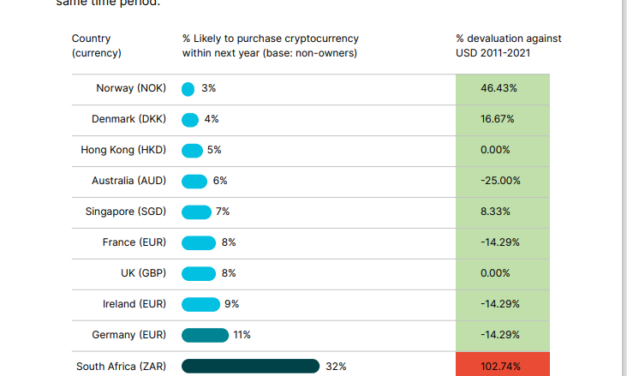
Last year, cryptocurrencies reached a “tipping point,” according to Gemini’s 2022 Global State of Crypto report, “evolving from what many considered a niche investment into an established asset class.” According to the report, 41% of crypto owners surveyed globally purchased crypto for the first time in 2021, including more than half of crypto owners in Brazil at 51%, Hong Kong at 51% and India at 54%.The study, based on a survey of 30,000 adults in 20 countries over six continents, also made a strong case that inflation and currency devaluation are powerful drivers of crypto adoption, especially in emerging market (EM) countries:“Respondents in countries that have experienced 50% or more devaluation of their currency against the USD over the last 10 years were more than 5 times as likely to say they plan to purchase crypto in the coming year than those in countries that have experienced less than 50% currency devaluation.”Brazil’s currency, the real, experienced a 218% devaluation — suggesting high inflation — against the United States dollar between 2011 and 2021, and 45% of Brazilians surveyed by Gemini said they planned to purchase crypto in the coming year. South Africa’s currency, the rand, recorded a 103% devaluation in the past decade — second only to Brazil among the 20 countries in the survey — and 32% of South Africans are expected to be crypto owners in the next year. The third and fourth highest devaluation, or inflationary, countries, Mexico and India, displayed a similar pattern.By comparison, the currencies of Hong Kong and the United Kingdom experienced no devaluation at all against the U.S. dollar over the past 10 years. Meanwhile, relatively few surveyed in those countries, 5% and 8%, respectively, professed an interest in purchasing crypto. What conclusions can be drawn from this? Noah Perlman, chief operating officer at Gemini, sees different crypto use cases, often depending upon where one lives. He told Cointelegraph:“In countries where the local currency has been devalued against the dollar, crypto is viewed as a ‘need to have’ investment, whereas in the developed world it is still largely seen as ‘nice to have.’” Source: GeminiCrypto as currency replacement Winston Ma, former managing director and head of North America at China Investment Corporation and now adjunct professor at New York University School of Law, makes a key distinction between an asset that works as an inflation hedge and one that is used as a currency replacement.Cryptocurrencies like Bitcoin (BTC) have yet to achieve “inflation hedge” status, unlike gold, in his view. In 2022, they have behaved more like growth stocks. “Bitcoin correlated more tightly to the S&P 500 index — and Ether to NASDAQ — than gold, which is traditionally viewed as an inflation-hedge asset,” he told Cointelegraph. But, things are different in parts of the developing world:“In the emerging markets like Brazil, India and Mexico that are struggling with inflation, inflation may be a primary driver of cryptocurrencies’ adoption as a ‘currency replacement.’”“There’s no denying that in early days and still now adoption has been driven by countries where currency stability and/or access to proper banking services has been an issue,” Justin d’Anethan, institutional sales director at the Amber Group — a Singapore-based digital asset firm — told Cointelegraph. Simply put, developing countries are more interested in alternatives to easily debased fiat currencies, he said, adding:“On a USD notional basis, the larger flows might still come from institutions and more developed countries, but the growing number of actual users will probably come from places like Lebanon, Turkey, Venezuela and Indonesia, among others.”Sean Stein Smith, assistant professor in the department of economics and business at Lehman College, told Cointelegraph that he was not particularly surprised by the survey’s findings, “since inflation is one of the factors that has and continues to drive adoption of Bitcoin and other crypto assets all over the world.”But, it remains just one of many factors, and often different regions have separate factors that push adoption, said Stein Smith. “On a fundamental level, investors and entrepreneurs are increasingly recognizing the benefits of crypto assets” as an “instantaneously accessible,” traceable and cost-effective transaction option. In other places, “the potential capital gains and returns of crypto assets” encourage crypto adoption.There are regulatory questions surrounding cryptocurrencies globally, particularly in the Asia Pacific and Latin America regions where 39% and 37% of survey respondents, respectively, said that “legal uncertainty around cryptocurrency,” tax questions and a general education deficit could affect adoption, the report noted. In Africa, for example, 56% of respondents said more educational resources to explain cryptocurrencies were needed.“It is not only inflation, it is a bigger issue of empowering our youth to have a better life than their parents and not to have fear of failure or allegiance to the legacy financial markets or products,” Monica Singer, South Africa lead at ConsenSys, told Cointelegraph. In addition, “the issue of dependency on cash and remittances is huge in Africa and the dependency on social grants.”The future of money?Overall, Brazil and Indonesia were the top two countries in cryptocurrency ownership in the survey. Forty-one percent of those surveyed in each of those countries said they owned crypto. Comparatively speaking, only 20% of Americans surveyed said they owned cryptocurrency. People living in inflation-afflicted markets are more likely to view cryptocurrencies as the future of money. According to the survey:“The majority of respondents in Latin America (59%) and Africa (58%), where many have experienced long-term hyperinflation, say that crypto is the future of money.”The strongest support for this view was seen in Brazil at 66%, Nigeria at 63%, Indonesia at 61% and South Africa at 57%. The fewest believers were in Europe and Australia, notably Denmark at 12%, Norway at 15% and Australia at 17%.Will the Ukraine conflict impact adoption?The survey was conducted before the Ukraine-Russia War. Will that devastating conflict have any long-term impact on global crypto adoption growth?“The Ukraine-Russia war has certainly led to crypto being thrust directly into the mainstream conversation,” said Stein Smith, “especially since the Ukrainian government has directly solicited over $100 million in crypto donations since the war began,” further adding:“This real-world demonstration of the power of decentralized money has the potential to turbocharge wider adoption, broader policy debate and increased utilization of crypto as a medium of exchange moving forward.” But, the war may not affect all parts of the developing world. “The war in Ukraine is of no consequence to the demand for crypto in Africa,” Singer told Cointelegraph. Other factors loom larger. “Inflation, yes, but also the lack of trust in the government in many countries in Africa and the fact that we have a young demographic that is very knowledgeable in using mobile phones and the internet.”The success of Mpesa in Kenya, for example, has had a big impact on the continent and will arguably help hasten further crypto adoption. It “is directly related to the spirit that exists in Africa of making a plan when everyone that you trust fails you,” she said. On the other hand, Ma views the Ukraine conflict as a sort of crisis check for cryptocurrencies. “The Ukraine-Russia War has served as a stress test for the payment rail of cryptocurrencies amid global uncertainty, especially for the residents in emerging markets,” he told Cointelegraph, adding:“We could expect the greatest future gains in crypto adoption to be found in emerging markets like these.”Inflation along with currency devaluation are enduring concerns in many parts of the world. In such afflicted areas, Bitcoin and other crypto are now seen as candidates for currency replacement — the “future of money.” This is generally not the case in the developed world, though that could change, particularly with more regulatory clarity and education. As d’Anethan told Cointelegraph, “It seems that even Western nations are waking up to inflation and the impact it will have on cash holdings.” 

Čítaj viac

Získaj BONUS 8 € v Bitcoinoch

nakup bitcoin z karty

Registrácia Binance

Burza Binance

Aktuálne kurzy