Autor Cointelegraph By Andrew Singer

Struggle for Web3’s soul: The future of blockchain-based identity

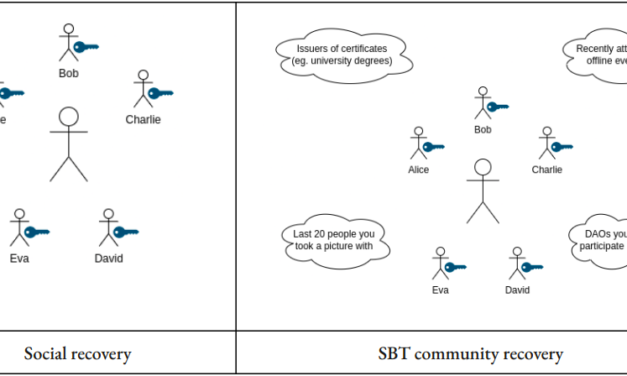
The attention, one might suspect, has much to do with the participation of Buterin, blockchain’s wunderkind and the legendary co-founder of the Ethereum network. But it could also be a function of the paper’s ambition and scope, which includes asking questions like: What sort of society do we really want to live in? One that is finance-based or trust-based?The authors illustrate how “non-transferable ‘soulbound’ tokens (SBTs) representing the commitments, credentials and affiliations of ‘Souls’ can encode the trust networks of the real economy to establish provenance and reputation.” These SBTs appear to be something like blockchain-based curricula vitae, or CVs, while “Souls” are basically people — or strictly speaking, individuals’ crypto wallets. However, Souls can also be institutions, like Columbia University or the Ethereum Foundation. The authors wrote: There is no shortage of visionary scenarios about how Web3 might unfold, but one of the latest, “Decentralized Society: Finding Web3’s Soul” — a paper published in mid-May by E. Glen Weyl, Puja Ohlhaver and Vitalik Buterin — is close to becoming one of the top 50 most downloaded papers on the SSRN scholarly research platform.“Imagine a world where most participants have Souls that store SBTs corresponding to a series of affiliations, memberships, and credentials. For example, a person might have a Soul that stores SBTs representing educational credentials, employment history, or hashes of their writings or works of art.”“In their simplest form, these SBTs can be ‘self-certified,’” continue the authors, “similar to how we share information about ourselves in our CVs.” But this is just scratching the surface of possibilities:“The true power of this mechanism emerges when SBTs held by one Soul can be issued — or attested — by other Souls, who are counterparties to these relationships. These counterparty Souls could be individuals, companies, or institutions. For example, the Ethereum Foundation could be a Soul that issues SBTs to Souls who attended a developer conference. A university could be a Soul that issues SBTs to graduates. A stadium could be a Soul that issues SBTs to longtime Dodgers fans.”There’s a lot to digest in the 36-page paper, which sometimes seems a hodgepodge of disparate ideas and solutions ranging from recovering private keys to anarcho-capitalism. But it has received praise, even from critics, for describing a decentralized society that isn’t mainly focused on hyperfinancializaton but rather “encoding social relationships of trust.”Fraser Edwards, co-founder and CEO of Cheqd — a network that supports self-sovereign identity (SSI) projects — criticized the paper on Twitter. Nonetheless, he told Cointelegraph:“Vitalik standing up and saying NFTs [nonfungible tokens] are a bad idea for identity is a great thing. Also, the publicity for use cases like university degrees and certifications is fantastic, as SSI has been terrible at marketing itself.” Similarly, the paper’s attention to issues like loans being overcollateralized due to lack of usable credit ratings “is excellent,” he added.Overall, the reaction from the crypto community, in particular, has been quite positive, co-author Weyl told Cointelegraph. Weyl, an economist with RadicalxChange, provided the core ideas for the paper, Ohlhaver did most of the writing, and Buterin edited the text and also wrote the cryptography section, he explained. Recent: Crypto 401(k): Sound financial planning or gambling with the future?According to Weyl, the only real sustained pushback against the paper came from the DID/VC (decentralized identifiers and verifiable credentials) community, a subset of the self-sovereign identity movement that has been working on blockchain-based, decentralized credentials for some years now, including ideas like peer-to-peer credentials.A “lack of understanding”?Still, the visionary work garnered some criticism from media outlets such as the Financial Times, which called it a “whimsical paper.” Some also worried that SBTs, given their potentially public, non-transferable qualities, could give rise to a Chinese-government-style “social credit system.” Others took shots at co-author Buterin personally, criticizing his “lack of understanding of the real world.”Crypto skeptic and author David Gerard went even further, declaring, “Even if any of this could actually work, it’d be the worst idea ever. What Buterin wants to implement here is a binding permanent record on all people, on the blockchain.”Others noted that many of the projected SBT use cases — such as establishing provenance, unlocking lending markets through reputation, measuring decentralization or enabling decentralized key management — are already being done in different areas today. SBTs are “potentially useful,” said Edwards, “but I have yet to see a use case where they beat existing technologies.”Cointelegraph asked Kim Hamilton Duffy, who was interviewed two years ago for a story on decentralized digital credentials, about some of the use cases proposed in the “Soul” paper. How do they compare, if at all, with the work she has been doing around digital credentials?“It is similar to my thinking and approach when I first started exploring blockchain-anchored identity claims with Blockcerts,” Duffy, now director of identity and standards at the Centre Consortium, told Cointelegraph. “The risks and, correspondingly, initial use cases I carved out — restricting to identity claims you’re comfortable being publicly available forever — were therefore similar.”While the Soul paper touches on potential approaches to risks and challenges — such as how to handle sensitive data, how to address challenges with key and account recovery, etc. — “These solutions are harder than they may initially appear. What I found was that these problems required better primitives: VCs and DIDs.”Weyl, for his part, said there was no intent to claim priority with regard to the proposed use cases; rather, it was merely to show the power of such technologies. That is, the paper is less a manifesto and more a research agenda. He and his colleagues are happy to pass credit around where credit is due. “The VC community has an important role to play,” as do other technologies, he told Cointelegraph.A question of trustworthinessBut implementation may not be so simple. Asked to comment on the practicality of an enterprise like “soulbound tokens,” Joshua Ellul, associate professor and director of the Centre for Distributed Ledger Technologies at the University of Malta, told Cointelegraph: “The main issues are not technological but, like many aspects in this domain, issues of trust.” As soon as any input is required from the outside world — e.g., an academic degree, affiliation or attestation — a question arises as to the trustworthiness of that input. “We can raise the levels of trustworthiness of data through decentralized oracles, yet we should acknowledge that that data is still dependent on the collective trustworthiness of those oracles,” Ellul said.Assume a university is a “Soul” that issues students blockchain-based certificates. “People may trust the attestation because they trust the centralized university that makes its public key public,” Ellul said. But then others might ask, “What is the point of storing SBTs on a DLT when the university keeps such control?”Or looking at the idea of peer-to-peer work credentials, “In the real world, would a company honor a peer-to-peer credential issued by an individual or institution unknown to the company? Or would they rather just rely on traditional credentials?”It’s a matter of “shifting the mentality of trust” from centralized institutional trust to trusting networks, Ellul told Cointelegraph — and that could take some time to achieve.As soon as any input is required from the outside world — e.g., an academic degree, affiliation or attestation — a question arises as to the trustworthiness of that input. “We can raise the levels of trustworthiness of data through decentralized oracles, yet we should acknowledge that that data is still dependent on the collective trustworthiness of those oracles,” Ellul said.Assume a university is a “Soul” that issues students blockchain-based certificates. “People may trust the attestation because they trust the centralized university that makes its public key public,” Ellul said. But then others might ask, “What is the point of storing SBTs on a DLT when the university keeps such control?”Or looking at the idea of peer-to-peer work credentials, “In the real world, would a company honor a peer-to-peer credential issued by an individual or institution unknown to the company? Or would they rather just rely on traditional credentials?”It’s a matter of “shifting the mentality of trust” from centralized institutional trust to trusting networks, Ellul told Cointelegraph — and that could take some time to achieve.What if you lose your private key?The paper presents several use cases in areas where very little work has been done until now, Weyl told Cointelegraph. One is community recovery of private keys. The paper asks the question of what happens if one loses their Soul — i.e., if they lose their private key. The authors present a recovery method that relies on a person’s trusted relationships — that is, a community recovery model.With such a model, “recovering a Soul’s private keys would require a member from a qualified majority of a (random subset of) Soul’s communities to consent.” These consenting communities could be issuers of certificates (e.g., universities), recently attended offline events, the last 20 people you took a picture with, or DAOs you participate in, among others, according to the paper.Community recovery model for Soul recovery. Source: “Decentralized Society: Finding Web3’s Soul”The paper also discusses new ways to think about property. According to the authors, “The future of property innovation is unlikely to build on wholly transferable private property.” Instead, they discuss decomposing property rights, like permissioning access to privately or publicly controlled resources such as homes, cars, museums or parks. Recent: Corporate evolution: How adoption is changing crypto company structuresSBTs could grant access rights to a park or even a private backyard that are conditional and nontransferable. For example, I may trust you to enter my backyard and use it recreationally, but “that does not imply that I trust you to sub-license that permission to someone else,” notes the paper. Such a condition can be easily coded into an SBT but not an NFT, which is transferable by its very nature.Backlash against NFTs?Inevitably, speculation is settling on Buterin’s motivation for attaching his name and prestige to such a paper. Some media outlets suggested the Ethereum founder was overreaching or looking for the next big thing to spur a market rally, but “This doesn’t fit Vitalik’s typical approach,” noted Edwards.Buterin’s motivation may be as simple as looking for another way to maintain and build Ethereum’s platform dominance. Or, perhaps more likely, the impetus “could be a backlash against the speculation and fraud with NFTs and looking to repurpose them into a technology that changes the world in a positive way,” Edwards told Cointelegraph.In any event, the Soul paper shedding light on decentralized society, or DeSoc, performs a positive service in the view of Edwards and others, even if SBTs themselves eventually prove to be nonstarters. In the real world, one often doesn’t need an all-encompassing, perfect solution, just an improvement over what already exists, which today is centralized control of one’s data and online identity. Or, as the paper’s authors write:“DeSoc does not need to be perfect to pass the test of being acceptably non-dystopian; to be a paradigm worth exploring it merely needs to be better than the available alternatives.”

Čítaj viac


Crypto’s youngest investors hold firm against headwinds — and headlines

These can be anxious times for holders of cryptocurrencies, especially those who entered the market in late 2021 when prices were cresting. Bitcoin (BTC), Ether (ETH) and especially altcoins now appear to be undergoing a major reset, down 50% or more from November highs.Some worry that a whole generation of crypto adopters could be lost if things crumble further. “If the market decline continues, it will become too painful and retail investors will bail,” Eben Burr, president of Toews Asset Management, told Reuters earlier this month. “Everyone has a breaking point.”But, all the gloom and doom could be overdone.It’s “unnerving,” acknowledged Callie Cox, United States investment analyst at eToro, but it’s only par for the course for a market that scarcely existed a decade ago. Bitcoin, arguably the most “institutionalized” digital coin, “has actually gone through 16 drops of 50% or more over the past 10 years,” she told Cointelegraph. The current correction hasn’t deterred younger investors, according to Cox. “We surveyed 1,000 investors across age groups in March, and 58% of investors ages 18–34 thought Bitcoin would present the best buying opportunity in crypto over the next three months.”Still, more recently, in early May, Glassnode reported that 40% of Bitcoin holders were underwater on their investments at a time when BTC was $33,800; it was $29,000 this past weekend on May 28. Are younger investors still as optimistic as they were in March?“Retail traders between 35-45 years old decreased their crypto balances amid market volatility in the last few weeks,” Bobby Zagotta, CEO of Bitstamp USA and chief commercial officer at Bitstamp Global, told Cointelegraph. By contrast, “Our younger users seem to be more bullish and have chosen not to sell.” He added:“Given the macroeconomic headwinds, every asset class is risk-off right now. That said, crypto and Bitcoin, in particular, are showing pretty amazing resilience.”Has LUNA’s collapse shaken newcomers?Not everyone is so sanguine, however. During the last bull run, retail investors were increasingly drawn to the most speculative investments, perhaps hoping to duplicate the spectacular gains of crypto’s earliest adopters, Lennix Lai, financial markets director at crypto exchange OKX, told Cointelegraph. Ether and Bitcoin are down some 50% from their late 2021 peaks, but many altcoins have plummeted even further. Meanwhile, the mid-May collapse of Terra (LUNA) and TerraUSD (UST) has shaken the whole crypto sector, said Lai, adding:“The devastating impact of the LUNA crash will certainly have soured crypto’s perception among less sophisticated investors — the damage done to retail sentiment will take time to recover from.”Still, Lai doesn’t believe that retail investor trust in cryptocurrencies has vanished. Rather a lesson has been learned. “Bearish markets teach everyone that the nature of crypto — in addition to other asset classes — is volatile.”Recent: How Terra’s collapse will impact future stablecoin regulationsAre the young inherently optimistic?In a 2021 paper, two researchers explored the impact of investors’ beliefs on cryptocurrency demand and prices. Focusing primarily on the 2017–2018 bull market, they found that “younger individuals with lower income are more optimistic about the future value of cryptocurrencies, as are late investors.” In particular, “‘fear of missing out,’ and contagious social dynamics may have contributed to a rampant increase in cryptocurrency prices.” Could the same dynamic be at play in the late 2021 price run-up? “I would speculate that not much has changed in terms of how educated/sophisticated the average crypto investor is,” Giovanni Compiani, one of the paper’s co-authors and assistant professor at the University of Chicago Booth School of Business, told Cointelegraph, “given that, to my knowledge, there haven’t been any major education campaigns or any policy changes that would make it harder for unsophisticated investors to trade.”If this is the case, then one might expect these late-comers or younger-aged crypto enthusiasts to be bailing out around now, but that isn’t necessarily happening. When asked about first-time retail investors, Cristina Guglielmetti, financial adviser and president of Future Perfect Planning, told Cointelegraph:“The clients I have who own cryptocurrency haven’t really sold their holdings from last year to this year. They’re looking at it more as an educational experience and not assigning an expected return per se. They’re expecting it to be speculative and very volatile.”Will new customers be hard to find?Even if latecomers aren’t fleeing en masse, won’t it still be difficult to attract new retail customers given the scorching some have suffered? “We’ve seen crypto bear markets before,” said Zagotta, “just as we’ve seen rallies. We are a part of a new financial ecosystem developing minute by minute and led by some of the smartest minds of our time, so my bet is always going to be on innovation versus stagnation.” Moreover, he told Cointelegraph:“Headlines might have you believe that there’s more volatility than there really is and that investors are fleeing when prices fluctuate. But, that’s not really happening.”“Crypto’s issue isn’t necessarily price, it’s education,” said Cox. Forty-two percent of investors surveyed by eToro in March said they don’t buy crypto because they simply don’t know enough about it: “But, the appetite for decentralization and digital transformation is still there, especially among younger investors.”Cox does not accept the assumption held by some that younger investors are flighty and quick to run at the first resistance. On the contrary, “younger investors naturally have higher risk appetites, and they’ve seemed willing to stomach these swings because of their longer-term optimism about the technology.”“Although some investors will be lost for good, each market cycle sees newcomers becoming believers in the technology,” added Lai. “Investors who abandoned crypto in 2018 and returned in 2021 are more likely to stick around, as they now realize that the industry doesn’t die during market downturns and that investments made during the lows have historically been most lucrative.”Meanwhile, “the open interest at OKX keeps increasing even when the market is bearish, indicating that users are not leaving the market,” said Lai. “We do expect investors to lower their leverage and maintain their positions, however.”Are retail customers even needed?Maybe we’re worrying too much about individual investors. Last week, JPMorgan Chase, the banking giant, was reported to be experimenting with blockchain technology for collateral settlements. If large institutional players like these are bullish on the technology, maybe it doesn’t even matter what retail investors do? “Both retail and institutions are critical for the continued adoption of digital assets,” said Zagotta. “Institutional interest certainly establishes maturity and confidence towards all other investor classes.” “What really matters for the industry is that good products are delivering real value to users,” added Lai. Institutional is only part of the ecosystem, though a crucial part. “The presence of institutional players in the sector fosters fair pricing of crypto assets and better liquidity.” What advice, if any, would Lai offer new crypto investors? “DYOR,” or do your own research. “Crypto is still an emerging asset class with a relatively short history compared to the traditional finance market. Some of the tokenomics, despite being very promising, are still experimental.” Recent: Digital identity in the Metaverse will be represented by avatars with utility“Know what you’re investing in,” added Cox. Investors have different goals, needs and risk tolerances. “So, ultimately, crypto may not be right for your money at this moment. There are risks to investing in an emerging asset class.”Overall, the crypto story is a compelling one, she continued. The world is moving toward a decentralized future generally, and cryptocurrencies are more inclusive and accessible relative to traditional financial instruments. “Focus on the utility of each coin you’re investing in, and always have an exit strategy in place,” Cox concluded.Most agree that more education is needed. “Our data shows that 76% of retail investors are excited to see crypto reaching mainstream status within a decade,” said Zagotta. “That means that we see a massive opportunity to support adoption through education. Education and knowledge will create trust amongst regulators and investors.” In sum, “We haven’t seen investors abandon the crypto space en masse,” said Cox, “but we have seen them become more selective of what crypto they buy.”

Čítaj viac

UST aftermath: Is there any future for algorithmic stablecoins?

TerraUSD (UST) is an algorithmic stablecoin that is pegged at $1.00. But, on the evening of May 19, it was trading for $0.083.This isn’t supposed to happen, of course, but last week UST, along with its affiliated coin Terra (LUNA), performed a sort of death spiral that “wiped nearly $50 billion of investor wealth in a few short days,” according to NYDIG’s May 13 newsletter.The crash shook the crypto sector, but it also raised some questions: Is this about a single flawed project or is it also about an entire class of cryptocurrencies — algorithmic stablecoins — which use an arbitrage mechanism instead of fiat reserves to keep their market price stable? That is, are algo stables inherently unstable?Also, how have last week’s events affected more traditional stablecoins, like Tether (USDT), the industry’s largest, but which also briefly lost its 1:1 peg to the United States dollar? And, what about implications for the cryptocurrency and blockchain space generally — has it too been tarred by UST’s fall? Finally, what lessons, if any, can be drawn from the week’s tumultuous events so that this doesn’t happen again?Can algo stables survive?As the dust settles, some are asking if the UST/LUNA flatlining spells the beginning of the end for algorithmic stablecoins as a class. For the record: Some algo stables, including UST, may be partially collateralized, but algo stables rely mainly on market maker “arbitrage” activity to maintain their $1.00 market price. Pure algo stables, which put up no collateral at all, are “inherently fragile,” according to Ryan Clements, assistant professor at the University of Calgary Faculty of Law. They “rely on numerous assumptions for operational stability, which are neither certain nor guaranteed.” As he further explained to Cointelegraph:“Specifically, they require ongoing demand, willing market participants to perform arbitrage and reliable price information. None of these are certain and all of them have been tenuous during times of crisis or heightened volatility.”For these reasons, last week’s bank run on LUNA and UST and the ensuing “death spiral” that resulted could have been predicted, said Clements, who indeed warned of something like this in an October 2021 paper published in the Wake Forest Law Review. “Prior to the failure of UST, I argued that algorithmic stablecoins — those that are not fully collateralized — are based purely on confidence and trust in the economic incentives of the stablecoin issuer’s underlying ecosystem. As a result, there is nothing stable about them.”“I don’t see how algorithmic stablecoins can survive,” Yves Longchamp, head of research at SEBA Bank — a Swiss regulated digital assets bank — told Cointelegraph. Last week’s drawdown in the stablecoin space showed that:“Not all of them are created equal and that quality matters. Relatively transparent, fully-collateralized fiat stablecoin USD Coin does better than somewhat opaque fully-collateralized fiat stablecoin Tether, which, in turn, does better than partially collateralized, algorithmic stablecoin UST.”Is more collateral the answer?Others, like Ganesh Viswanath-Natraj, assistant professor of finance at Warwick Business School, agreed that algo stablecoins are “inherently fragile,” but only insofar as they are under-collateralized. They can be shored up by “dollar reserves or an equivalent in stablecoins on the blockchain. Alternatively, they can adopt a system of over-collateralization through smart contracts.” The latter is how decentralized stablecoins like Dai (DAI) and Fei (FEI) work.Kyle Samani, co-founder of Multicoin Capital, largely agreed. “The problem with UST wasn’t the algorithm, but the lack of collateral.”“An algorithmic stablecoin is very challenging,” Campbell Harvey, Duke University finance professor and co-author of DeFi and the Future of Finance, told Cointelegraph. “Every time you’re under-collateralized, you run the risk of a so-called bank run.” What was worse in the UST case is that it used an affiliated cryptocurrency, LUNA, to help keep its price steady. LUNA was “highly correlated with the fate of UST,” said Harvey, and when one began to sink, the other followed, which drove the first token’s price down even more, and so on. He added:“Does this mean it will be difficult to launch another algorithmic stablecoin? Yes. Does this mean the idea disappears? I’m not sure about that. I’d never say never.” What is more certain is that UST was using a flawed model, insufficiently stress-testing and lacking in circuit breaking mechanisms to break the fall when the death spiral began, said Harvey.Recent: ‘DeFi in Europe has no lobby,’ says co-founder of Unstoppable FinanceAre algo stables even needed?One hears again and again that algorithmic stablecoins are a “fascinating” experiment with important implications for the future of global finance. Indeed, a purely algorithmic stablecoin that sustains operational stability without reserves is sometimes viewed as the “holy grail” in decentralized finance (DeFi) development, Clements told Cointelegraph, adding:“This is because, if it could be attained, it could scale in a capital efficient manner and still be ‘censorship resistant.’” “We need a decentralized stablecoin,” Emin Gün Sirer, founder and CEO of Ava Labs, declared last week. “Fiat-backed stables are subject to legal seizure and capture. A decentralized economy needs a decentralized stablecoin whose backing store cannot be frozen or confiscated.”Are stablecoins subject to seizure? “This is certainly true,” commented Samani, “but it hasn’t been much of a problem historically. In general I think most people overstate this risk.”“I see the argument,” Todd Phillips, director of financial regulation and corporate governance at the Center for American Progress and a former Federal Deposit Insurance Corporation lawyer, told Cointelegraph.What he can’t understand, however, is how decentralized assets get around this conundrum: Decentralized assets are invariably more volatile than traditional assets, and so to pledge that their assets will hold a stable value — and not back them with stable assets like U.S. dollar but with other decentralized assets, like LUNA, or an arbitrage mechanism — is ultimately just asking for a UST-type scenario. Many were deploring Terra and its “flawed” stablecoin model last week, but maybe the notion of an algorithmic stablecoin in itself isn’t so outlandish, especially if one takes a more historic view of money. Look at how the U.S. dollar and other currencies evolved in terms of their backing or “reserves,” Alex McDougall, the president and COO of Stablecorp — a Canadian fintech firm, told Cointelegraph — further explaining:“Fiat currencies started out as ‘fully-backed,’ like by gold, silver, etc, and evolved into basically algorithmic currencies with the central banks being the opaque algorithm underpinning and managing their value.”Consequences for crypto generallyIn the longer term, will the TerraUSD collapse have a lasting impact on the larger cryptocurrency and blockchain world?“It will help formulate clear principles on stablecoin design and the need for stable and liquid reserves to back the peg at all times,” said Viswanath-Natraj. “For regulators, this is an opportunity to introduce rules on auditing and capital requirements for stablecoin issuers.” Clements already sees some changes in the stablecoin environment. “In light of Terra’s failure and the contagion that it caused across crypto markets, demand has moved to fully or over-collateralized forms.” Stablecoins are largely a U.S. phenomenon, but the UST crash could have implications in Europe, too, Oldrich Peslar, legal counsel at Rockaway Blockchain Fund — a Swiss venture capital firm — told Cointelegraph. For example: “In the EU, there is a discussion about whether there should be a real claim for redemption by law for all stablecoins, whether they should always be backed at least 1:1, and whether the issuance of stablecoins can be halted if they grow too big, or even whether the regulation should apply to decentralized stablecoins.” “The UST saga,” Peslar continued, “could serve as a pretext for stricter regulation rather than for a softer approach.”Longchamp predicted that “algorithmic stablecoins will be under pressure and are unlikely to be part of coming regulation” in Europe — which is not a good thing for algo stables because in Europe, regulation is tantamount to acceptance. “My prediction would be that only audited asset-backed stablecoins will be regulated and encouraged.”Last week’s events could even “chill” institutional and venture capital formation for stablecoin and DeFi projects, at least in the near term, suggested Clements. It will also likely hasten regulatory policy formation in the U.S. and internationally around all stablecoin forms, “identifying taxonomic forms, and distinguishing operational models.” This is needed because algorithmic versions of stablecoins “are not stable and should be distinguished from the fully collateralized forms.”It may even discourage retail investment in crypto markets at large “given the impact of the failure of Terra on the larger market,” added Clements. On the positive side, Bitcoin (BTC), the oldest and largest cryptocurrency by market cap, often viewed as a bellwether for the entire industry, held up relatively well last week. “Even though the market collapsed and BTC lost most of its value, its price has remained close to $30,000, which is high,” said Longchamp. “The value offered by blockchain and crypto in the market remains strong.”In the stablecoin sphere, performances were mixed. “What was the impact on DAI? There was no impact,” said Harvey, referencing the leading decentralized stablecoin. “What was the impact on FEI, another decentralized stablecoin? There was no impact. There was no impact because those coins were over-collateralized and have multiple mechanisms to make sure the peg stays as close as possible to one dollar.” “What happened to USDC? Nothing,” continued Harvey, alluding to USD Coin (USDC), the centralized stablecoin with a 1:1 USD backing. “But, what about Tether? Tether is a centralized stablecoin backed by fiat, but Tether is so opaque that we don’t know what the collateral is.” The result: “Tether took a hit” because “people said, ‘Well, maybe this is just a situation similar to UST.’” Its opaqueness was held against it, he suggested. Tether, in its defense, claimed in a May 19 statement that “Tether has never once failed to honor a redemption request from any of its verified customers.” And, on the reserves front, Tether said it was reducing its commercial paper investments, for which it has been criticized, and increasing its U.S. Treasury Bill holdings.Recent: Indian government’s ‘blockchain not crypto’ stance highlights lack of understandingLessons learned?Finally, what lessons, if any, can be learned from the UST tumult? One can probably assume that the “quest” for a pure algorithmic stablecoin will continue among DeFi developers, Clements told Cointelegraph. But, it is important that it be “done within a regulatory environment that has sufficient consumer and investor safeguards and disclosures.”The last week has brought us closer to crypto regulation in the U.S., according to Phillips, “at least I hope so, because we need regulation so investors don’t get hurt.” At a minimum, they should be forewarned about the risks. Overall, given that the crypto and blockchain industry is still in early adolescence — only 13 years old — periodic failures like UST/LUNA probably should be expected, Harvey added, though “we hope the frequency and the magnitudes decrease.” A certain amount of philosophical calm might be in order too. “We have to take the position that we’re 1% into this disruption using decentralized finance and blockchain technology, and it will be a rocky ride,” said Harvey, adding:“The problems that DeFi solves are very substantial. There’s a lot of promise. But it’s early and there will be a lot of iterations before we get it right.” 

Čítaj viac

CBDC activity heats up, but few projects move beyond pilot stage

Government-issued electronic currency seems to be an idea whose time has come. “More than half of the world’s central banks are now developing digital currencies or running concrete experiments on them,” reported the Bank for International Settlements, or BIS, in early May — something that would have been unthinkable only a few years ago. The BIS also found that nine out of ten central banks were exploring central bank digital currencies, or CBDCs, in some form or other, according to its survey of 81 central banks conducted last autumn but just published. Many were taken aback by the progress. “It is truly remarkable that some 90% of central banks are doing work on CBDCs,” Ross Buckley, KPMG-KWM professor of disruptive innovation at the University of New South Wales, Sydney, told Cointelegraph. “The year-on-year growth in this field is extraordinary.”“What I found most surprising was the speed at which advanced economies were moving toward retail CBDCs,” Franklin Noll, president at Noll Historical Consulting, LLC, told Cointelegraph. “As recently as the middle of last year, central banks in advanced economies were taking a rather relaxed view of CBDCs, not seeing them as particularly necessary or worthy of much attention.”Momentum accelerated last year, the report observed. After the Bahamas launched the world’s first live retail CBDC — the Sand Dollar — in 2020, Nigeria followed in 2021 with its own electronic money, the eNaira. Meanwhile, the Eastern Caribbean and China released pilot versions of their digital currencies, DCash and e-CNY, respectively. “And there is likely more to come: a record share of central banks in the survey — 90% — is engaged in some form of CBDC work,” said the BIS.The Bahamas struggles, Sweden deliberates, Chile delaysImplementing a successful CBDC may be easier said than done, however. The Bahamas’ new digital money has struggled to gain traction, accounting for less than 0.1% of currency in circulation in that island nation, the International Monetary Fund said in March, and “there are limited avenues to use the Sand Dollar.” More education of the populace is needed, said the IMF, a challenge that other government-issued electronic currencies will probably face as well. Sweden’s central bank, the Riksbank, has been researching, discussing and experimenting with digital currencies longer than most. Its e-krona project began in 2017, and a pilot program, launched in 2020, is now in its second phase. Carl-Andreas Claussen, a senior advisor in the Riksbank’s payments department, told Cointelegraph that there are lots of reasons why central banks might want to implement a CBDC, but “at the Riksbank, it is first of all the decline in Sweden’s use of cash.” Sweden is racing toward becoming the Western world’s first cashless society. From 2010 to 2020, the proportion of Swedes using cash fell from 39% to 9%, according to the Riksbank. But, this also raises questions. As Claussen told Cointelegraph:“If physical cash disappears, the public will not have access to central bank money anymore. That will be a serious change from how it has been over the last 400 years in Sweden. With an e-krona, the Riksbank will offer central bank money that the public can use.”Still, nothing has been decided in Sweden. “It is not clear that we will need it,” Claussen said. “So first, we have to sort out if we need it at all and if it is worthwhile to do it. We are not there yet.” Claussen has little doubt, however, that if a modern government decides to issue a digital currency it can succeed. It will need to be sure that it really needs a CBDC, however. “Neither the Riksbank nor the larger central banks around the world have decided whether or not to issue a CBDC,” he declared. Not even China? “I have not heard that they have made a final decision to issue,” he told Cointelegraph.Riksbankshuset, the headquarters of the Swedish National Bank in Stockholm. Source: Arild VågenElsewhere, Chile announced last week that it was delaying the rollout of its CBDC, explaining that a government-issued digital peso required more study. Chile is looking to develop a national payment system that is “inclusive, resilient, and protects people’s information,” according to a report. But, its central bank said that it still doesn’t have enough information to make a final decision on it.According to CBDC Tracker, only the Bahamas and Nigeria have progressed to full CBDC “launch” in the real world, while 2022 thus far has seen more canceled projects like Singapore’s Project Orchid than full roll-outs. On the other hand, only five “pilot” programs were underway in January 2020, compared with 15 in May 2022, which suggests more launches could be imminent. Related: Blockchains are forever: DLT makes diamond industry more transparentWhat is driving the trend?The BIS sees different motivating factors behind this “growing momentum” toward CBDCs. Advanced economies tend to be interested in improving domestic payment efficiencies and safety, while maintaining financial stability. Poorer economies, emerging markets or developing economies, by comparison, may focus more on financial inclusivity, or look for ways to enable people who have never had a bank account to participate in the economy.Andrey Kocevski, co-founder at WhisperCash.com — whose firm has developed a digital bearer instrument that could be used by CBDCs — agreed that developing countries usually “want to compensate for the lack of private sector fintech or payment companies and to increase financial inclusion for the unbanked,” further telling Cointelegraph: “I am not surprised that the number of central banks exploring digital currencies is at 90% now, considering last year it was 80% and in 2018 it was around 30%.”“For advanced economies, the catalyst was stablecoins,” said Noll, adding that 2021 was “the year of the stablecoin.” Central banks in the developed world began taking seriously the possibility that stablecoins could make headway against fiat currencies, threatening their monopoly on money and disrupting monetary policy potentially, he said.As for BIS’ contention that the COVID-19 pandemic may have been a prod, “I do not see much evidence for the impact of COVID-19 and a flight from cash driving new interest in CBDCs,” added Noll. “Cash usage remains strong and may be rebounding to pre-pandemic levels.” Peer pressure, too, could be a factor — yes, even among central bankers. As Buckley told Cointelegraph:“If one’s major competitor countries do this, everyone feels the need to follow or risk being left behind — some form of sophisticated FOMO.”Kocevski seemed to agree: “Central banks in developed countries feel the need to digitize in order to stay relevant.”Could state-run digital currencies co-opt crypto?Where do cryptocurrencies figure in all this? Just to be clear, government digital money is typically issued in the currency unit of the land such as pesos in Chile, and dollars in the United States, and is a “liability” of the central bank. Cryptocurrencies, by comparison, have their own currency “unit” — like Ether (ETH) — and are private digital assets with no claim on the central bank. According to the BIS survey, most central banks see payment networks like Bitcoin and Ethereum posing little threat to their activities, and stablecoins even less: “Most central banks in the survey still perceive the use of cryptocurrencies for payments to be trivial or limited to niche groups.”Still, couldn’t CBDCs pose an existential danger to cryptocurrencies at some point? “A year ago I thought they would — now I don’t,” Buckley told Cointelegraph. CBDCs are essentially payment instruments, while cryptocurrencies are more like speculative assets. “These new instruments will not represent an existential threat to Bitcoin and the like, but they will make it harder for Bitcoin to argue for itself as anything other than a speculative play,” he said. Gourav Roy, a senior analyst at the Boston Consulting Group in India, who also contributes to CBDC Tracker, told Cointelegraph that many governments still view crypto as a “big threat to their country’s macroeconomics and main financial/payment landscape,” and for that reason, these countries regularly issue warnings about cryptocurrencies, introduce legislation to tax crypto transactions, and sometimes even ban crypto trading. Roy offered China as a case in point: It banned cryptocurrencies while at the same time “carrying out the world’s biggest CBDC pilot testing with 261 million users.” That said, Roy still sees stablecoin projects surviving and continuing to play an important part in the decentralized finance ecosystem — even with widespread CBDC adoption. Kocevski, for his part, didn’t think government-issued electronic money was an existential threat to crypto.Related: DeFi attacks are on the rise — Will the industry be able to stem the tide?Noll not only believes that CBDCs and cryptocurrencies can co-exist, but CBDCs could potentially “work to popularize and mainstream crypto in general.” As public and private sectors become more informed and comfortable with cryptocurrencies, “this should advance the entire industry,” he told Cointelegraph, adding:“The downside for crypto is that CBDCs will work to crowd out private cryptocurrencies, especially stablecoins focused on retail payment areas. Cryptocurrencies will stay in niches in the payment system where they serve unique functions and provide specialized services.” Overall, much has happened on the CBDC front in recent years. While most advanced projects so far have been in non-Western economies like the Bahamas, Nigeria and China, interest in many Western economies like France and Canada seems to be picking up, all the more noteworthy because many already have advanced payment systems in place. As Noll said: “Just look at President Biden’s recent executive order, which is all about advancing a U.S. CBDC and is a far step from 2020 and 2021 speeches by Fed officials that questioned the need for any such thing.”

Čítaj viac

Largest NFT mint ever: Making sense of Yuga Lab’s ‘virtual’ land bonanza

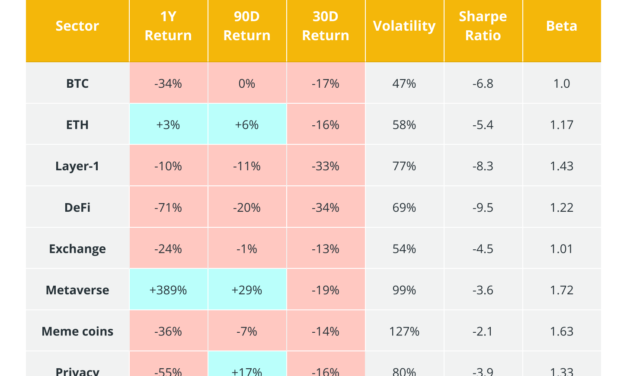
Last week, 55,000 parcels of “virtual land” were sold on the Ethereum blockchain for more than $300 million, the largest nonfungible token (NFT) mint ever. It wasn’t without controversy. In return for shelling out close to $6,000, a purchaser received an Otherdeed NFT, which authenticates that buyer’s ownership of a patch of digital real estate in developer Yuga Labs’ new Otherside game environment. What can you do with a plot of virtual ground? Well, you can develop your own online games on it or build a digital art gallery, among other things. Moreover, you might expect a lot of online traffic driving your way because the Otherside “world” is an extension of Yuga’s popular Bored Ape Yacht Club (BAYC) NFT project. The sale began at 9:00 pm EDT on April 30, and the NFTs were sold out in about three hours. During that time, gas fees on the Ethereum blockchain soared — with eager customers sometimes needing thousands of dollars to complete a single transaction. That’s above and beyond the cost of the land parcel. Hundreds of investors not only failed to secure an Otherdeed token, but they also lost their Ether (ETH) gas fees as well. The Ethereum blockchain even went dark for a time.Some charged Yuga Labs with favoritism in the process, saying, for instance, it had saved all the good “land” for itself or existing owners of Bored Ape Yacht Club NFTs. Others wondered what all this had to say about gaming and NFTs. If it cost $6,000 for a parcel, and as much as $6,000 in gas fees just to play, was it all becoming a playground for the very wealthy alone?The sale also raised questions about Ethereum’s scalability — again — and the susceptibility of blockchain-based projects to manipulation and self dealing.The Metaverse shines brightlyStill, even if the Yuga Labs sale didn’t go entirely smoothly, shouldn’t it still be celebrated as a milestone of sorts in the crypto/blockchain world, especially at a time when the price of Bitcoin (BTC), Ether and other cryptocurrencies have been flat or ebbing? Consider a report published last week by Kraken Intelligence which reinforced the notion that the Metaverse — a community of online “worlds” with many devoted to role-playing games — is one of the brightest stars in the crypto-based galaxy these days. Over the most recent 12-month period, the metaverse sector notched an annual return of +389%, noted Kraken, compared with Bitcoin’s at -34%, Ether’s at +3%, layer-1 networks at -10% and decentralized finance (DeFi) projects at -71%.The Metaverse sector includes assets like Decentraland (MANA), The Sandbox (SAND), Axie Infinity (AXS), as well projects like Yuga Lab’s Apecoin (APE). In online “communities” like Sandbox, an Ethereum-based play-to-earn (P2E) game, players can build a virtual world, including the purchase of digital land whose ownership is guaranteed by an ERC-721 standard nonfungible token. The fungible SAND, an ETH-20 standard token, is used not only to buy land, purchase equipment and customize avatar characters but also enable holders to participate in The Sandbox’s governance decisions.“The Metaverse is still a relatively fresh theme in the crypto industry,” Thomas Perfumo, head of strategy at Kraken, told Cointelegraph to help explain why the Metaverse seemed to be thriving when other sectors were moving sideways. “When Facebook rebranded as Meta in the second half of 2021, we saw a corresponding rise in the price of metaverse-associated fungible assets such as SAND and MANA. Before that, it wasn’t top of mind for most market participants.” It also represents part of an ongoing evolution of the crypto industry. Perfumo said earlier in a press release that “it expands from financial utility into creative expression and community building.”Still, $320 million for 55,000 parcels of “virtual land” seems a bit pricey. Mark Stapp, the Fred E. Taylor chaired professor of real estate at Arizona State University’s W. P. Carey School of Business, was asked if “virtual land” has any special qualities or uses that may be commonly overlooked — and could explain the considerable outlays for Otherdeeds and their ilk. He told Cointelegraph: “I view the ‘virtual land’ as having value for marketing purposes so the platform/world it exists within adjacencies to others. Relative location for capturing visitors and awareness would be desirable attributes.”In other words, it could enhance your own personal or commercial brand or game, if that is what you’re creating, having Snoop Dogg, for example, as a neighbor in your online eco-system. This happened recently when someone reportedly paid $450,000 for a virtual parcel bordering Dogg’s The Sandbox estate. Recent: Mixing reality with the Metaverse: Fashion icon Phillip Plein goes cryptoIt all seems a new application of the traditional real-estate adage: “location, location, location.” As Sandbox notes on its website:“LANDs which are closer to major partners or social hubs will likely get higher traffic from gamers, which can potentially mean more income through monetisation.” Along these lines, some grumbling attended last week’s Otherdeed launch about the quality of “land” that was offered to the public. The really good patches were being kept by insiders like existing BAYC holders, while others were charged. According to Crypto Twitter celebrity CryptoFinally:i wanted to participate in yuga, but one of the more fked up parts of otherdeed: non BAYCs who want to get involved paid for far shttier land, BAYCS got the only land worthwhile. yuga doesn’t seem to show interest in decentralization outside the existing core group. priced out.— CryptoFinally (@CryptoFinally) May 2, 2022Is a bubble forming?What about the notion that the astronomical prices being paid for metaverse real estate is indicative of a developing bubble — one that could burst at any moment?Lex Sokolin, head economist at ConsenSys, told Cointelegraph that he wouldn’t call anything a bubble. Rather, he prefers to talk about instances of “over-valuing future appreciation.” But, in this case, as with crypto generally, a different dynamic may be at play. Sokolin said:“In traditional markets, you would discount future expectations based on some probability of hitting those expectations, and some cost of capital. In crypto, enterprise value is immediately capitalized through tokens and becomes very volatile as sentiment changes.”That doesn’t mean that the entrepreneurial ideas here are wrong or misleading, he added, just that there can be “long-term disconnects between how people project the future and how it is actually built.” Why is Ethereum gas so expensive?Then, there’s the matter of Ethereum’s gas fees, which by one estimation may have reached as high as $14,000 during the Otherdeed sale. Should one worry about the world’s second-largest blockchain network? “There’s no debate that gas fees as high as $6,000 per transaction is indicative of the ongoing scaling challenges Ethereum faces,” Perfumo told Cointelegraph. “But, it’s important to note that ordinary transfer transactions and minting NFTs are not fully comparable activities on the Ethereum blockchain,” he said, adding:“In this specific example, too many people appear to have minted at the same time. As such, smart contract optimization by itself would likely not have changed much.” Sokolin added that Ethereum provides a scarce computational resource and is a natural destination for high-value transactions “since capacity is limited per block.” And, there were also scaling solutions available that could have avoided the transaction crunch, but Yuga Labs chose not to use them. “That said, having NFTs that are on Ethereum gives them higher perceived status and the largest secondary market, which is likely why Yuga Labs went this route.”Presight Capital crypto venture adviser Patrick Hansen went even further, asserting that the launch in a sense showcased Ethereum’s current status. “Ethereum has massive challenges ahead, yet again visible in yesterday’s crazy gas fees spike,” he tweeted on May 2. “But the fact that some people are ready to spend mind-boggling +4k$ for #Ethereum transactions also shows how valuable its blockspace is. No other blockchain comes close in that regard.”Sokolin agreed. “Exactly. If people weren’t willing to pay transaction fees, they wouldn’t pay.” It is one of the peculiarities of crypto economics that the arbitrage activity in such events is so high that even the long-term players “have to pay a very high price to scalpers,” he observed. Leaving a bad tasteStill, the record launch left a sour aftertaste for some. “I think the Otherdeeds sale was botched, leading to user backlash,”Aaron Brown, a crypto investor, told Bloomberg. But, maybe a certain amount of manipulation just seems to come with the virtual turf? “I believe that what many companies are calling ‘ownership’ in the metaverse is not the same as ownership in the physical world, and consumers are at risk of being swindled,” wrote legal scholar João Marinotti recently. Land swindles occur in the physical real estate world, of course, so maybe one shouldn’t over-react here, but there are some differences. “Normally a prudent and informed buyer of real property would conduct due diligence, and the offeror would be subject to regulatory controls including required disclosures,” Stapp told Cointelegraph. In the case of virtual real estate, “I’m unaware of any required disclosures or regulatory oversight,” he said, adding:“Regulation is intended to prevent fraud, misrepresentation and keep the uninformed out of trouble. The current environment for selling these ‘opportunities’ is ripe for fraud or at least disappointment.”A betrayal of crypto’s roots?Finally, what about inclusivity and the crypto world’s cherished democratic ethos. What does it say if it takes $10,000 or more just to participate in a blockchain-based community?“There’s always been a freedom in the idea that anyone could participate with any amount they wanted,” Mark Beylin, co-founder of Myco, told Cointelegraph. Bitcoin is divisible to eight decimal places, after all, so even if you owned just a tiny fraction of a Bitcoin, you still got the same benefits as someone who owned a lot, such as control of your own funds or freedom to transact, for instance, said Beylin, adding:“That isn’t true for NFTs, though, since owning a fraction of an NFT doesn’t usually confer any rights to holders, beyond the speculative upside potential.”There were other sorts of disappointments too. Some would-be investors, for instance, lost all their Ethereum transaction fees and still didn’t come up with any land tokens. These “gas” losses ran into thousands of dollars in some cases. When Yuga Labs announced on May 1 that it was working on refunding gas fees to all Otherdeed minters whose transactions failed, some were skeptical. Recent: Eager to work: Bitcoin switch to proof-of-stake remains unlikelyNevertheless, on May 4, the developer posted this message:“We have refunded gas fees to everyone who made a transaction that failed due to network conditions caused by the mint. The fees have been sent back to the wallets used for the initial transaction.”The developer refunded some 500 transactions worth collectively 90.566 ETH, or about $244,000 at the time of the refund. The largest single refund was for 2.679 ETH, worth about $7,877 on May 4 when refunds were sent, according to Etherscan.Meanwhile, Beylin, who had some bitter things to say about Yuga Labs early last week, struck a more positive and philosophical note by the week’s end. “In the long run, the best projects will figure out a way to open up access for the many instead of just the few,” he told Cointelegraph.

Čítaj viac

Získaj BONUS 8 € v Bitcoinoch

nakup bitcoin z karty

Registrácia Binance

Burza Binance

Aktuálne kurzy