Autor Cointelegraph By Andrew Fenton

ZK-rollups are ‘the endgame’ for scaling blockchains: Polygon Miden founder

ZK-rollups are the hottest thing in Ethereum right now, having seemingly appeared out of nowhere in late 2018 to fundamentally reshape the “Eth2” plan to scale via sharding alone.Zero-knowledge, or validity proof rollups, essentially perform the computations for many thousands of transactions away from Ethereum and then write a tiny cryptographic proof back to the blockchain that verifies those transactions were performed correctly. It’s much faster and cheaper than using the base layer and has the potential for virtually unlimited scaling.

To an outsider, it looked like the technology went from 0 to 100 in a couple of years, but from the perspective of Polygon Miden founder Bobbin Threadbare, it doesn’t seem fast enough.

“Your internal perception is that it’s moving slowly,” he says. “People say, ‘We’re going to be doing this in a year,’ and it takes longer because people overestimate [how quickly it can be done].”

“But if you take a step back out of your own bubble, I do think that the tech is moving at an amazing pace. A lot of the things we’re doing now did not exist 10 years ago — or even maybe like eight years ago — they were just theoretical concepts.”

“So, it’s not often that you see that something goes from pure theory — that is probably not practical or ‘maybe we can do it in the long term future’ — to ‘OK, we’re doing it now, and there are now billions of dollars riding on it.’”

Polygon Miden at StarkWare Sessions

Magazine catches up with Threadbare at the StarkWare Sessions in Israel. Since Polygon Miden is a competing ZK-rollup solution to StarkWare’s tech, this is a little like interviewing the CEO of Pepsi at a Coca-Cola convention. But it turns out zero-knowledge proofs are not as cutthroat as sodas.“On the technical side, there is a lot of collaboration,” Threadbare explains. “If you follow Twitter, you may get an impression that people are at each other’s throats all the time, but you know, it’s Twitter more than anything.”

He points out that all of the projects are building open-source technology (or plan to make it open-source). “We’re not building like Web2 walled gardens here,” he says, adding that various projects “don’t necessarily perceive other rollups as their technical competitors; we learn from each other more.”

Polygon’s crack team of co-founders, including Threadbare back row, second from the right. (Twitter)

Polygon is the 8th-most valuable project

Polygon’s MATIC became the eighth-most valuable cryptocurrency in the world thanks to its current Ethereum scaling solution, but Polygon’s founders knew ZK-rollups could potentially render the network obsolete and spent some of their massive war chest on a ZK tech acquisition and hiring spree.

The Polygon team’s approach is essentially to throw a lot of stuff at the wall and see what sticks. Their zkEVM project has just launched on mainnet in beta, and it enables any Ethereum Virtual Machine-compatible project to scale on its new network.

Other ZK flavors at Polygon include Zero (recursive scaling), Hermez 2.0 (an EVM-compatible solution focused on decentralization and a proof-of-efficiency consensus) and Nightfall (Optimistic Rollups meet zero-knowledge cryptography).

Threadbare, who was working for Facebook at the time, was headhunted to develop his open-source ZK technology into Miden.

“This strategy made sense to me; the space is very early,” he says. “I mean, in all honesty, they didn’t even require that I use STARKs, or SNARKs, or anything.” STARKs (zero-knowledge Scalable Transparent Argument of Knowledge) and SNARKs (Succinct Non-Interactive Argument of Knowledge) are the two different types of ZK proof systems.

“They were very open to whatever technology because nobody had the answer. Hopefully, now we have more of an answer than we did like a year or two years ago.”

What is Polygon Miden?

Polygon Miden is essentially the Polygon version of StarkNet. It enables a bunch of transactions to be processed off the main blockchain, and then “validity proof” demonstrating the transactions are computed correctly, to be written back as a single transaction on Ethereum.

STARKs have some advantages over SNARKs in that less trust is required for the setup, and they’ll be resistant to quantum computer attacks. However, STARKs have much, much larger validity proof sizes, which is more expensive to write back to Ethereum.

In another similarity to StarkNet, which uses the Cairo programming language and virtual machine instead of Solidity and EVM, Miden uses its own virtual machine. For both projects, this is a gamble, as it makes it more difficult for Ethereum projects to port over to the rollup. On the other hand, it means Polygon Miden can scale faster and further by enabling it to escape Ethereum’s constraints.

“Within Polygon, we do think about How do we expand Ethereum?, and there are multiple dimensions,” Threadbare says. “So, scaling is one dimension but also features and other things that are not easy to do on Ethereum, such as privacy and parallel processing, would be another dimension, and this is where Miden comes in.”

Magazine later asks StarkNet co-founder Eli Ben-Sasson for his assessment of his competitor, whom he’s known since the first StarkWare Sessions four years earlier.“I think Miden is amazing,” says Ben-Sasson. “I have a lot of respect for all of those working within the framework of general validity proofs.”

“Having said that, and with all due respect, I do think that, as far as VMs and feature-laden compute frameworks go, I think that Cairo is better. And I’ve said so to Bobbin.” Threadbare isn’t a cryptographer; he’s a hands-on builder and says the instant he learned about ZK-rollups, he knew it would be the answer to blockchain scaling because it removes one of technology’s greatest inefficiencies — requiring everyone on the network to process each transaction.

“Once I learned about ZK tech, it became almost obvious that this is going to be the end game. Because in the blockchain, basically, you have the same computation that everybody has to reexecute. And this is so wasteful. When you see this technology where you only have to execute once and everybody can verify your computation exponentially faster, that’s almost like an obvious thing that needs to be done.”

Threadbare operates under a pseudonym but is not a shadowy anon coder. (Supplied)

Run smart contracts locally with Polygon Miden

With Polygon Miden, anyone will be able to run a smart contract locally and just send the proof to the network, which enables transactions to be run in parallel, rather than sequentially. If Polygon Miden had stuck with the EVM, that would be very difficult, and that limits throughput.

With Ethereum currently processing a dozen or so transactions a second, that’s not a problem, but when TPS ticks over into the thousands, it will be. “You need to be able to process transactions in parallel because, in a single thread, there’s only so much you can do,” he says. “I don’t think you can go much more than a few thousand TPS without parallelizing things.”

“Being able to execute transactions locally means you can run arbitrarily complex computation, and it places almost no burden on the network,” he explains, pointing out that running a 3D physics engine is impossible on Ethereum right now, but will become possible with Polygon Miden. “The design space opens up,” he says. “That enables a bunch of new use cases, but it also helps with privacy if I don’t have to actually reveal the computation.”

Like zkSync Era and StarkNet, the plan is to launch with a centralized prover and then gradually decentralize. Eventually, all of Polygon’s ZK solutions will become interoperable, with MATIC remaining the key token. However, native account abstraction means users could pay with other major tokens, too.

Read also

Features
Blockchain games take on the mainstream: Here’s how they can win

Features
US enforcement agencies are turning up the heat on crypto-related crime

Who is Polgon Miden founder Bobbin Threadbare?

Threadbare (not his real name) was born in the Republic of Georgia in the dying days of the USSR in the 1980s. He moved to the United States when he was 17 to study computer science in San Diego, later attending business school at the University of Chicago. He was a consultant for five years before he launched a Web2 startup that calculated user trustworthiness and reputation scores for things like P2P transactions. He started exploring blockchain in 2018 as a way to avoid having to store a large database of user information.

“Self-sovereign identity is one of the things that was very interesting to me,” he says. 

“And then I got very deep into the technical aspects and then came across zero-knowledge proofs. Once I understood what they can do, the identity use case wasn’t all that interesting anymore. I thought there are much bigger and more interesting things you can do with them.”

He stumbled across a blog about STARKs by Ethereum co-founder Vitalik Buterin, and that set him off down the rabbit hole. “He actually had a code written that demonstrates a very basic proof-of-concept of how it works — and that was, for me, very, very useful.”

Threadbare took the code and rewrote it in another language so he could understand how it worked from the inside out. A born tinkerer, he started improving aspects to make them more general. Before long, he’d built a basic general-purpose prover for STARKs and posted it on Eth Research.

Threadbare’s post on Eth Research back in June 2019. (Eth Research)

“A lot of people were interested in zero-knowledge proofs at that time, but there were not a lot of tools, especially around STARKs. And I just got lucky in the thing that I picked to learn and build on because it fascinated a bunch of people.”

“Even Vitalik himself basically sent me a message on Eth Research, saying, ‘Hey, who are you? What are you doing?’” It was Buterin who introduced him to StarkWare, and they invited him along to the first StarkWare Sessions four years ago. 

Threadbare started creating ZK tools and libraries. He developed the AirScript and AirAssembly domain-specific languages, which in turn led him to develop the Distaff Virtual Machine in early 2020 so people could code without having to learn those new languages.

Read also

Art Week
Coldie And Citadel 6.15: The Creator, The Collector, The Curator

Features
Crypto audits and bug bounties are broken: Here’s how to fix them

Facebook experimented with ZK-rollups

But as the pandemic started, he took up a job as a core ZK researcher for Facebook, working on the Libra cryptocurrency project. Part of the appeal was working alongside and learning from “real” cryptographers, and he helped build the open-source Winterfell STARK prover and verifier.

Facebook didn’t actually need one or plan to use it. “I don’t want to say that it was just for the hell of it,” he says. “The thought was it was going to be used at some point in time. But it was probably fairly clear this is not going to be used in the next two to three or maybe even five years time frame.”

Ultimately, regulators did not approve of the social media giant launching a private currency, and Libra transformed into Diem and then quietly disappeared. Around the same time in 2021, Polygon co-founder Mihailo Bjelic was assembling his crack team of ZK developers and remembered the shadowy anon who’d posted a bunch of useful ZK tech like Distaff on Eth Research. So, he got in touch, totally unaware Threadbare was working at Facebook.

For his part, Threadbare was totally unaware Polygon even existed but started holding regular calls every couple of weeks with Bjelic to talk about their scaling plans and sketch out a possible collaboration.

Polygon zkEVM? Nope, Polygon Miden is something else

They discussed building a ZK EVM, but Threadbare was keen to use his own virtual machine and combine STARKs with the power of recursion. That’s where you take a bunch of validity proofs, each representing a bundle of transactions, and produce one validity proof that proves all other validity proofs were done correctly. Suddenly, the fact the STARK-proof size is 50–100 times bigger than a SNARK-proof size was a lot less important.

“That’s one of the reasons I went the virtual machine route because if you have the VM, it’s much easier to have this infinite recursion because if you think about it, when you have a virtual machine that is Turing-complete, it basically it can execute any program.”

“You just write a program that verifies itself, and you kind of have infinite recursion at this point in time. And that was appealing to me.”

This talk of infinite recursion recalls Declan Fox, product manager for rollups at ConsenSys, who told Magazine last year that ZK-rollups and recursion meant it was “theoretically possible” for the entire world’s financial system to run on Ethereum.

Infinite scaling is unfortunately still limited by data availability on Ethereum — which refers to how much data needs to be, and can be, written back to the chain. The new rollup-focused roadmap will increase the amount of data each block can carry by 160 times. Even that probably won’t be enough.

“There are still limitations like nothing is infinite,” he says. “Assuming the blockchain and the crypto space succeeds… the demand for TPS will be hundreds of thousands or maybe millions of TPS eventually, so I don’t know if the base layer will always be able to provide this much data availability.”

But he’s very hopeful we’ll see a huge amount of adoption within the next 10 years. 

“Hopefully, if we are successful, Ethereum will be the most secure base layer, and there will be a thriving rollup ecosystem that caters to different things, and hopefully, Polygon will be a big part of that ecosystem.”

Subscribe
The most engaging reads in blockchain. Delivered once a
week.

Andrew Fenton
Based in Melbourne, Andrew Fenton is a journalist and editor covering cryptocurrency and blockchain. He has worked as a national entertainment writer for News Corp Australia, on SA Weekend as a film journalist, and at The Melbourne Weekly.

Follow the author @andrewfenton

Čítaj viac

South Korea’s unique and amazing crypto universe

Maybe it’s the language barrier, or the walls authorities have set up to prevent money from leaving the country. But whatever it is, South Korea has built its own unique corner of the cryptoverse that’s unlike anywhere else on the planet.

Doo Wan Nam, a MakerDAO delegate who co-founded the research and advisory firm StableNode, laughs as he describes how crazy the intense speculation and crypto gambling can get in South Korea. He says it’s a country where the price of stablecoins like Dai or USD Coin can sometimes trade sky-high because if the price starts to rise a little above the $1 peg for some reason, speculators will jump in on the momentum trade. 

“They sometimes trade for $20 because they don’t know it’s a stablecoin,” he explains. “They go, ‘You know, it was trading at $10, I bought it because it was pumping… I don’t know, I didn’t read, I just bought.’”

“So, I think that kind of tells you whether people knew what Terra was.”

The spectacular $60-billion implosion of the Terra ecosystem, headed up by the charismatic but ultimately deluded Korean developer Do Kwon, casts a pall over the entire ecosystem.

Evening in downtown Seoul. Source: Pexels

Terra is also instructive about some of the unique characteristics of the crypto culture in Korea, which places less emphasis on decentralization and puts more trust in project leaders like Kwon.

Crypto is huge in this country obsessed with the latest and greatest technology. The capital city Seoul is a futuristic metropolis with massive high-res screens and blistering fast internet everywhere. One in three people in the country owns cryptocurrency, and the government has unveiled an ambitious plan to transform it into the fifth-most metaverse-friendly country in the world.

South Korea technology

While English is taught in schools, few speak the language at a conversational level. This is true of many countries of course but helps explain why many Koreans aren’t plugged into the same information sources as crypto fans in the United States. Forget western social media and tech giants such as Reddit, Google, Twitter and Facebook — Google Maps barely works in the country and good luck getting an Uber.Instead, South Koreans access the internet, chat, search, order food and call for rides using local giants Kakao and Naver.

Sangmin Seo from metaverse blockchain Klatyn. Source: Andrew Fenton

“More than 90% of Koreans are using (social media app) KakaoTalk every day,” explains Sangmin Seo, who prefers to go by Sam. He’s the representative director of the Klatyn Foundation, Kakao’s blockchain and metaverse offshoot. “Naver is the most dominant search engine in South Korea. Google’s share is about 10%–20% and 70%–80% of the market share for search engines is Naver.”

Founded in 2011, Kakao is now the 15th-largest company in a country that’s dominated by around 40 mega-corporations. Samsung, LG, Hyundai and SK together account for half the local stock market’s value, while Samsung produces one-fifth of the country’s exports alone.

Zerocap analyst Nathan Lenga has researched the South Korean ecosystem in detail and explains there’s a whole other crypto world bubbling in the country. He cites blockchain-based video game and Roblox competitor Zepetto.

“People haven’t really heard about it, but it has 20 million users (a month), which is mindblowing,” he says. 

“There’s this whole other side of crypto that we just don’t hear about that’s based on Asian culture. And that’s all originating in South Korea, and that’s why they’re such adopters — because they have their own versions.”

Read also

Features
You can now clone NFTs as ‘Mimics’: Here’s what that means

Features
Airdrops: Building communities or building problems?

2017: South Korean crypto news

Seonik Jeon, CEO of Financial News and founder of Factblock, says that prior to 2017, the only time South Korea made international news was when North Korea was firing missiles.

“However, as the blockchain market began in Korea, around 2017 and 2018, the amount of searching for blockchain and Korea together increased significantly,” he explains.

Seonik Jeon, founder of Korean Blockchain Week and CEO of Factblock. Source: Supplied

Observers were fascinated by the speculative cryptomania that saw South Korea become the world’s third-largest crypto market in 2017. Bitcoin sometimes traded up to 20% higher in the country (also known as the famous “Kimchi premium”) due to capital controls introduced after the 2007–2008 global financial crisis to stop money from leaving the country. 

Many tried and failed to exploit this mouth-watering arbitrage opportunity, including crypto’s current main character Sam Bankman-Fried — but a handful succeeded.

Cryptocurrency and gambling

Korea’s relationship with crypto is tied up in its complicated relationship with gambling, which is mostly outlawed for locals (except lotteries and horse racing). A study from the Korean Center on Gambling Problems suggests the average Korean is two to three times more likely to suffer from gambling addiction than other nationalities, and gambling is seen in a very negative light. 

“Gambling itself is illegal in Korea, so a lot of people with gambling or a speculative [nature] then tend to go into stocks or crypto,” says Nam. “Crypto is very fast, high risk, high reward.”

Seoul at night. Source: Pexels

Nam got into the space during the initial coin offering boom of 2017 after finishing his military service and joining a blockchain company.

“It was quite crazy. In Korea, it was very, very, highly speculative. Like, there were people literally — especially middle-aged or the elderly, who didn’t know much about blockchain — they just had money, and they go to different events and say, ‘I want to invest; how can I invest?’”

South Korean authorities banned ICOs toward the end of 2017, and news reports at the time claiming it was mulling a complete ban on crypto sent Bitcoin’s price plunging in January 2018 from a record high in December 2017.

Crypto bull run

The complete ban never happened, though, and there was a huge surge in adoption in 2021 due to skyrocketing prices that put the ICO boom to shame. According to Korea’s Financial Services Commision (FSC), at the beginning of 2021, just 1.9 million citizens owned cryptocurrency. By the end of the year, that number had grown to 15.25 million citizens.

That means one in three citizens now owns crypto, and the FSC put the country’s digital asset market cap at 55 trillion won (currently $40,719,445,990), making it the seventh-largest country in the world for crypto ownership by market capitalization. Lenga attributes the surge in adoption to the 2021 bull run and the successful presidential campaign of Yoon Suk-yeol, which was strongly pro-crypto and even released a nonfungible token collection for supporters. Yoon took office in May this year.

Jeon, however, believes that tech-loving millennials are behind the surge. 

“I believe the popularity of crypto in Korea is largely due to the younger generation’s curiosity and willingness to try new technologies,” he explains.

“The millennial generation here is often called the mobile native generation due to their familiarity and acceptance of technology. They are enthusiastic and passionate and ready to quickly accept and adapt to changes and development in areas such as blockchain, Web3, NFTs and GameFi.”

Growth slowed the following financial year (to June 2022), adding just 13.2% more transactions.

South Korean crypto exchanges

The surge in adoption in 2021 was accompanied by new licensing laws brought in around September that effectively banned the vast majority of crypto exchanges in the country. Each provider was required to get approval from both the Korea Internet and Security Agency and the FSC, and the 63 exchanges operating in the country were cut down to just a handful, including Upbit, Bithumb, Coinone and Korbit.

“They have almost complete domination over the crypto industry,” says Lenga. “Once the new president starts to introduce more positive regulations and legislation in South Korea, I think that more diverse exchanges will come back. But most of them are just gone forever because they weren’t allowed to survive.”

Read also

Features
Crypto in the Philippines: Necessity is the mother of adoption

Columns
Helping Ukraine without donating: Laura’s DeFi staking plan

Although viewed as overreach by many in the crypto community outside of Korea, inside, there was more acceptance of the need to clean up the industry, which Jeon said was fiercely competitive. 

“In this small market, there was a competition for listing coins between exchanges, and all these scam coins were listed, which sometimes caused damage to investors,” he says. 

“Many insolvent coins that did not have proper business feasibility were sorted out. And it was an opportunity for investors to invest in a safer environment.”

Doo Wan Nam from Stablenode. Source: Supplied

Nam puts the blame more on the banks than the government and points out that while 40 different exchanges were approved on the government’s side, “the ones that passed the bank’s side was only five,” he says. Exchanges needed a banking partner to get fiat in and out, and few banks were willing to do business.

Another much-discussed regulatory issue surrounds crypto taxes, with longstanding plans to charge an additional 20% tax on crypto capital gains. Originally due to be implemented in January this year, it’s been delayed to 2025 and may never happen.

Subscribe
The most engaging reads in blockchain. Delivered once a
week.

Jeon says the government is feverishly studying the industry to understand it properly and regulate it effectively. “Once they have these regulations ready, I think many companies are ready to jump into crypto,” he says.

With the collapse of FTX following so quickly after the fall of Terra, reports emerged this week that the FSC is looking at bringing in new regulations to keep customer deposits separate from exchange assets and to regulate exchange tokens more strictly.

Korean technology: Decentralization

Probably the biggest difference between the crypto community in South Korea and in the West is the lack of emphasis — and ideology — around the importance of decentralization.

Nam explains that while American conceptions of crypto are built around ideas of self-sovereignty and decentralization, “not your keys, not your coins,” those sorts of ideas are not widely embraced in Korea.

“We’ve done a lot of surveys and research, and most Koreans don’t really access crypto from, let’s say, MetaMask. Most of them just put it in the crypto exchanges, and they never withdraw to [a wallet]. In fact, we have some surveys and realize that a lot of them don’t even know [private cold wallets] exist.”

As a result, decentralized autonomous organizations are an alien concept to many, and decentralized finance (DeFi) adoption is not as widespread. This is common to the East Asian region according to recent data from Chainalysis, which shows that just 28% of transaction data is related to DeFi. That’s lower than any other region apart from Eastern Europe and miles behind North America’s 43.3%.

Nam explains that there’s a level of trust and faith in centralized projects with identifiable leaders that western crypto enthusiasts simply doesn’t share.

“They kind of believe in this having single leadership — we kind of saw with Terra as well. Despite the fact that they were very big, we saw that Do Kwon had a lot of power, and he was able to hold sway within this ecosystem, which, for more decentralized protocols, might be criticized but, at least within Korea, felt like it was very natural,” he says.

“It doesn’t really have this strong ideal of libertarianism; it’s seen more as a company or another form of cooperation. And second, there’s still a lot of faith in traditional institutions. Ironically, that was the reason Ripple became really popular in Korea,” Nam adds.

“From their side, they believe it’s better to trust a centralized entity than themselves.”

1/ Many are visiting Korea for @buidl_asia @eth_seoul_ @kbwofficial, and I frequently got this question: “Who are good Korean teams / leaders in the crypto space to meet?”There are many interesting teams, but here are 24 you should definitely meet or at least learn of ?— Doo | StableNode @Seoul (@DooWanNam) August 2, 2022

Sam, however, says that is starting to change — and he believes it must change to embrace the opportunity fully.

“Kakao and Koreans also care about decentralization, and we believe that our world will be more decentralized in the future, but we need time, and we need to educate people about the power of decentralization and how we lose from decentralization and what we get from decentralization,” he stated.

Keep an eye out for part 2 which will explore South Korea’s fascination with gaming, its blockchain game industry and ambitious plans to dominate the metaverse. 

Read also

Features
Forced Creativity: Why Bitcoin Thrives in Former Socialist States

Features
The FBI’s takedown of Virgil Griffith for breaking sanctions, firsthand

Andrew Fenton
Based in Melbourne, Andrew Fenton is a journalist and editor covering cryptocurrency and blockchain. He has worked as a national entertainment writer for News Corp Australia, on SA Weekend as a film journalist, and at The Melbourne Weekly.

Follow the author @andrewfenton

Čítaj viac
Attack of the zkEVMs! Crypto’s 10x moment

Crypto is currently languishing like the internet did in 1996 with slow speeds and few practical use cases, says Steve Newcomb, chief product officer of Matter Labs.

But a major increase in bandwidth and security soon after saw the internet become a crucial part of daily life across the globe — and we’re right on the cusp of that happening for crypto in the next few months.

“Nobody trusted their credit card on it and everybody thought it was a fad and there weren’t any use cases for it,” Newcomb explains. 

“And then we had 10x moments in bandwidth and then SSL came, and HTPS where you got that lock — that was a 10x moment in trust. Suddenly in 2005 ecommerce just went through the roof.”

Crypto’s ‘10x’ moment could finally be here, with zkSync’s Ethereum Virtual Machine compatible mainnet launching on October 28. EVM is essentially the operating system for Ethereum and enabling it to work using zero knowledge rollups means everything running on Ethereum can seamlessly port over to experience a huge jump in speed and lower costs. 

They’re not the only ones attacking the problem: Polygon launched its testnet for its own zkEVM this week with Aave, Uniswap and Lens all committing to deploy on it. Scroll launched its “Pre Alpha testnet” in July while StarkWare’s zk solution has been ploughing through millions of transactions a month. 

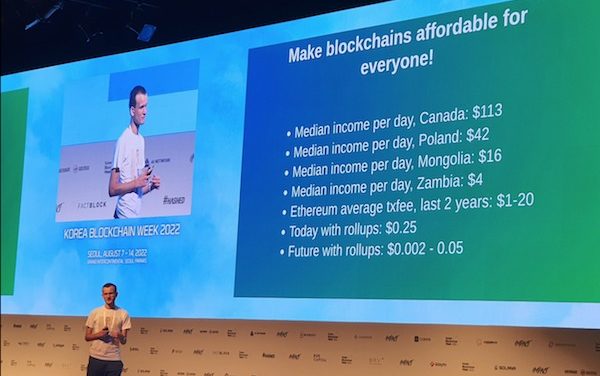
Ethereum co-founder Vitalik Buterin says ZK rollups mean crypto can finally be used for payments again. (Andrew Fenton)

These solutions are all well funded, with Scroll raising $30M, Starkware raising $150M and Polygon raising $450M. Newcomb hints that zkSync’s own funding round is in the same ballpark as Polygon’s, but it’s yet to be officially announced.  

StarkWare is way out ahead of the pack, having launched its own zk rollup solution nine months ago and it turned on recursive scaling in August. But it also made the risky decision to use a custom programming language called Cairo in order to scale more efficiently. This could see adoption by the big protocols move to the path of least resistance on the EVM compatible solutions.

All of the solutions are also working on recursive scaling and/or ‘Layer 3’ implementations which will see Ethereum transactions potentially become thousands of times faster, remove the need for interchain bridges, and allow crypto to finally realize its true potential.

What is a zero knowledge thingamy?

ZK rollups are among the biggest buzzwords in blockchain today. The technology allows for thousands of transactions to be computed away from the achingly slow Ethereum blockchain, with a tiny “validity proof” verifying that all the transactions were carried out correctly. So you can “roll up” 10,000 transactions carried out elsewhere into a single ETH transaction. This is a big deal because even after the Merge Ethereum limps along at 15 transactions per second.

ZK rollups have been used for NFTs and financial transactions for some time now on platforms like Loopring, dyDx and others. But as co-founder Vitalik Buterin pointed out during ETH Seoul in August: 

“In general, I think we’ve learned that people don’t just want like a scalable money thing, they want a scalable EVM.”

It’s one of what Newcomb calls “five magic elements” for ZK rollups. In his view a ZK rollup solution should be general purpose, EVM Compatible and support Ethereum’s programming language Solidity. It should also be open source to fit with crypto’s founding ethos, and it should have a token distribution that decentralizes the protocol rather than concentrates wealth among the team.

By curious coincidence, zkSync has achieved all five of these self imposed metrics. (Newcomb says he can’t detail the exact token distribution, but says around 30% for insiders seems to be the “consensus.”)

The checklist is something of a veiled criticism of competitor StarkWare which is set to give 49.9% of its StarkNet token supply to investors and core contributors. It’s also not open source, although it plans to give control of the IP to its community. 

Co-founder Eli Ben-Sasson explains that the only way to take full advantage of the scaling afforded by ZK rollups is to use a custom language like Cairo.

“I’m very confident people will realise once they turn on proofs that the goal is not to simulate EVM. The goal is to reach scalability. To put 10,000, 100,000, one million transactions and have their proof fitted inside a single block of Ethereum,” he says.

“I’m willing to bet that you won’t see a full blown ZK EVM that can put a million transactions inside a single proof on Ethereum. As we can easily do today and have been doing for months and years.”

Eli Ben-Sasson says its solution is faster and better than kludgy EVMs. (Andrew Fenton)

Scaling versus compatibility

StarkWare’s Odin-Free explained on Twitter there are complicated mathematical reasons behind the need for a custom language because “proof systems like Stark are based on polynomials over finite fields, giving a much more effective polynomial equation.” OK, let’s take his word for it.

For Ben-Sasson, trying to soup up the EVM is just dumb:

“If you wanted to solve transportation, you could take a big truck and put it inside a plane and have the plane deliver it,” he says.“There are planes that can fit a truck inside, but that’s a very inefficient way of doing it. Far better way is just taking things and putting them directly in the plane.”

That said, the ecosystem does have a transpiler called Warp that turns Solidity code into Cairo code and which has just been used to port over a fork of Uniswap to StarkNet.

So essentially with zk rollups there is a choice to be made between total compatibility with the EVM and scaling. Total compatibility enables DApps and protocols to seamlessly port over and everything just works exactly like on Ethereum for devs and users, but in scaling terms, faster is obviously better.

Newcomb admits StarkWare’s solution will produce scale better, but says sacrificing accessibility means it is more suited to bespoke enterprise applications than being a fundamental part of Ethereum due to “adoption friction.”

“They’re not EVM compatible, so it’s really hard to port to them. We’ve seen projects that take seven months to port to them.”

Compatible but less elegant

There’s no agreed upon definition, but ‘EVM equivalent’ usually means “exactly the same as EVM” so you can just deploy the existing smart contract on the solution without any changes.

Scroll is widely agreed to be equivalent, but it’s also not on a proper testnet yet and is many months behind the others with a comparatively small budget. Polygon’s zkEVM solution claims to be equivalent (however this is contested.) zkSync meanwhile, will be EVM compatible – which means it’s almost identical but a few things may not work due to some design choices to make the solution work better.

Steve Newcomb is passionate about why he believes zkSync has all five ingredients required for success. (Interview screenshot)

Polygon launched its zkEVM Public Testnet on Monday claiming “Polygon is the first project ever to deliver a full-featured, open source implementation of zkEVM; a groundbreaking milestone, not just for Polygon, but for the whole industry.” Polygon says the testnet “includes a completely open-sourced zk-Prover — the first of its kind to be released publicly.”

Co-founder Mihailo Bjelic tells Magazine early tests show that “Polygon’s zkEVM can reduce Ethereum’s network fees by approximately 90% and increase the network’s throughput by several orders of magnitude.”

He says that open sourcing the technology “proves our alignment with the ethos of the industry and increases security of the solution since anyone can review it and point out potential bugs. This is not the case with StarkNet or zkSync, which keep critical parts of their implementations closed source, at least for now.”

Technical bit

According to Scroll’s Luozhu Zhang there are three potential types of zkEVMs: bytecode level, language level and consensus level. zkSync and StarkWare are at the language level and require a compiler or transpiler step, while Scroll and Polygon are bytecode level approaches. The human readable form of bytecode is called an opcode.

Bjelic says that Polygon’s solution is designed to be EVM equivalent whereas:

“Projects like StarkNet and zkSync are taking a different route — they have their own custom virtual machines, and then they try to transpile Solidity, the most popular language built on top of EVM to the languages these virtual machines can interpret,” he says.

“There are two major challenges with this approach: (i) it is hard to build a transpiler that will support 100% of Solidity smart contracts and (ii) even if you have the transpiler you still can not leverage all the developer and end user tools like Polygon zkEVM can.”

Newcomb says there is bad information circulating. “We do not transpile, we compile,” he says. And he takes a shot back at Polygon saying that from looking at the project’s Github that they are yet to develop a working general purpose prover integrated with a working sequencer.  

“If this is the case then it means they have an undefinable amount of work to be done. The last 10% of any complex system is always the most difficult. This looks similar to where we were or even behind where we were when we launched testnet. And then after that it took us nine months.”

Polygon’s Mihailo Bjelic says its solution is 100% EVM equivalent. (Twitter)

Mostly compatible

zkSync meanwhile is compatible with all but three of Ethereum’s 141 Opcodes — one of which has been deprecated, another is being deprecated and the third one is used by  less than 1/10th of 1% of projects according to Newcomb.

“So what did we get for not being fully equivalent? We got two things, our cost for performance is way better than any solution going after equivalence. We’re way faster, way cheaper. And the second thing we got is we were able to stick an LLVM compiler inside of our chain which you can’t do if you’re doing equivalent. And what an LLVM compiler does is we’re already looking at layer three.”

The LLVM would let a Python, Rust or C++ developer code on their solution, which then compiles down to work the same way with Solidity. 

“That is huge for adoption. So where this project that took seven months over here in Cairo that same ecosystem project ported to us in seven days. That’s compatibility.”

He concedes it would take just one day to port over if zkSync had total equivalence but would miss the LLVM and the increased scaling. So he says it’s a trade off worth making.

Layer 3 and recursive scaling

The coolest thing about being able to compress a large number of transactions into a single validity proof, is that the technology allows you to compress numerous other proofs into a single proof as well. 

It’s called recursive scaling and Declan Fox, product manager for rollups at Consensys, believes it’s so powerful that in theory the entire global financial system could run on Ethereum. “We have the technology to achieve that kind of throughput necessary,” he says. “With recursive rollups and proofs, we theoretically can infinitely scale.”

Also read: Ethereum is eating the world: — ‘You only need one internet’ 

StarkWare turned on recursive scaling back in August and has processed more than 30 million transactions since using the tech.

“Recursion has already, at this early stage, increased the number of transactions in a single proof by approximately 8x,” explains Ben-Sasson. “What is more, it’s proving so efficient, soon after it went into production there’s a reduction of around 40% to our own cloud cost for proof generation.

“These aren’t predictions or numbers we hope to see, but rather numbers from what’s in production today. And I stress: this is just the start, and changes we’ll make will mean these numbers will get more and more impressive.

The Starkware ecosystem is growing. (ZK Daily Twitter)

Polygon is about to implement its Plonky2 solution according to Bjelic. It’s an open source zk-SNARK solution. “This recursive SNARK can be used to verify transactions orders of magnitudes faster than existing alternatives. Plonky2 is also natively compatible with the Ethereum Virtual Machine, which allowed Polygon to develop the zkEVM.”

And the testnet for ZK Sync’s Layer 3 will be released soon, in time to take advantage of an Ethereum upgrade called Proto-Danksharding early next year designed specifically to give rollups the space on Ethereum to blossom. Newcomb expects Layer 3 to be in production within a year. They’re calling it Pathfinder, an ecosystem of ‘fractal hyperchains.’

‘We could probably go on for hours engineering wise, but functionally the further up the recursive chain you get away from Etherium the cheaper the data costs get and it’s a 10x, 10x, 10x, 10x, as you recurse off up with data costs, and that’s unique to zk.”

“That’s where we get to 100,000 TPS and a million TPS,” he says. Visa chugs along at around 4000 TPS on a normal day, spiking up to around 65,000 TPS at peak times like Chrismats.

“ZK is the only way to get to like 100,000 TPS so that you can get to the levels where something like Visa replaces its underlying protocol with a blockchain. And when you do that, that’s your mass adoption moment.”

Another astonishing development according to Newcomb is that Layer 3 can get rid of the requirement for interchain bridges, which is where all more than $2 billion of hacks have occurred this year alone.

“One of the other things that we’ve already achieved up in Layer 3, we get rid of all bridges. And when you can have one prover doing the circuit for all of the hyperchains up in L3, any communication from one blockchain to another now is native. That’s the other reason why Vitalik said this is the end game because there are no more bridges.”

‘If you make it faster, cheaper by orders of magnitude, if you make it easier to use and more welcoming to a broader audience of developers by having more languages available, and then you make people trust it because you get rid of bridges. That’s what I always say is a star cluster of 10x moments up in L3 and that’s where the game is going to be had.”

The demo launch was successful, and now our goal is to get our project on the path of regular updates. @zksync is scheduled to launch on October 28th, and you’ll soon see the release of @zkSync compatible version of Homespace Metaverse.?Get ready, it’s going to be hot! pic.twitter.com/O6sRm3tryz— Homespace.is (@HomespaceNFT) September 29, 2022

Not fixed yet 

So that’s it? With the arrival of ZK rollups and EVM compatible scaling solutions everything has been solved?

Unfortunately not. ZK rollups are currently very good at taking computation off of Ethereum, but they still need to write enough data back to the main chain so that if the rollup stopped working or it taken over by bad guys, then some other outfit could step into the breach and work out who owes what to who.

It’s called the data availability problem and a considerable amount of Ethereum’s roadmap with proto danksharding and full danksharding aims to solve it and allow for more data to be included. There are a couple of ways around this at present including storing data on Validiums, which are cheaper but less secure. 

Subscribe
The most engaging reads in blockchain. Delivered once a
week.

“So the way we describe it is if you have a baseball card collection, and many of these cards don’t cost a lot and you’ve saved them in Valdium but then one rare card that is worth a lot of money you will probably save on Layer 1,” says Ben-Sasson.

Polygon is working on a number of solutions to this same problem including Avail “a blockchain where information is available to everyone at any time, was designed specifically for this purpose,” Bjelic says. zkSync’s Pathfinder will enable devs to choose from three options for data availability, a Validium, zkPorter (mixing on chain and off chain) and ZKRollup (full security).

zkSync is already on the road. (Pexels)

Don’t expect a big bang from zkSync’s mainnet launch on October 28. It will be kind of underwhelming at first, with a couple of months of just Matter Labs testing and offering users bounties to try to hack it or exploit it. Then DApps will be allowed to port over, and start building and testing security.

“And then when we feel like we got everything done, we do what’s called lift in the gate. And then all the users can come into the system simultaneously and it’s called a fair release program. So we don’t favor any project over another.” He says that 150 projects will launch at that point and there will no longer be any reason a project would wait around for Polygon’s solution to be finished..

“It’s like they’re going to a racetrack and they’re showing up with the chassis of a car that doesn’t have any wheels, no steering wheel and absolutely no engine,” he says.

“And we have the whole product done. You know we have the Ferrari and we’re ready to go.”

Andrew Fenton
Based in Melbourne, Andrew Fenton is a journalist and editor covering cryptocurrency and blockchain. He has worked as a national entertainment writer for News Corp Australia, on SA Weekend as a film journalist, and at The Melbourne Weekly.

Follow the author @andrewfenton

Čítaj viac
Saving the planet could be blockchain’s killer app

The sustainability movement has emerged as a 21st century megatrend, and it shows no signs of abating. Record heat in Europe, wildfires in the U.S. West, floods in Pakistan, drought in China, and accelerating ice cap melt in Greenland and Antarctica have driven home to many the looming threat of climate change.  Meanwhile, the New York Times declared in December “the sustainable industrial revolution is just getting started,” and even heavy industries like shipping, steel, and plastics are beginning to grasp the importance of an ecologically sustainable future — developing products like “green steel,” which is a fossil-free steelmaking process. But hurdles remain, including questions about transparency, accountability, traceability, trust, data integrity, and even greenwashing (making false or insincere environmental claims.) Or as the Times asked: “Can some of history’s highest-polluting industries be trusted?” in spite of their professed good intentions.This is where blockchain technology could make a difference. Like the sustainability movement itself, blockchain tech is global, 21st century, and mostly unformed though likely to be shaped soon by new laws and rules. Blockchains can simplify and lower costs of ESG (environmental, social and governance) reporting, build trust in “collected” data, develop new eco-related trading markets, and suggest new sources of innovation.Blockchain can prove that green energy is really green. (Source: Pexels)In March, for instance, automaker Volkswagen announced that it was using blockchain technology to help ensure that electric vehicle (EV) charging stations were using sustainable sources to recharge their electric cars. This move is aimed at consumers who want validation that the energy being used to recharge their vehicles isn’t coming from brown coal-powered electric companies or the like. BMW is said to be developing something similar.Elsewhere, energy giant Shell announced in June the launch of Avelia, a sustainable aviation fuel (SAF) solution for business travel.  The project uses a public blockchain to promote and validate SAF, which can reduce lifecycle emissions by up to 80% compared to conventional jet fuel.Many now foresee a blossoming partnership between environmentalists and blockchain developers, especially as Ethereum with its big Merge, as well as other networks, move closer to carbon zero and even carbon negative platforms.“I continue to believe that putting Paris Agreement carbon markets on Ethereum and connecting the national carbon accounts of the world, is blockchain’s killer app,” Joseph Pallant, climate innovation director at Ecotrust Canada and founder and executive director of the Blockchain for Climate Foundation, tells Magazine.But if this promise of a blockchain/ESG alliance is to reach fruition, some questions need to be resolved, including:Are public permissionless blockchains sufficiently scalable to handle the sheer amount of data to be tracked for sustainability use cases? Looking off-chain, do blockchain-based sustainability-related projects face an oracle problem? Who is going to attest, for example, that carbon offset credits entered on the blockchain are legitimate — and that they are really doing something beneficial for the environment?Finally, blockchain technology might be a useful tool in the quest to develop a global sustainable future, but is it a necessary one? Does the sustainability movement really need public blockchains to succeed?We are pleased announce the launch of the “Pilot Project on Peer to Peer (#P2P) Trading of Rooftop #Solar Power on #Blockchain” in Lucknow, Uttar Pradesh ~The first of its kind project in #SouthAsia and #IndiaTags: @rejipillai @UPPCLLKO @PowerLedger_io pic.twitter.com/iydmQz9cm1— India Smart Grid Forum (@IndiaSmartGridF) December 17, 2020Tokenizing for more efficient marketsMany think that blockchain tech can make ESG-related markets more efficient, including the rapidly growing Voluntary Carbon Market, or VCM, where parties voluntarily buy and sell carbon credits that represent certified carbon removals or reductions of greenhouse gasses (GHGs). Corporations can purchase carbon credits to meet their carbon neutrality commitments. “A significant proportion of carbon credits issued this year have been minted on-chain,” Charlie Moore, head of Carbon and ESG Solutions at Chainlink Labs, tells Magazine, adding:“The carbon credit market has historically been manual, slow, opaque, and inefficient. By moving carbon credit markets on-chain, the market inherently becomes automated, fast, transparent, and highly efficient.”Globally, carbon dioxide (CO2) permits grew to $851 billion in 2021, a gain of 164% compared with the previous year, according to Refinitiv, with most trading taking place within the European Union.  But multiple challenges remain in scaling Web3 carbon markets, adds Moore, including the lack of market standards. “In addition, there are hundreds of layer-1 blockchains with little interoperability between them.”The blockchain trilemma looms, too. In building networks, it’s commonly believed that developers must choose among three key benefits — decentralization, scalability and security. They can have two but not three. So a project can have decentralization and security, but not scalability. Or scalability and security, but not decentralization, etc. John Bulich, Technical Director and co-founder of Powerledger, along with Dr Jemma Green, Executive Chairman and co-founder.Powerledger, for example, is an Australian company that uses blockchain technology to enable neighbors in India’s Uttar Pradesh state to trade solar energy on a P2P basis. Its secure network is able to process an impressive 50,000-plus transactions per second, the project’s founder and CEO Jemma Green tells Magazine. But Powerledger uses a permissioned network — not a public, decentralized one.By comparison, Nori, an innovative carbon removal marketplace, has expanded using secure, decentralized platforms like Ethereum and more recently Polygon through creating and selling NRT tokens, each one representing one tonne of removed CO2 stored. The idea is that farmers are paid for adopting regenerative agricultural techniques — while other stakeholders, including consumers, can purchase tokens to reduce their carbon footprint. Scaling up is still a challenge, however. “We can scale up the amount of supply/inventory that we have by further partnering with agriculture companies who can source large numbers of farmers for us,” Nori CEO Paul Gambill says, though “we’re sold out at the moment [in mid August] because the demand for carbon removal has outpaced the new supply enrollment.” Projects like these may take time to reach a global scale.Beyond carbon removalCarbon removal isn’t the only sustainability use case, of course. Indeed, a system like Nori’s which uses two assets—an NRT as a reference token, and NORI as medium of exchange token — could arguably be used in other ecological contexts, like ocean plastic recycling in the developing world. Can blockchain help alleviate the effects of drought? (Source: Pexels)“Yes, I would love to see this two-asset model adopted in other social impact areas,” Gambill says. “Another intractable problem is wildfires that grow to such huge sizes because of low brush and debris on the ground that acts as kindling. It should be possible to incentivize removal of that in a similar manner. Ocean plastic is also applicable.”Blockchain technology can also help to alleviate a water shortage in parts of the U.S., where water is being diverted away from lakes, reservoirs, and rivers at unsustainable rates, says January Walker, a U.S. Congressional candidate in Utah. “Often there is no accountability as to where it goes,” she tells Magazine:“Blockchain distributed ledger technology can be combined with IoT water parameter monitoring to track where the water is going, who is using the most, and provide a means of collaboration across state lines to drastically reduce water usage.”“The sustainability movement needs to harness the power of frontier technologies like blockchain to help reach its goals in a faster and more efficient way,” Amna Usman Chaudhry, a founding member of the Oxford Blockchain Foundation tells Magazine. Blockchain offers various advantages such as increased transparency, security, immutability, and decentralization which can be utilized to find new innovative solutions to age old problems, including plastic pollution, particularly in oceans. “Similarly Blockchain offers immense potential for sustainability for smart cities, such as is the case with Dubai, which through its implementation of the Dubai Blockchain Strategy aims to save USD $3 billion in operational costs, 398 million printed documents per annum and 77 million work hours annually,” Chaudhry adds.The Dubai Blockchain Strategy aims to save $3 billion in operational costs. (Source: Pexels)Volkswagen’s EV pilot: Pick your energy sourceThen there’s Volkswagen’s smart-charging electric vehicle (EV) pilot project which enables car owners to specify their favored source of energy. Drivers pulling into charging stations can “select to charge using wind and solar resources, from energy assets within a 10 km radius […] with an accurate breakdown of their session’s carbon footprint,” says project partner Jesse Morris, CEO at Energy Web, a firm that claims to have built first enterprise-grade, public blockchain tailored to the energy sector.  An algorithm determines the optimal charging schedule to maximize usage of clean, locally sourced electricity, while a smart-contract deployed on Energy Web’s network issues to the EV owner after charging an ERC1888 NFT, a fractionalized renewable energy certificate that proves the provenance and volume of clean electricity generated and consumed. VW’s innovation group is now working out how to roll this out at production scale.A ‘huge catalyst’ for renewal energySolutions like these can help solve the sustainability movement’s greenwashing problem. “Some are skeptical that EVs are really carbon neutral given that they require recharging from electric sources that as far as they know could be generated by brown coal,” Anthony Day, global head of ecosystem stewardship at Parity Technologies, commented in a recent LinkedIn post. This is consistent with Web3 project designs that, generally speaking, seek to make owners out of users and users out of owners. The EV is generating information all the time for the grid — temperature, traffic conditions, and so on, Day tells Magazine. “Your vehicle becomes an oracle. It could be identifying potholes on the road.”  Solutions like VW’s will also be of interest to businesses that own fleets of cars and need to document the carbon footprint of their vehicles, especially in Europe. “If you can show that your vehicles are topped up on fully renewable energy, that’s a major contribution” toward reducing a business’s carbon footprint, Day adds. A boost from U.S. legislation?The U.S. Inflation Reduction Act (IRA), signed into law in August, has earmarked $370 billion for the fight against climate change. Could the legislation indirectly spur blockchain adoption? “Blockchain technology will provide an immense boost to the impact of climate-related investments embedded in the Inflation Reduction Act,” Pallant tells Magazine. On-chain carbon pricing tools can help ensure that the most capital efficient climate solutions are selected in future projects, as well as providing the “needed transparency for verifying the ultimate impacts of this third of a trillion dollar spend.” Not all agree, however, that the U.S. legislation will do much for blockchain adoption. “Having read through the IRA, I believe that it is unlikely to boost the utilization of blockchain as it does not make specific suggestions to lean into the technology,” says Walker.To make a difference, blockchain would need a “champion” on every project being funded. “The only portion of the bill that I think would even help is the $4 billion for a water project. That however will go mostly to research and replacing a few 90-year-old pipes across the nation instead of innovating water technology and tracking,” adds Walker. There’s only one planet so there are no alternatives. (Source: Pexels)Is it really helping the planet?It needs to be remembered, too, that blockchain technology has inherent limitations, and by itself “blockchain won’t save the world,” according to Day, who has a podcast by that title. Before ESG-related projects can be tokenized, someone or group needs to verify that the projects exist, they are useful for the environment and that they wouldn’t have happened without tokenized funds — they must have ‘additionality,’ in other words. The human factor can’t be finessed. “The sad fact of life is that the more manual you make that verification, the less scalable the system is,” says Day.Verification in carbon markets is typically done by third parties based on standards developed by offset registries like Verra and Gold Standard. Recent efforts to meld blockchain with the registry process hasn’t gone smoothly. Earlier this year, for instance, crypto firms Toucan Protocol and KlimaDAO were criticized for promoting “cheap, low-quality carbon credits that don’t actually help the environment,” according to Bloomberg.Indeed, a recent analysis by non-profit research organization CarbonPlan found that over 99.9% of Toucan’s BCT reference token came from CORSIA-ineligible credits, “i.e., the low-quality end of the carbon market,” Danny Cullenward, policy director at CarbonPlan, tells Magazine, including “zombie projects” like Dayingjiang-3, a Chinese hydropower dam project that has been operating since 2006. Credits from existing dams don’t do much to help the environment, many people argue. “Even if the registries are the most culpable actors,” Cullenward continues, “Toucan, Klima, and other tokenization efforts point to registry standards as proof of quality. Anyone who is professionally engaged in these areas either knows or should know about the underlying quality control problems that remain, so I don’t have any patience for what effectively amounts to passing the buck.”In response to the Bloomberg story that raised similar concerns, KlimaDAO published in April a letter-to-the-editor response, which acknowledged the problem on the “supply side” regarding the “quality and integrity” of carbon credits in the Voluntary Carbon Market (VCM), but it also noted that “the article fails to consider the widely accepted need to scale up the VCM to meet the emissions reduction targets prescribed by the Paris Climate Accord.”To avoid the worst effects of climate change, according to the Taskforce on Scaling Voluntary Carbon Markets, “the volume of the VCM will need to grow by up to 15 times by 2030,” wrote Natacha Rousseau.Other veterans of carbon markets like Pallant stand by Toucan and KlimaDAO, even after their BCT and KLIMA tokens plunged in price this year — KlimaDAO’s by 99% — and Verra announced that it was prohibiting the practice of creating tokens based on retired carbon credits. “Klima’s price collapse mirrored […] the crash in crypto prices” generally, Pallant tells Magazine. “I think the actual story is how crazy it was that KlimaDAO’s price got so high, rather than that it has gone low. I don’t think anyone at KLIMA expected the price to go to $3,000 plus.” Shortly after its October 2021 launch, Klima soared over $3,600. It was trading at $3.84 in early September, according to CoinGecko.Klima DAO soared and then crashed. (Source: Pexels)Toucan, for its part, acknowledges that “many of the criticisms around the tokenization of dormant credits were valid,” John Hoopes IV, strategy and ecosystem at Toucan Protocol, tells Magazine, while Toucan is developing technologies to improve the quality and integrity of the VCM, including “a system to store the digital monitoring, reporting and verification [dMRV] data that will underpin many credit types.” As for the problem of dormant credits:“We also introduced a rule to prevent carbon credits issued more than 10 years after emission reductions have taken place from using our technology and be converted into a carbon-backed token.” Day isn’t giving up on tokenizing carbon credits, either. “I think it has a significant potential to be one of the largest blockchain use cases. “Global climate initiatives often struggle because of local regulation. What is accepted in Argentina may be different from what is accepted in France,” says Day. With a standardized token anybody can participate in that system —  purchase, trade, invest. “You can get liquidity into that system. That’s very powerful if those token standards are recognized.”As with many new technologies, a certain amount of patience may be required.  “Both crypto and carbon are pretty complex and difficult — and when you put them together, it’s like difficulty squared,” Ollie Gough, strategy lead for the carbon-rating startup Sylvera, tells Time. “Mistakes have been made—and we’re waiting to see how it pans out.” Is blockchain tech a ‘must have’?Is blockchain technology really essential for the sustainability movement, though? “We see blockchain as something akin to using barcodes in supermarkets,” Powerledger’s Green says. “Barcodes and scanners are now integral to a supermarket. […] they facilitate supermarkets operating at high volumes and low margins.”“Could supermarkets have taken off without barcode technology?” continues Green. “The answer is ‘probably,’ but at a much slower pace, because the high volume, low margin [success] is hard to achieve with just a manual input of prices into a till.” The best of blockchain, every TuesdaySubscribe for thoughtful explorations and leisurely reads from Magazine. By subscribing you agree to our Terms of Service and Privacy PolicyNew areas may emerge. “ESG investing is yet to embrace smart contracts at any real scale,” says Chainlink’s Moore. “There is enormous potential for smart contracts and blockchains to transform areas such as green bonds through tamper-proof automation.” With the European Council and European Parliament’s recently agreed-upon rules for corporate sustainability reporting, nearly 50,000 EU companies in coming years will have to report ESG data, up from a mere 11,600 firms at present, according to EY.  Blockchain technology could potentially make those filings more accessible, transparent, and credible for citizens, consumers and investors, many believe.  “I’m generally very bullish on future blockchain use cases, especially in the sustainability space,” Nori’s Gambill tells Magazine, while Pallant adds that “We’ve seen an absolute flood of new minds, talent and capital flow into the ReFi [regenerative finance] space over the last year. Well thought out, successful projects in that space will deliver profound value to climate, nature, forests, and seas by leveraging blockchain to deliver credible environmental assets.”

Čítaj viac

Získaj BONUS 8 € v Bitcoinoch

nakup bitcoin z karty

Registrácia Binance

Burza Binance

Aktuálne kurzy