Autor Cointelegraph By Ana Paula Pereira

Hardware wallets to take similar approach to potential Ethereum hard fork

Ethereum’s blockchain Merge is expected to take place around 05:05 UTC on Sept. 15. It is a milestone that marks a full transition towards Proof-of-Stake (PoS) for Ethereum, and eliminates the need for energy-intensive mining by a projected 99.9% when compared to Proof of Work (PoW).Some miners are also getting ready for a hard fork that would allow them to continue using PoW consensus. Forked coins have proven to be lucrative in the past. The holders of Ethereum (ETH), for example, came to possess an equivalent amount of Ethereum Classic (ETC) when it forked in 2016.In the event of a new hard fork, in which the Ethereum blockchain would split into two different networks, users holding ETH on-chain would have equal balance of ETHW on the forked chain. This would be an additional token; a totally different asset from ETH.For ETH holders using hard wallets, the question is more straightforward: what would happen to your tokens if a fork followed the merge? We have wrapped up some answers to this question, so you don’t get lost or trapped in a scam in the coming hours. In fact, most of the hard wallets providers are taking the same approach: monitor adoption in the new chain as well as the forked chain before adding any support for ETHPoW. Also, they alert that there is no need for users to take any action during the upgrade.Charles Guillemet, CTO of security hard wallet Ledger, explained to Cointelegraph that, “in the event of a fork, the first thing everyone should know is that any assets the user currently has on the main network are safe,” adding that the company “will not support an ETH Proof of Work fork on day 1, as there are a number of technical aspects that need to be evaluated to ensure it’s safe for users, chief among those is ensuring the new chain is secure.”Similarly, Josef Tětek, bitcoin analyst at Trezor, said that “Trezor Suite will not support interaction with the pre-merge proof of work coins after the merge, but users can still use their Trezor with a third-party interface like MetaMask to access the older version of the blockchain.”Tangem, a Swiss wallet provider, also has no plans to support the PoW fork. “Until we are certain of the seriousness of the proponents of this hard fork, we are not ready to show our customers support for the project”, stated the CTO, Andrey Lazutkin.ETH holders who use non-custodial wallets and control their own private keys will have fast access to both sets of coins (ETHW and ETH). Private key owners can collect the forked coins using Metamask to connect the PoW network to an Ethereum Virtual Machine (EVM) wallet. Crypto wallet companies also warn users to take extra precautions during and after the network upgrade. “Scammers are especially active during major network upgrades. Do not engage with anyone who claims you need to take urgent steps to protect your coins”, warned Tetek.

Čítaj viac

SWIFT and Symbiont announce corporate data blockchain pilot

The Society for Worldwide Interbank Financial Telecommunication (SWIFT) disclosed on Tuesday a partnership with fintech company Symbiont to provide more accurate data for financial firms through blockchain technology. Vanguard, Citigroup, American Century Investments, and Northern Trust are among the companies participating in the initiative.According to the announcement, the pilot project “could help providers distribute data in near real time to global custody clients.” Through Assembly, Symbiont’s proprietary technology platform, smart contracts will be used “to create a network effect that leverages the 11,000+ institutions connected to SWIFT globally.”In 2017, Symbiont partnered up with Vanguard to improve price index data distribution through blockchain, consuming data from funds worth $1.3 trillion at the time.“By bringing Symbiont’s Assembly and smart contracts together with SWIFT’s extensive network, we’re able to automatically harmonize data from multiple sources of a corporate action event,” said Tom Zschach, chief Innovation Officer at SWIFT, adding that Assembly’s smart contract would allow to “compare information shared between participants and flag discrepancies, contradictions or inconsistencies across custodians.”Due to the rise of Central Bank Digital Currencies (CBDC), the company has been making efforts to maintain its relevance in the international economic order. In 2017, the interbank cooperative launched its global payments’ innovation, gpi, seeking to enhance payments tracking and fee transparency, allowing customers to send cross-border payments 24 hours per day.In February, the European Commission decided to deactivate the SWIFT network for several Russian banks due to the war in Ukraine. Recently in a panel session at the Blockchain Central Davos conference, Michael Miebach, Mastercard’s CEO, said that he does not expect SWIFT is unlikely in five years. Founded in 1973, SWIFT handles over five billion financial messages a year and has a presence in 200 countries.

Čítaj viac

New regulatory bill grants Uruguayan Central Bank control over the nation's crypto industry

The Uruguayan government has introduced legislation to the parliament that accelerates the regulation of the crypto space in the country and establishes the central bank as the regulatory authority.Introduced on Sept 5, the bill strives to clarify the country’s regulatory framework for cryptocurrency assets, stating that all companies that provide digital asset-related services, including initial coin offerings (ICOs) are under the supervision of the Superintendency of Financial Services (SSF), a central bank entity. Cryptocurrency exchanges, custody services and any financial services relating to these digital assets should also adhere to Anti-Money Laundering regulations and best practices.Additionally, the document defined four types of digital assets: stablecoins, governance tokens, tradable assets and debt tokens, saying:”If the activity carried out with these instruments involves the exercise of financial intermediation or financial activity, it will be subject to the regulation and control of the Central Bank of Uruguay.”Last year, Uruguayan Senator Juan Sartori introduced a draft bill to regulate cryptocurrency and enable businesses to accept digital payments, seeking to “establish a legitimate, legal and safe use in businesses related to the production and commercialization of virtual currencies.”This development is part of an ongoing wave of legislation or regulations being pursued by governments or legislators in Latin America. Brazil’s Securities and Exchange Commission is reportedly pursuing to change its legal framework to recognize tokens as digital assets or securities. In August, Paraguay’s president vetoed a bill that sought to recognize cryptocurrency mining as an industrial activity, arguing that mining’s high electricity consumption could hinder the expansion of a sustainable national industry.

Čítaj viac

Tokenization of illiquid assets to reach $16T by 2030 — Report

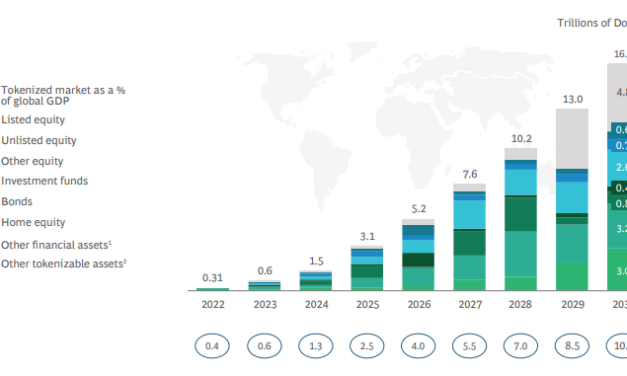
The total size of tokenized illiquid assets, including real estate and natural resources could reach $16.1 trillion by 2030, according to the Boston Consulting Group (BCG).In a newly released report from BCG and digital exchange for private markets ADDX, authors including BCG managing director Sumit Kumar and ADDX co-founder Darius Liu noted that “a large chunk of the world’s wealth today is locked in illiquid assets.”According to the report, illiquid assets include pre-IPO stocks, real estate, private debt, revenues from small and medium businesses, physical art, exotic beverages, private funds, wholesale bonds, and many more. Reasons for this asset illiquidity are attributed to factors such as limited affordability for mass investors, lack of wealth manager expertise, limited access — such as when assets are restricted to elite cliques (in the case of fine art and vintage cars), regulatory hurdles, and other scenarios in which users have difficulty acquiring or trading an asset. On-chain asset tokenization could solve this problem, a market that surpassed $2.3 billion in 2021 and is expected to reach $5.6 billion by 2026, as per the report. The authors added that in just the last two years, global digital asset daily trading volume has soared from 30 billion euros in 2020 to 150 billion euros in 2022, noting that it “is still minuscule in comparison to the total potential of illiquid tokenizable assets in the world.”By 2030, the authors forecast the on-chain asset tokenization opportunity to reach $16.1 trillion — made up largely of financial assets (such as insurance policies, pensions, and alternative investments), home equity, and other tokenizable assets, such as infrastructure projects, car fleets, and patents. Tokenization of global illiquid assets by 2030. Source: Boston Consulting GroupThe authors also noted that this was a “highly-conservative forecast” and that in a best-case scenario, the tokenization of global illiquid assets could reach $68 trillion. However, the potential of tokenized assets will differ across countries due to various regulatory frameworks and asset class sizes. In Singapore, the Monetary Authority recently launched the Project Guardian, a blockchain-based asset tokenization pilot that will explore decentralized finance (DeFi) applications in wholesale funding markets by establishing a liquidity pool of tokenized bonds and deposits to execute borrowing and lending processes on-chain.In addition to Singapore, tokens issuance is regulated in Hong Kong, Japan, the European Union, the United Kingdom, the United States, the United Arab Emirates, Germany, Austria, and Switzerland.Other authors in the report include BCG’s project leader Rajaram Suresh, associate director Bernhard Kronfellner, and consultant for BCG Aaditya Kaul, noting:“On-chain asset tokenization presents an opportunity to obviate many of these barriers of asset illiquidity as well as the current modality of traditional fractionalization.”Real estate may be among the illiquid assets that could benefit from tokenization, with investors looking for investments backed by real-world assets in DeFi. Cointelegraph Research Terminal revealed that real estate assets account for upwards of 40% of the pipeline for certain technology providers, making it one of the primary sectors for security token offerings.Earlier this month, the digital asset investment platform Zerocap announced that companies on the Australian Securities Exchange (ASX) could be able to trade tokenized bonds, equities, funds, or carbon credits after a successful proof-of-concept trial.

Čítaj viac

GameFi fundraising jumps 135% in August, but is still down from June: Report

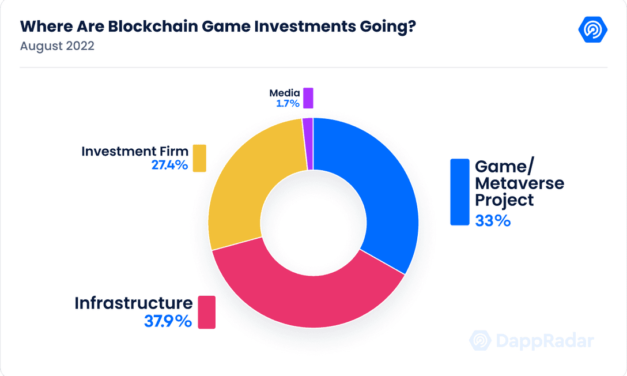
The GameFi sector remains a leading force in the blockchain and crypto space despite the ongoing downturn in the crypto market. Recent numbers from DappRadar revealed that Web3 games and Metaverse projects raised $748 million in funds last month. This was up 135% from July but is still a decline of 16% compared with June.Blockchain gaming collected $3.1 billion in investment last quarter; so far in 2022, it has added $6.9 billion in funds. This year’s forecast seems to indicate that investments could reach $10.2 billion — an increase of 20% over the $4 billion of 2021. The figures suggest that investors remain bullish on GameFi, despite uncertain market conditions.”Looking at the whole picture, we observed that 38% of the investments goes to infrastructure, 33% to games and metaverse projects, and 27% to investment firms,” the report stated.More than 50% of the industry’s usage is still in blockchain games, despite an 11% decline from last month, to an average of 847,000 daily Unique Active Wallets (UAW).On the nonfungible token, or NFT, side, the total trading volume related to games increased by 13.25% in August, and sales jumped by 83.36% to over 1.3 million nonfungible tokens traded. A recent ChainPlay Survey found that 75% of GameFi investors joined the crypto space solely for games projects, and 81% are prioritizing positive in-game experiences above profit-making.Metaverse projects’ sales rose 38.62% month-to-month to 19,354, while trading fell 28.90% to $22 million. Among the protocols, Ethereum’s trading volume fell 14.40% in August, bringing it to $11 million. Meanwhile, Solana’s increased 171% to $1.7 million, and Ronin’s increased 27.64% to $8.2 million in total trading volume.

Čítaj viac

Získaj BONUS 8 € v Bitcoinoch

nakup bitcoin z karty

Registrácia Binance

Burza Binance

Aktuálne kurzy