Autor Cointelegraph By Ana Paula Pereira

Cosmos Hub postpones vote date following white paper revision

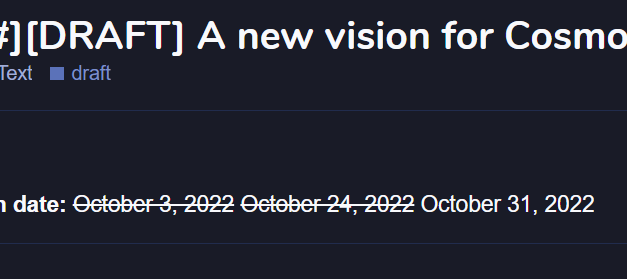
An updated version of the Cosmos Hub white paper went live on October 29, with the community now set to vote on the document. According to the project, concerns related to the issuance model of Cosmos token (ATOM) were addressed in the new revision, among other issues. The paper’s first version was published in September, proposing a redesigned Hub focused on strengthening interoperability and security, along with key changes to its token, with a new issuance model aiming to strike a better balance between ecosystem growth and interchain adoption, “while still preserving the security afforded by the original regime,” according to the white paper.Community members raised concerns about the token’s newly proposed issuance model by Sam Hart, Strategy Lead of the Cosmos Hub, claiming that minting a significant amount of ATOM would lead to lower inflation levels. The transition phase would see 10,000,000 ATOM issued in the first month, decreasing over time until it reaches the steady state phase 36 months later. The updated version proposes a 4,000,000 ATOM mint into the community pool instead.Cosmos Hub proposal draft. Source: Cosmos Hub ForumAccording to Hart, the document, “marks the transition to the next phase of the Cosmos Hub as an infrastructure service platform, and a renewed role for ATOM as preferred collateral within the Cosmos Network.” The white paper also described two functionalities — the Interchain Scheduler and Interchain Allocator — along with describing a new optimized issuance regime for liquid staking. As per the document, the proposed plan would be managed by the Cosmos Councils, formed by domain-specialized entities, which would be responsible for carrying out development and operations. In the Cosmos ecosystem, blockchains are designed to scale and interoperate with each other. Cosmos Hub was the first blockchain built on Cosmos, which initially acted as an intermediary between other interconnected blockchains.

Čítaj viac

Binance may form a team to support Twitter's blockchain efforts

According to reports on Oct. 28, the crypto exchange Binance intends to create a team to work on crypto and blockchain solutions for Twitter, following the acquisition of the social media company by tech billionaire Elon Musk.The development came hours after Binance’s founder and CEO, Changpeng Zhao, or CZ, confirmed that the company had backed Musk with $500 million in financing, making the crypto exchange the fourth-biggest contributor to the takeover amid 19 investors that provided $7 billion to Tesla’s founder. On Twitter, CZ confirmed that the money was wired earlier this week and clarified that the transaction was performed through traditional banking services and using fiat currency, not over cryptocurrencies or blockchain protocols. In May 2022, the crypto exchange had indicated that it would co-invest on Twitter, alongside other investors including Lawrence J. Ellison Revocable Trust, Sequoia Capital Fund and Fidelity Management. At the time, CZ classified the company’s investment as a “small contribution to the cause.”Billionaire CEO and founder of Tesla Musk officially announced the acquisition of Twitter on April 25, with the $44 billion worth transaction subject to the approval of Twitter stockholders and regulators. He previously stated that removing spam and scam bots, including those related to crypto, would be among his top priorities for Twitter.I feel much more secure about my Twitter account now that Elon has sink’ed in there.Edit buttonNo API/bot comments— CZ Binance (@cz_binance) October 27, 2022Before partnering for Twitter’s acquisition, Musk and CZ staged a brief battle in the platform, when Musk pushed Binance to address Dogecoin withdrawals issues last year. On Oct. 27, Musk acquired the social network platform for $54.2 per share, bringing the total value of the deal close to $44 billion. The new owner fired the company’s top executives as one of his first measures. Also, as part of this deal, Musk said he will take the company private, which will result in the stock of the company being delisted from the public market.

Čítaj viac

Crypto companies are still hiring, but you may not find a job post about it

Crypto companies are still hiring but might not be actively recruiting amid the market downturn. If you are considering joining the space, however, this is still a good time to get your feet on the door, sources in the industry told Cointelegraph. “While there may not be as many open roles advertised as there were last year, companies are definitely still hiring. Our clients continue to come to us for assistance with finding top talent for key hires,” noted Tyler Feinerman, global head of talent for Wachsman. According to data from LinkedIn, over 7,200 job positions were listed in October in the United States. Also, the number of monthly jobs posted on blockchain job site Crypto Jobs List in September is back to the same level as one year ago. The limited pool of talent still represents a challenge for companies in the space, said Feinerman, even with the wave of layoffs that slashed over 11,000 positions in the past six months. Unfortunately several crypto exchanges announced big layoffs recently: – @coinbase 18%- @Gemini 10% – @cryptocom 5%- @BlockFi 20%Despite all this several of our hiring partners are still looking for devs: Rust, Solidity, React, NodeJS… ✉️ DMs are open! #hiring— CryptoCareers | Hiring Web3 Developers (@_cryptocareers) June 14, 2022“People in the industry are wearing many hats now,” explained Emily Landon, founder and ​​CEO of The Crypto Recruiters, as more companies have slowed down the hiring process in the past months. The opportunities are still there, she said, but the bear market affected the crypto and Web3 sector in various ways. Regular job posts are less likely to be found, meaning that candidates must actively network to land a position.Joining Discord and Telegram channels, along with crypto meetups to engage with community members, remain key strategies for those who seek to work in the crypto space. “I really encourage people who are interested in working in the Web3 space to attend local meetups. Tons of cities have crypto meetups that anyone can attend, and they are great opportunities to network and meet people who are already in the industry,” said Feinerman.Amid the crypto winter, companies are also revisiting their priorities when hiring, with more available positions for product development roles rather than marketing and sales. “Companies shift their hiring plans to focus more on developer and product roles and building,” commented Wachsman’s head of talent.As previously reported by Cointelegraph, to keep up with the demand for professionals in the coming years, colleges and universities have started offering specialized courses to help students better understand the blockchain ecosystem, with programs at the University of California, Berkeley and the University of Wyoming among the entities targeting the workforce of the future.

Čítaj viac

Solana-based protocol seeking to decentralize ride-sharing raises $9M

The ride-sharing industry is poised for another paradigm shift with Web3 protocols, allowing new companies and drivers to bid for rides using a matching algorithm, according to the Decentralized Engineering Cooperation (DEC) — the company behind the Solana-based protocol TRIP that enables mobility-based applications.According to DEC, on the TRIP ecosystem, companies and riders can collaborate and compete in a shared marketplace. The protocol also rewards the most active participants with stake in its governance for both drivers and customers.The first company to operate on TRIP is Teleport, a decentralized ride-sharing application set to be launched in December and run by the parent company DEC. On Oct. 27, the company announced a $9 million seed round co-led by Foundation Capital and Road Capital. DEC CEO and Teleport co-founder Paul Bohm told Cointelegraph that Web3 technology, including TRIP, will compete to replace “closed platforms run by corporate monopolies with decentralized protocols that are open source, competitive, and fair for everyone.”Bohm stated that the additional funding will be used to “launch TRIP permanently in specific cities.” It will also help the company achieve its decentralization milestone.By using a blockchain-based solution, riders using the TRIP ecosystem can pay using USD Coin (USDC) on Solana and fiat currencies through Apple Pay, while drivers will be able to accept the stablecoin as payment straight to their bank accounts or have it deposited into their wallet.“By turning ride-sharing into a protocol, Teleport is building what we couldn’t build at Uber in 2010, and what Uber should be building today,” said Ryan McKillen, a former Uber employee and one of the investors who joined the seed round. Additional investors include Thursday Ventures, 6th Man Ventures, 305 Ventures, Common Metal. Related: Web3 is the solution to Uber’s problem with hackersThe market size for ride-sharing is expected to grow to $344.4 billion by 2030, according to Precedence Research Data from Statista shows that Uber is the most popular ride-sharing app in the world, with 93 million people using the application on a monthly basis.

Čítaj viac

SushiSwap to create three DAOs in Panama and Cayman in business restructuring

The Sushi DAO, a decentralized autonomous organization behind crypto exchange SushiSwap, has approved a legal restructuring on Oct. 26 that creates three new decentralized entities, aiming to provide more flexibility to its operations.The proposal, which received 100% votes in favor, will create the DAO Foundation, the Panamanian Foundation, and the Panamanian Corporation, each serving different purposes.Among other things, the DAO Foundation will be able to administer treasury, grants and on-chain governance processes, and facilitate proposals and voting. The Panamanian Foundation will administer the existing Sushi protocol (including smart contracts related to the AMM/orderbook, Kashi and staking). Finally, the Panamanian Corporation will operate the GUI layer (front-end) of the protocol.As per the preposition discussion, the process to set up the entity structure is expected to take four weeks. According to Sushi, the “purpose of the entity structure & framework is to provide maximum flexibility for Sushi to proceed in whichever direction the DAO or governance takes it, while also mitigating risk.”The move came as authorities in the United States and Union European continue to work on frameworks for regulating digital assets. Participants in the discussion forum agreed that a legal structure was necessary, but questioned the countries and the model selected. As stated in a long series of comments by a user named Daimon: “Don’t pick countries which are constantly at risk of political collapse, financial collapse, military coups or North American bail-outs. Don’t pick countries in which you wake up one day and find presidential or royal decrees being plastered on your front door, forcing you to beat a hasty exit through the departure lounge.”On Oct. 13, John Hickenlooper, a United States Senator representing Colorado, penned a letter to Gary Gensler urging the Securities and Exchange Commission (SEC) chair to establish “clear rules” for the crypto market, including identifying the cryptocurrencies that will be considered securities, establishing registration guidelines for trading platforms, and “determining what disclosures are necessary for investors to be properly informed.”The SEC boosted its ability to handle specialized issuer filings by adding an Office of Crypto Assets in September, dedicated solely to cryptocurrency asset applications and services.

Čítaj viac

Získaj BONUS 8 € v Bitcoinoch

nakup bitcoin z karty

Registrácia Binance

Burza Binance

Aktuálne kurzy