
Autor Cointelegraph By Ana Paula Pereira

SBF calls for collaboration with Binance 'for the ecosystem'

FTX founder and CEO Sam Bankman-Fried took to Twitter again on Nov. 7 to claim that “a competitor is trying to go after the cryptocurrency exchange with false rumors”, while also calling for collaboration with the rival exchange Binance. The comments follow a statement from Binance CEO Changpeng “CZ” Zhao concerning the liquidation of the exchange’s position in FTX token (FTT) as “post-exit risk management” over the weekend.1) A competitor is trying to go after us with false rumors.FTX is fine. Assets are fine.Details:— SBF (@SBF_FTX) November 7, 2022FTX “assets are fine”, according to SBF, who also alleged that the exchange has enough funds to cover all clients holdings and does not invest client assets, even in treasuries. He also said that:”[FTX] It’s heavily regulated, even when that slows us down. We have GAAP audits, with > $1b excess cash. We have a long history of safeguarding client assets, and that remains true today.”Binance co-founder & Chief Customer Service Officer Yi He clarified that the sell-off of FTT had nothing to do with the alleged war between the two exchanges.3)The point we’d like to stress is that the decision to hold or sell a token depends on one’s own risk appetite and judgement. Our decision to sell FTT is a pure investment-related exit decision, which has nothing to do with “a war” and we have no intention to engage in drama https://t.co/Jl5yQRcouv— Yi He (@heyibinance) November 7, 2022

Earlier today, FTX’s profile on Twitter also addressed user complaints surrounding withdrawal delays, assuring users that everything is running smoothly with the matching engine, although node throughput remains limited for Bitcoin withdrawals at time of publication.On Reddit, some users expressed alarm toward the developments, likening the situation to Celsius halting withdrawals and misleading its users prior to the platform’s collapse.In a Nov. 6 tweet, Zhao said the decision to liquidate the assets was made after “recent revelations that have came to light,” in reference to Terra’s Luna Classic (LUNC) crash and its impact on the crypto market. He also commented on the FTX founder’s recent actions. In a tweet from CZ, he added:“We won’t support people who lobby against other industry players behind their backs.”On-chain analysis shows that an unknown wallet transferred approximately 23 million FTT to Binance — worth around $584 million USD — in the early hours of Nov. 7. According to Zhao, the transfer wa part of the exchange’s decision to offload tokens.Related: FTX addresses user withdrawal complaints amid major token movementThe series of tweets triggered a selloff in the FTX Token that broke below the pattern’s support line near $22.50, accompanied by a volume spike. The FTX exchange token’s selloff continued on Nov. 7 below the support line, raising risks of a bearish continuation phase in the coming months, as reported by Cointelegraph. Binance’s decision was influenced by allegations that the FTX-founded crypto hedge fund Alameda Research could go insolvent due to its exposure to illiquid altcoins, including FTT. As of June 30, Alameda Research reported a balance sheet of $14.66 billion with FTT the largest holding company with $5.8 billion, making up 88% of its net equity.

Čítaj viac

CBDCs are a declaration of war against the banking system claims economist

CBDCs are a declaration of war against the banking system, Richard Werner — development economist and professor at De Montfort University — told Cointelegraph at Web Summit on Nov. 4.Known for his quantitative easing theory, published almost 30 years ago, Werner is an advocate for a decentralized economy. In an exclusive interview with Cointelegraph’s editor-in-chief Kristina Lucrezia Cornèr, he discussed the challenges that surround decentralization, the role of central banks, and how blockchain can help promote transparency in economies.This interview was part of Cointelegraph’s extensive coverage at Web Summit in Lisbon — one of the world’s leading tech conferences.Cointelegraph: Do you think that a decentralized financial system is actually possible?Richard Werner: Yes, because of course what we have is lots of forces for centralization by the central players. They love that, and they want more centralization, but that’s very dangerous and very bad. The extreme case is the Soviet Union, through key periods that was a very centralized monetary system with only one central bank, and that wasn’t a good system. But that’s what the central planners in other countries like the ECB [European Central Bank], that’s what they want.The ECB says there are too many banks in Europe. Why is that? And who are they to say that? Well, they’d love it to be only them. They don’t want competition. They want to be back to the central bank, the only central bank. So, that’s where the issuance of CBDC’s comes in because through CBDC’s the central planners are thinking it’s a declaration of war against the banking system. CBDC is really literally the central bank saying we’re going to open current accounts, ordinary banking for the ordinary public at the central bank. In other words, the bank regulator is suddenly saying we’re going to compete against the banks now because the banks have no chance. You can’t compete against the regulator.CT: And is decentralization possible in this scenario? RW: Yes, it is, but only if we create many local community banks, proper full-blown banks with a banking license because a banking license is a license to print money, literally. When a bank gives a loan, you know where that money comes from for the loan? It doesn’t come from deposits. That’s just breakers of what the bank owes you the money for. The new loan is newly created by the bank and added to the money supply, and that’s allowed when you have a banking license.A banking license is a license to print money, and if we have many community banks, that is a decentralized system. They lend only locally to the local area, local small firms. That’s productive lending, that’s sustainable, non-inflationary. Then you get growth and prosperity, employment, job creation, stability, no inflation. But when you get a centralized system and bigger banks, they buy up the small banks, or you only have one central bank.They also want to do only big deals. The bigger banks get, the bigger the deals they want to do, but big deals are usually asset lending where the bank creates money. People buy assets, which creates asset inflation and the asset bubble. That’s why we have them. And then you get a banking crisis because it’s always, you know, dependent on money creation continuing.CT: What is the role of blockchain here?RW: It does usually mean the potential for decentralization by definition because it is a distributed ledger. Why? Where does this expression come from on distributed ledger? The ledger is the account double entry, accounting, asset liability, the balance sheet of a company and a bank.The standard system is a centralized ledger held by the central bank and then the banks. Because the more banks you have, the more decentralization you already have, but a totally decentralized ledger is where everyone can check using the technology for transactions. You have this post and check and, therefore, accountability. That’s why it’s an interesting tool. It gives this transparency and local accountability if it’s used in the right way. I think, once again, it’s an ideal combination of blockchains and combining it with local banking because then you maximize service.

Čítaj viac

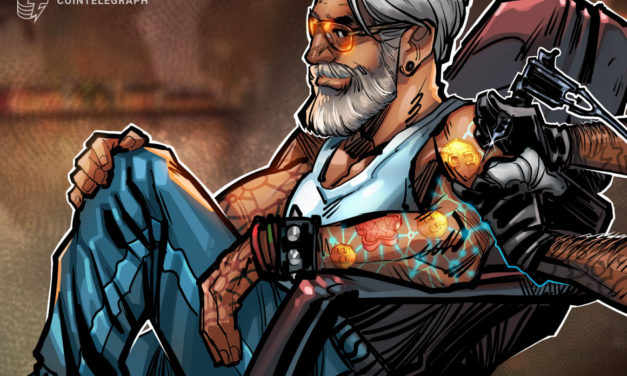
Tattoo industry expands into the NFT space amid digital culture shift

Tattoos have been a universal phenomenon throughout the world for thousands of years, transcending cultural transformations and technological shifts. As the art continues to evolve, it has now taken steps into the nonfungible token (NFT) space in a bid to maintain relevant in an increasingly digital world. Known as Bang Bang in the tattoo industry, Keith McCurdy is one of the artists who hopes to merge the ethos of tattoo culture with disruptive technologies. He’s using a new type of rewriteable tattoo ink that appears and fades away under different lighting conditions.Over the past five years, Bang Bang said that scientists at the University of Colorado have developed a tattoo ink made of photochromic microcapsules, a technology dubbed “tech tattoos” that leaves a color-changing mark that is activated by UV light, thus changing the tattooed image as it reacts to UV light. He sees the technology as a way to bridge tattoo culture’s desire for individuality with the provable uniqueness of NFTs. Back in June, he sold the first rewritable tattoo as a 1/1 NFT for 100 ether (ETH), or nearly $100,000 at the time.McCurdy told Cointelegraph:”Our digital identity will become very important in the future. It may already be more important than our physical identity today. Individualization in a digital world and defining one’s identity is what we do best, and in that exists endless parallels and opportunities.”Another company working on bridging the tattoo community to Web3 is Indelible — which is allowing owners to use their IP rights by drawing new tattoos and adding i to existing profile pic (PFP) NFTs. Mike Amoia, founder of Indelible, told Cointelegraph:”NFT holders are always looking to monetize or do different things with their IP. And we feel it’s a really interesting way to monetize or even have fun with your IP by putting like famous tattoo art on it.”Created eight months ago, the startup had the idea that tattoo artists should be able to expand their work beyond their studios, and have access to unlimited ways to make money from their art. “We felt like it’s a really fascinating application for tattoo culture, and we wanted to do it in the opposite way, which would be tattooing characters on real people. We wanted to tattoo Web3.” Related: What is an NFT and why are they so popular?Amoia, who is also an angel investor, came up with the idea two years ago and decided to fund his own startup focused on the untapped potential of combining tattoos with NFTs. He said that the project’s first PFP characters collection will be signed by tattoo artists Mike Rubendall, Matt Skinny, and Bj Betts. Amoia stated: “All communities should embrace projects like this and then vice versa because we’re all helping each other out. The more successful my project is, it helps out all the other ones because it’s just getting more people to understand what it is.”NFTs are digital objects whose authenticity can be verified on a blockchain, holding features such as uniqueness and non-interchangeability. There are several categories in which they can be classified, but they are most notably appearing as art, music, and blockchain-based video games. During the pandemic, NFTs have taken over the art world, with digital tokens selling at major auction houses for tens of millions of dollars.By 2030, Verified Market Research (VMR) predicts the NFT market will grow to $231 billion in value. In the next eight years, the sector is expected to grow by 33.7% compound annual rate. Music, films, and sports are among the many industries where NFTs are in high demand.

Čítaj viac

Immunefi launches scoring system for Web3's elite white hats

Bug bounty platform Immunefi has released its Whitehat Leaderboard — a scoring system that showcases the top 20 most elite white hats in Web3. The rank will measure a given white hat’s skills and status amid Immunefi’s security community, said the company at the Web Summit on Nov 4. A white hat hacker is someone who identifies security vulnerabilities by testing an organization’s information technology security. In Immunefi’s community, the top 10 white hats alone have generated over $42 million in total earnings by disclosing critical vulnerabilities that have led to big bounty payments in the software industry.In the leaderboard, white hats will be daily classified by the number and severity of paid reports, as well as total earnings made. The hackers in Immunefi’s community reviews projects’ blockchain and smart contract code, disclosing vulnerabilities and being paid for it. The rewards are based on the severity of the vulnerability discovered.Mitchell Amador, founder and CEO at Immunefi, noted in a statement:“As the volume of saved funds continues to grow, the leaderboard is another opportunity to give our white hats the recognition they deserve, as well as to encourage them to keep pushing the boundaries to make the web3 ecosystem safer.”Related: Team Finance hacker returns $7M to associated projects after exploitAccording to the company, white hats who rank on the leaderboard will also be selected to earn further rewards, all-expenses-paid trips, exclusive merch, and speaking opportunities on a regular basis. Created in 2020, Immunefi claimed to have saved over $25 billion in user funds and paid out over $62 million in bounties. The platform currently supports 300 projects across multiple crypto sectors, helping the industry players save funds stored in smart contracts. Amid the top bounties paid for white hats in the past two years, Immunefi facilitated payment for the discovery of a critical bug in the Wormhole core bridge contract on Ethereum, which led to the record-breaking bug bounty of $10 million for a white hat identified as satya0x, as well as the critical infinite spend bug found in Aurora Engine with a $6 million payout for white hat pwning.eth.Security vulnerabilities had been among the challenges in the crypto industry this year. On Oct. 11, a hacker manipulated the value of the Mango Markets’s native token, MNGO, to achieve higher prices. The attacker took out significant loans against the inflated collateral, draining Mango’s treasury. After a proposal on Mango’s governance forum was approved, the hacker was allowed to keep $47 million as a “bug bounty,” while $67 million was sent back to the treasury.

Čítaj viac

UBS AG launches digital bond settled on blockchain and traditional exchanges

Swiss investment bank UBS AG introduced its hybrid digital bond on Nov. 3, claiming to be the world’s first publicly traded and settled on both blockchain-based and traditional exchanges.According to the bank, the digital bond has the same instrument structure, legal status and rating as a traditional UBS AG senior unsecured note. In its statement, the bank said:”Through this bond, UBS enables investors, regardless of whether they have the blockchain infrastructure, to invest in a digital bond. This removes a hurdle on the way to adopt new disruptive technology that can make issuing bonds faster, more efficient and simpler.”The senior unsecured digital bond is a 375 million Swiss franc-denominated ($272 million) three-year bond with 2.33% coupon, according to UBS. The bank will list the digital bond at SDX Trading and SIX Swiss Exchange. It will be eligible for the Swiss Bond Index, along with other UBS AG senior unsecured notes.With atomic settlement technology, the digital bond settles through the SIX Digital Exchange (SDX) distributed ledger-based central securities depository (CSD), which is instant and automatic, not requiring a central clearing counterparty. “Investors will have the ability to automatically settle and clear the UBS digital bond on either SDX CSD directly or on SIX SIS”, noted the bank.Beatriz Martin, UBS Group Treasurer, said that the initiative shows the investment bank’s commitment to supporting the development of new financial market infrastructure using technology “not just as an enabler, but to make it a true differentiator for UBS.” UBS moves into the crypto space following the company CEO’s comments last year classifying crypto as an “untested asset category” and urging caution from investors during the bull market. Last month, another major traditional financial institution in Europe, the Société Générale, granted approval as digital asset provider (DASP), allowing the French bank to provide digital assets custody and trading through a subsidiary. The bank joined other international DASP operators such as Bitpanda, Binance and Etoro.

Čítaj viac

Získaj BONUS 8 € v Bitcoinoch

nakup bitcoin z karty

Registrácia Binance

Burza Binance

Aktuálne kurzy