
Autor Cointelegraph by Amin Haqshanas

Exodus sells over 1,000 Bitcoin as Q1 loss widens to $32M

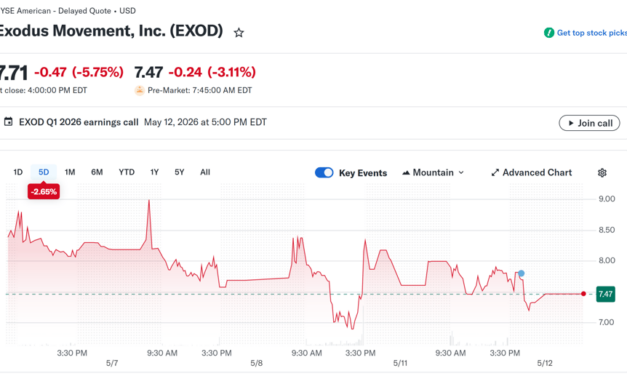
Exodus Movement reported a net loss of $32.1 million for the first quarter of 2026, more than double the $12.9 million loss recorded in the same period last year, as the crypto wallet company liquidated the bulk of its Bitcoin treasury to fund acquisitions.Total revenue came in at $22.7 million for the three months ended March 31, down 36.8% from $36 million a year earlier, the company announced Monday.  Exchange aggregation, the company’s main business line, drove most of the decline, sliding $13.8 million, or 40.8%, as user trading volumes dried up.Monthly active users dipped to 1.5 million from 1.6 million a year ago, while quarterly funded users fell more sharply, dropping 22.2% to 1.4 million from 1.8 million.The company cited macroeconomic pressures, including the Federal Reserve’s revised growth outlook and uncertainty around the administration’s tariff policy, as primary drivers of the market-side damage. “The Company expects that volatility in digital asset prices will continue and may result in significant fluctuations in the Company’s results of operations in future periods,” it added.Related: How AI became crypto’s favorite reason to cut staffExodus sells 63% of its Bitcoin stashExodus held 1,704 BTC at the end of December 2025. By March 31, that position had been cut to 628 BTC, a reduction of roughly 63% in unit terms. The company raised $73.2 million through the sales during the quarter, nearly all of which was earmarked to fund its push to acquire W3C Corp., the holding company behind fintech firms Monavate and Baanx.The company’s broader digital asset portfolio swung to a net loss of $36.4 million, reflecting $76.8 million in unrealized losses partly offset by $40.4 million in realized gains on asset exchanges.At the end of the quarter, the company held $72.9 million in cash and cash equivalents, up from $4.9 million at year-end 2025.Exodus shares drop. Source: Yahoo! FinanceExodus shares fell 5.75% to $7.71 on May 12 and slipped a further 3.11% to $7.47 in pre-market trade.Related: Bitcoin exchange reserves fall to two-year low after $8B exodusExodus launches XO Cash in push into AI agentsAs Cointelegraph reported, Exodus has rolled out XO Cash, a Solana-based stablecoin toolkit built with MoonPay that lets AI agents spend money through Visa’s payment rails without exposing a user’s private keys.Developers can spin up agent-linked wallets, cap daily spending, restrict merchants and issue virtual debit cards through Exodus Pay balances. Payments settle automatically in USDC (USDC) or USDt (USDT) via infrastructure from Monavate, and transactions carry no fees.Magazine: AI-driven hacks could kill DeFi — unless projects act now

Čítaj viac
Bakkt pivots into stablecoin infrastructure as revenue tumbles 77% in Q1

Bakkt swung to a first-quarter loss as crypto services revenue fell 77%, underscoring the digital asset platform’s push to reposition itself around stablecoin payments and AI-enabled financial infrastructure.On Monday, the company reported a net loss attributable to Bakkt of $11.7 million, or 41 cents per basic and diluted share, for the quarter ended March 31. That compares with net income attributable to Bakkt of $7.7 million, or $1.13 per diluted share, a year earlier.Crypto services revenue fell to $243.6 million from $1.07 billion in the prior year’s period, Bakkt said. The company attributed the decline primarily to lower crypto trading volumes. However, nearly all of that revenue figure is offset by crypto costs and brokerage fees, which totaled $242 million in the quarter.Excluding crypto costs, operating expenses held steady at $18.5 million, down slightly from $18.9 million a year ago. The net loss was $11.7 million, compared to net income of $7.7 million a year ago.Bakkt ended the quarter with $82.6 million in cash, including $69.6 million raised through equity offerings during the period. The company also revealed that it carries no long-term debt.Bakkt shares drop in pre-market trading. Source: Yahoo! FinanceShares closed up 0.71% at $9.92 on Monday but fell 9.14% in pre-market trading on Tuesday to $9.00 following the release.Related: US Senator Questions Mark Zuckerberg on Meta’s Stablecoin PlansBakkt goes all in on stablecoinsBakkt’s shrinking revenue comes as the company is in the middle of a major pivot, moving away from crypto trading infrastructure and toward stablecoin payments and agentic AI.The company closed its acquisition of Distributed Technologies Research on April 30, bringing in an AI-native payments engine and stablecoin compliance stack. It has also signed a memorandum of understanding (MoU) with Zoth, a stablecoin provider targeting $1 billion in annualized payment volumes across South Asia, the Middle East and Sub-Saharan Africa.“We believe stablecoin infrastructure represents one of the most significant structural transformations in global finance in decades,” CEO Akshay Naheta said in the earnings release, pointing to the GENIUS Act and CLARITY Act as regulatory tailwinds that could boost the value of Bakkt’s licensed infrastructure.Related: OpenTrade Raises $17 Million to Expand Stablecoin Yield PlatformStablecoin infrastructure draws interestBakkt’s pivot comes as public-market investors show growing interest in stablecoin infrastructure companies.Circle Internet Group shares rose nearly 16% Monday after the USDC (USDC) issuer reported a 20% rise in first-quarter total revenue and reserve income to $694 million and disclosed a $222 million presale of its ARC blockchain token at a $3 billion fully diluted network valuation.Circle’s results showed USDC in circulation rose 28% year over year to $77 billion at quarter-end, while onchain transaction volume rose 263% to $21.5 trillion.Related: Crypto Biz: Wall Street wants more than just Bitcoin

Čítaj viac

CleanSpark shares slide after reporting $378M fiscal second quarter loss

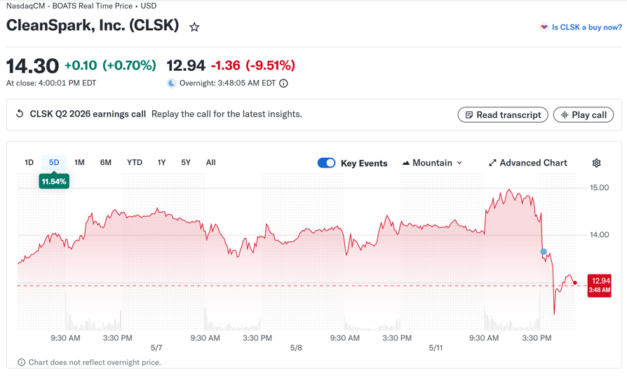
Bitcoin miner CleanSpark (CLSK) recorded a net loss of $378.3 million in its fiscal second quarter, more than doubling the $138.8 million loss reported in the same period a year ago, largely due to a sharp drop in Bitcoin’s price.On Monday, the Las Vegas-based miner disclosed the results for the quarter ended March 31, 2026. It reported a $224.1 million loss tied to the fair value of its Bitcoin holdings, accounting for nearly 60% of the total quarterly loss. The company held $925.2 million worth of BTC at quarter’s end.It reported a fiscal second-quarter net loss of $1.52 per basic share, widening from a loss of $0.49 a year earlier. Revenue for the quarter ended March 31 was $136.4 million, down from $181.7 million a year earlier.Despite the Bitcoin-driven losses, CleanSpark grew its BTC holdings by 14% and increased its average monthly hashrate by 18% year-over-year.CleanSpark shares drop in after-hours trading. Source: Yahoo FinanceShares closed up 0.70% at $14.30 on Monday but fell 9.51% in after-hours trading to $12.94 following the earnings release.Related: Bitcoin Miner Bitdeer Liquidates Entire BTC Treasury, Holdings Fall to ZeroCleanSpark shifts toward AILike many of its peers, CleanSpark is pushing into artificial intelligence and high-performance computing infrastructure. The company doubled its contracted megawatts year-over-year and secured 585 megawatts of ERCOT-approved capacity in Texas, while continuing site development in Sandersville, Georgia.“Our objectives are clear: commercialize our AI/HPC-applicable assets, grow the portfolio, and continue mining efficiently to power CleanSpark’s transformation,” CEO and chairman Matt Schultz said. The company ended the quarter with $260.3 million in cash and $2.9 billion in total assets, per the announcement. However, long-term debt nearly tripled, from $644.6 million to $1.8 billion, six months prior.Related: Saylor signals another Bitcoin buy after hinting at selling in Q1 earnings callMore miners see quarterly lossesAs Cointelegraph reported, MARA Holdings posted a $1.3 billion loss for the first quarter of 2026, widening sharply from $533.4 million a year earlier, as unrealized losses on its 38,689 Bitcoin treasury dragged on results. Revenue fell 18% year-on-year to $174.6 million, missing analyst expectations of $192.7 million.TeraWulf also recorded a net loss of $427 million in the same quarter, up from $61.4 million a year earlier, though its pivot to AI infrastructure showed early results, with HPC revenue hitting $21 million, roughly 60% of total revenue.Magazine: Bitcoin will not hit $1M by 2030, says veteran trader Peter Brandt

Čítaj viac

Three young DeFi apps return $100M in revenue to token holders in 30 days

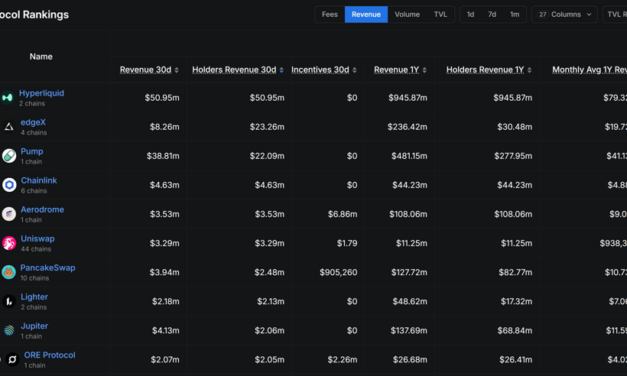
Three of DeFi’s relatively young applications, including Hyperliquid, EdgeX and Pump.fun, have distributed a combined $96.3 million to token holders over the past 30 days, as the sector’s focus shifts to actual earnings.Hyperliquid led the pack, generating $50.95 million in revenue over the period, all of which went directly to token holders with zero spent on incentives, according to data from DefiLlama. Pump.fun came in second with $22.09 million returned to holders out of $38.81 million in total revenue. EdgeX followed with $23.26 million distributed to holders from $8.26 million in protocol revenue, suggesting that the platform is drawing on reserves or alternative income streams to reward holders.On an annualized basis, Hyperliquid has generated $945.87 million in revenue over the past year, all returned to holders, while Pump.fun sits at $481.15 million and EdgeX at $236.42 million.Among other major protocols, Chainlink returned $4.63 million to holders, Aerodrome $3.53 million and Uniswap $3.29 million across 44 chains. PancakeSwap generated $3.94 million in revenue but returned $2.48 million to holders while spending $905,260 on incentives.Related: DeFi can freeze stolen funds, but not everyone agrees it shouldCrypto community now focuses on revenueThe data comes as revenue is becoming the metric that matters most in crypto, with token holders pushing protocols to justify their valuations through actual earnings rather than transaction volumes or network growth figures.“Nobody cares that your chain does 10x the TPS anymore,” wrote Robbie Klages, co-founder of The Rollup, referring to a blockchain’s measure of transactions per second. “The market is ‘show me the money right now.’ Treat it like a business not a network growth thesis,” he added.Top DeFi protocols by Holders Revenue. Source: DefiLlamaAnother X user wrote that the shift from narrative to earnings is “permanent now,” warning that protocols unable to show real revenue will be valued like pre-revenue startups in a rate hike environment, a reference to the kind of sharp devaluations that hit speculative assets when capital gets expensive.Related: Aave-Linked DeFi United Details rsETH Recovery PlanDeFi is becoming backend for onchain economyAndre Cronje, founder of the popular DeFi protocol Yearn.Finance, said that DeFi in 2026 looks less like a speculative playground and more like functioning financial infrastructure. He noted that stablecoins have grown into a $320 billion market led by Tether and Circle, decentralized exchanges are processing over $160 billion in monthly spot volume and perpetual DEXs are handling $540 billion monthly.Cronje added that lending protocols, including Aave, Morpho and Maple Finance, are sitting on $28 billion in active loans, while real-world assets are increasingly being used as onchain collateral. “DeFi is no longer just competing for APY. It is becoming the backend for the onchain economy,” he wrote on X.Magazine: Guide to the top and emerging global crypto hubs — Mid-2026

Čítaj viac

South Korea crypto holdings halve in a year as investors turn to stock market

The value of cryptocurrency held by South Korean investors more than halved over the past year, falling from 121.8 trillion won ($83.3 billion) at the end of January 2025 to 60.6 trillion won ($41.4 billion) by the end of February 2026.Daily trading volumes across the country’s five major exchanges, including Upbit, Bithumb, Korbit, Coinone and Gopax, also took a hit, collapsing to $3 billion by February compared to $11.6 billion in December 2024, Korean outlet The Chosun Daily reported, citing data the Bank of Korea submitted to Rep. Cha Gyu-geun of the Rebuilding Korea Party.Won deposits held at exchanges, a proxy for investor dry powder, also fell from 10.7 trillion won at end-2024 to 7.8 trillion won. The drop is attributed to a combination of falling crypto prices and capital flowing into the stock market.Stablecoins bucked the trend. Holdings climbed from $60 million in July 2024 to a peak of $597 million in December before easing to $41 million in February, a far smaller decline than the broader crypto market.Related: South Korea seeks 20-year sentence for Delio CEO over $169M crypto fraudTighter AML rules threaten to push investors awayThe market contraction comes as regulators prepare to tighten oversight. Financial authorities plan to implement revised AML rules in August that would require crypto transactions above 10 million won involving overseas exchanges or private wallets to be automatically flagged as suspicious.Top Korean exchanges by volume. Source: CoinGeckoIndustry body DAXA has pushed back, arguing the rule is disproportionate and could drive users to offshore platforms like Binance. The industry body said the proposal could increase suspicious transaction reports from South Korea’s five largest exchanges by 85 times, from about 63,000 cases last year to over 5.4 million, making compliance difficult in practice.Debate over the government’s planned 22% crypto tax, set for 2027, is also intensifying. On Thursday, South Korea’s Finance Ministry confirmed for the first time that a 22% tax on crypto gains will take effect as scheduled on January 1, 2027.Related: Bithumb wins temporary court stay on South Korea suspension: ReportSamsung SDS to build South Korea’s blockchain securities platformAs Cointelegraph reported, Samsung SDS has won a contract to build and operate a blockchain-based securities platform for South Korea’s Korea Securities Depository (KSD), with the project expected to be completed by February 2027.The move comes ahead of South Korea’s broader push to build market infrastructure for tokenized assets ahead of a new legal framework taking effect in early 2027.Magazine: AI-driven hacks could kill DeFi — unless projects act now

Čítaj viac
Získaj BONUS 8 € v Bitcoinoch

nakup bitcoin z karty

Registrácia Binance

Burza Binance

Aktuálne kurzy

