
Autor Cointelegraph by Amin Haqshanas

Spot Bitcoin ETFs bleed $1B in a week, snapping six-week inflow run

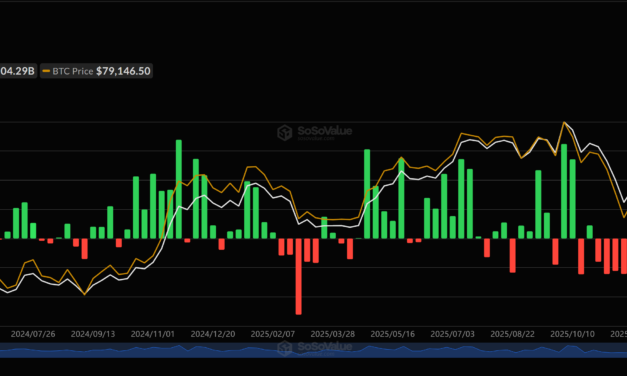
Spot Bitcoin exchange-traded funds (ETFs) recorded $1 billion in weekly net outflows, ending a six-week inflow streak that had drawn a combined $3.4 billion.The week started on a cautiously optimistic note, with Monday posting modest inflows of $27.29 million, according to data from SoSoValue. The tide turned sharply on Tuesday, when investors pulled $233.25 million from the funds. Selling pressure intensified on Wednesday, the worst single day of the week, with outflows reaching $635.23 million.A brief reprieve came on Thursday, as inflows of $131.31 million offered a momentary reversal. However, Friday erased that recovery as well, when a further $290.42 million exited the products, sealing the week in the red at exactly $1 billion in net outflows.Spot Bitcoin ETFs see weekly outflows. Source: SoSoValueThe weekly loss marks a reversal from the previous six weeks, during which spot Bitcoin ETFs attracted consistent net inflows, with the week of April 17 standing out as the strongest, pulling in $996.38 million. This week’s selling leaves total net assets sitting at $104.29 billion, with cumulative net inflows across all products at $58.34 billion.Related: Bitcoin ETFs Post Largest Outflows Since January as BTC SlipsCapital rotates toward AI, cryptoIn a recent note, analysts at Bitunix said capital is “aggressively” rotating toward both the “AI growth narrative” and the institutionalization of crypto assets. NVIDIA, Google and Apple pushed toward fresh all-time highs last week, while AI chipmaker Cerebras surged more than 70% intraday on its IPO debut.On the crypto front, the CLARITY Act, widely seen as one of the most consequential crypto market structure bills in the US, cleared the Senate Banking Committee. Coinbase shares rallied sharply subsequently as markets priced in the development, and Bitcoin climbed back toward the $82,000 mark.However, Bitcoin’s price structure points to a market on edge, Bitunix said. They noted that heavy short liquidity sits clustered between $82,400 and $82,600, with $80,000 serving as the key support level to watch. “Current price action suggests the market has clearly entered a high-leverage volatility structure, as capital waits for further direction from the three dominant macro themes: AI expansion, U.S.-China relations, and crypto regulation,” they wrote.Related: JPMorgan Boosts Bitcoin ETF Holdings in Q1 2026 FilingSpot Ether ETFs see consistent outflowsMeanwhile, spot Ether ETFs recorded outflows across all five trading days last week. Tuesday was the worst session, with $130.62 million exiting the products, followed by $65.65 million on Friday, $36.30 million on Wednesday, $16.89 million on Monday, and a relatively muted $5.65 million on Thursday.Combined, the five-day streak wiped $254.46 million from the funds, pulling total net assets down to $12.93 billion by week’s end.Magazine: Guide to the top and emerging global crypto hubs — Mid-2026

Čítaj viac

Law firm Fenwick & West sued for $525M over alleged role in FTX collapse

A group of 20 victims from five countries or jurisdictions has filed a $525 million lawsuit against Fenwick & West LLP, one of Silicon Valley’s top tech law firms, accusing it of helping conceal the FTX fraud.The complaint, filed Wednesday in the US District Court for the District of Columbia, names the firm alongside six individual defendants. The plaintiffs say they lost their life savings when FTX collapsed, claiming that Fenwick’s involvement gave the exchange a false air of legitimacy that kept them from pulling their money out.At the center of the case is testimony from Nishad Singh, FTX’s former director of engineering, who pleaded guilty to fraud charges and testified at Sam Bankman-Fried’s criminal trial. Singh said he personally told Fenwick attorneys that customer funds were being misused, and instead of walking away, the firm advised on how to hide it.The complaint goes further. It says Fenwick attorneys set up North Dimension Inc., a Delaware shell company that posed as an electronics retailer but funneled over $3 billion in stolen customer funds. The firm also allegedly implemented FTX’s Signal auto-delete messaging policy, the same system federal prosecutors said helped the fraud go undetected by regulators and investigators.Related: FTX estate misses out on $3B Cursor stake value after $200K sale in 2023Examiner found Fenwick “intertwined” in FTX’s wrongdoingA court-appointed bankruptcy examiner, whose report came out in 2024 after reviewing more than 200,000 documents, found that Fenwick created the corporate structures for both FTX and Alameda Research, formed shell entities to obscure money movements, and drafted backdated agreements to cover illicit transfers, the complaint states. The examiner concluded the firm was “deeply intertwined in nearly every aspect of FTX Group’s wrongdoing,” the lawsuit reads.“These findings are those of a court-appointed officer based on documentary evidence in federal bankruptcy proceedings to which Fenwick was a party,” the lawsuit added.FTX victims file lawsuit against Fenwick. Source: CourtListenerAfter FTX filed for bankruptcy in November 2022, Fenwick scrubbed all mentions of the exchange from its website. The firm also quietly hired top-tier law firm defense lawyers at Gibson Dunn before any civil lawsuit was filed against it, per the lawsuit.The plaintiffs are bringing seven claims against Fenwick, including malpractice, fraud and gross negligence. They are seeking compensatory damages exceeding $525 million, return of all legal fees Fenwick earned from FTX and punitive damages against partners Tyler Newby and Daniel Friedberg for “deliberate and reckless individual professional conduct.”Related: Sam Bankman-Fried withdraws motion for a new trial, still asks for new judgeJudge denies SBF’s bid for new trialLast month, a federal judge denied Bankman-Fried’s bid for a new trial, calling his claims of new evidence baseless. Judge Lewis Kaplan, who sentenced the former FTX CEO to 25 years in prison in 2024, said Bankman-Fried’s argument that three former FTX executives could counter the government’s case was without merit, noting that he knew all three witnesses well before the trial.Bankman-Fried had argued that Ryan Salame and Daniel Chapsky could challenge the government’s claims about FTX’s insolvency, and that Nishad Singh changed his testimony under pressure from prosecutors. Kaplan dismissed those claims as “wildly conspiratorial and entirely contradicted by the record.”Magazine: How crypto laws changed in 2025 — and how they’ll change in 2026

Čítaj viac

BitGo posts wider Q1 loss despite revenue more than doubling

Digital asset infrastructure company BitGo reported a wider first-quarter net loss as Bitcoin treasury mark-to-market losses and IPO-related expenses outweighed stronger client growth and a year-over-year jump in revenue.Revenue for the quarter ended March 31 was $3.8 billion, up from $1.8 billion a year earlier, driven by higher digital asset trading activity and growing contributions from its stablecoin business, the company announced Wednesday. Revenue fell 38.7% from Q4 2025’s $6.2 billion, partly due to a shift in client trading from spot to derivatives, a product BitGo launched at the start of the quarter that generated roughly $3 billion in notional volume.However, net loss widened to $60.7 million from $25.7 million in Q1 2025, hit by a $53.7 million non-cash loss tied to the declining value of the company’s Bitcoin treasury, as well as stock-based compensation from its recent IPO. BitGo said stock compensation costs are expected to normalize going forward.Adjusted EBITDA (earnings before interest, taxes, depreciation and amortization) swung to a loss of $1.7 million from a gain of $3.9 million a year ago, partly due to a $3 million in one-time legal and professional costs tied to the IPO.Related: Circle to launch cirBTC wrapped Bitcoin, challenging BitGo and CoinbaseBitGo client base surges 42%On the platform side, client count grew 42% year-over-year to 5,569. These are institutions like hedge funds, exchanges, fintech companies and other businesses that plug into BitGo’s infrastructure. Users on the platform also grew to 1.2 million, up 7.3% year-over-year.BitGo KPIs. Source: BusinessWireStablecoin-as-a-service revenue jumped 43.6% to $38.2 million, while staking revenue dropped 66.2% to $49.4 million amid lower token prices.BitGo ended the quarter with $186.6 million in cash and held 2,449 Bitcoin valued at approximately $167.1 million.BTGO shares slipped 1.09% in overnight trading to $11.78 after the earnings release, according to Yahoo! Finance. Related: BitGo launches portfolio-based crypto lending platform for institutionsCrypto companies post widening losses in Q1A string of crypto companies reported deepening losses in the first quarter of 2026 amid the market decline. Coinbase swung to a $394.1 million net loss, missing revenue estimates of $1.5 billion with $1.41 billion. Exodus Movement more than doubled its losses to $32.1 million as revenue dropped 36.8% and active users slid.Bitcoin miners, including Riot Platforms, Core Scientific, CleanSpark and TeraWulf, all posted widening losses in Q1 2026, with MARA topping the group at a $1.3 billion net loss, roughly $1 billion of which stemmed from non-cash mark-to-market adjustments on Bitcoin holdings.Magazine: Guide to the top and emerging global crypto hubs — Mid-2026

Čítaj viac
Paybis secures MiCA, payment licenses in Latvia for EU crypto expansion

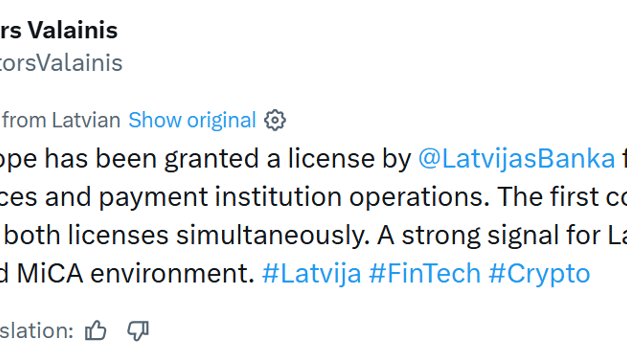
Cryptocurrency platform Paybis has received two licences from Latvia’s central bank, including one for crypto-asset services under the European Union’s Markets in Crypto-Assets Regulation (MiCA) and another for payment institution operations under Payment Services Directive 2 (PSD2).The licences were issued by the Supervision Committee of Latvijas Banka on May 12 to SIA Paybis Europe, the company’s EU entity, according to an announcement from the central bank. Paybis is the third company in Latvia to receive a MiCA CASP licence, the central bank said.The MiCA licence covers custody and administration of crypto assets on behalf of clients, exchange of crypto-assets for funds or other crypto assets, execution of orders, transfer services and crypto asset advisory, Latvijas Banka said. The central bank added that the PSD2 payment institution licence enables Paybis’s EU entity to execute payments and make transfers to payment accounts.Paybis CEO and co-founder Innokenty Isers said the dual licensing allows the firm “to make a broad, future-focused offering, including working with stablecoins.”Related: MiCA has made euro stablecoins safe but weak, new report arguesPaybis eyes B2B crypto infrastructure pushKonstantins Vasilenko, co-founder and chief business development officer of Paybis, told Cointelegraph that Paybis is targeting business clients with a white-label crypto infrastructure stack, covering on/off-ramps, buy/sell/swap, payment acceptance and stablecoin payouts. These services would be delivered through a single API, allowing companies to offer crypto services to their own customers without building their own regulated setup.“This is where the combination of MiCA CASP authorisation and PSD2 PI licensing is particularly important, because it allows us to connect crypto asset services with regulated payment rails,” he added.Source: Viktors Valainis, Minister of Economics of LatviaFounded in 2014, Paybis supports 90 cryptocurrencies and serves seven million users across 180 countries. It also holds money services business licences in the US and Canada.Related: MiCA-licensed Banking Circle joins bank stablecoin settlement race in EuropeEU weighs “MiCA 2” amid rising scrutinyIn April, a European Commission adviser said the EU’s MiCA crypto regulation is likely to evolve over time, with the Commission planning a public consultation to assess whether the rules are working for market participants. Speaking at Paris Blockchain Week 2026, Peter Kerstens said it would be “rather unusual” if there were no “MiCA 2” at some point, noting that EU financial legislation typically develops in stages.The comments came amid growing scrutiny and opposition from the crypto industry. Stablecoin issuer Circle has pushed back on euro stablecoin thresholds, while policymakers debate whether supervision of major crypto firms should be centralized under the European Securities and Markets Authority.Magazine: Singapore isn’t a ‘crypto hub’ — it’s something better: StraitsX CEO

Čítaj viac

EToro profits rise as commodities boom offsets crypto trading slump

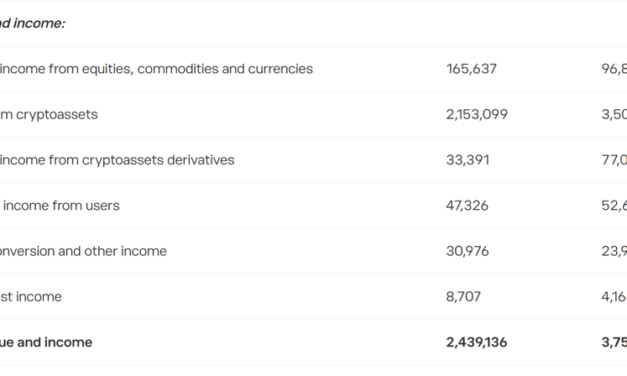
EToro reported first-quarter net income of $82 million, up 37% from a year earlier, as a surge in commodities trading offset weaker crypto activity.Net income rose 37% year-over-year to $82 million, compared to $60 million in Q1 2025, the company announced Tuesday. Adjusted EBITDA (earnings before interest, taxes, depreciation and amortization) climbed 35% to $109 million, from $80 million a year earlier, while net contribution grew 19% to $258 million.The upbeat results were driven largely by commodities trading, which accounted for roughly 60% of trading commissions in the quarter, with volumes up nearly fourfold year-over-year. The company also expanded its equities offering, adding Japanese stocks to bring its exchange coverage to 26 and activated its BitLicense to launch crypto trading in New York.Net revenue and income. Source: EToroFunded accounts grew 12% to 4.02 million, while assets under administration rose 15% to $17 billion. The company held $1.3 billion in cash, cash equivalents and short-term investments as of March 31.Related: Deutsche Börse invests $200 million in Kraken parent PaywardCrypto trading volumes tumbleDespite the surge in commodities trading, crypto volumes took a hit. April data released alongside the earnings showed crypto trade volumes fell 32% year-over-year to two million trades, while the invested amount per trade dropped 22% to $207.On the product side, eToro launched an AI-powered Agent Portfolios feature and deepened its partnership with xAI, embedding Grok 4.2-powered market sentiment into Tori, its AI investing agent.EToro shares dip. Source: Yahoo! FinanceThe company also closed its acquisition of Zengo, a self-custodial crypto wallet provider, on April 30, a move CEO Yoni Assia said advances eToro’s strategy of bridging traditional finance with on-chain infrastructure.Assets under administration climbed further to $18.7 billion in April, up 19% year-over-year, while total money transfers for the month hit $1.4 billion, up 53%.Related: Block Inc rises 8% as Q1 gives ‘earnings surprise’ despite Bitcoin dipCrypto exchanges see lower trading volumesAs Cointelegraph reported, Coinbase posted a net loss of $394.1 million in Q1, its second straight quarterly loss, swinging from a $65.6 million profit a year earlier.Revenue came in at $1.41 billion, missing analyst estimates of $1.5 billion, as transaction revenue slumped 40% and subscription and services revenue fell 13.5% year-over-year. Total crypto market cap and trading volume were both down more than 20% quarter-over-quarter.Magazine: Guide to the top and emerging global crypto hubs — Mid-2026

Čítaj viac
Získaj BONUS 8 € v Bitcoinoch

nakup bitcoin z karty

Registrácia Binance

Burza Binance

Aktuálne kurzy

