Autor Cointelegraph by Amin Haqshanas

Pump.fun accounts for over one-third of Solana’s Q1 revenue despite memecoin slowdown

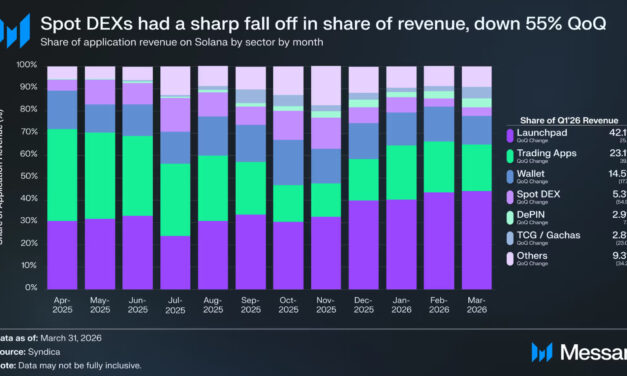
Pump.fun remained Solana’s largest revenue generator in the first quarter of 2026, pulling in $124.7 million, more than a third of the network’s $342.2 million in total app revenue, despite cooling memecoin activity.The memecoin launchpad’s revenue rose 17% quarter over quarter, a sign that its core business remains resilient, Messari said in its Solana Q1 report.Launchpads generated $144 million in Q1, roughly 42% of Solana’s total app revenue. A standout within the sector was Bags, whose quarterly revenue surged 1,347% to $11.5 million, fueled by a wave of AI-themed memecoins in January. The surge proved short-lived, with monthly revenue dropping 85% by February.Solana revenue. Source: MessariSolana’s memecoin revenue is holding up even as the network increasingly attracts a broader range of users, with major institutions like BlackRock, Visa and JPMorgan expanding their presence across its payments and tokenization ecosystem.“Memecoins don’t define Solana,” Lily Liu, president of the Solana Foundation, said in a recent interview.Related: MoonPay Acquires DFlow, Adding Solana Trading InfrastructureTrading apps, RWAs grow on SolanaTrading apps on Solana were the quarter’s strongest-growing sector overall, with revenue rising 40% to $79 million. Axiom led the pack at $42.4 million, making it the second-highest revenue-generating app on the network.Elsewhere, Solana’s real-world asset market cap crossed $2 billion, up 43% in the quarter, led by BlackRock’s BUIDL doubling to $525 million after Anchorage Digital added custody support. DeFi total value locked fell 22% to $6.16 billion, though Messari researchers attributed the decline largely to SOL’s 33% price drop rather than user exits. The network’s share of total DeFi TVL remained roughly flat at 6.7%.RWAs grow on Solana, fueled by institutional inflows. Source: MessariOn the infrastructure side, the focus is on Alpenglow, a sweeping consensus upgrade targeting the Agave 4.1 release. If it ships as planned, the upgrade would cut Solana’s transaction finality from around 12.8 seconds to 150 milliseconds.Related: Solana Clients Introduce Post-Quantum Solution FalconGoldman Sachs exits Solana positionsAs Cointelegraph reported, Goldman Sachs exited its Solana ETF positions in Q1 2026, dropping stakes in funds from Grayscale, Bitwise and Fidelity.Italy’s largest bank, Intesa Sanpaolo, also nearly wiped out its Solana position in Q1 2026, slashing its stake in Bitwise’s Solana ETF from 266,320 shares to just 2,817, even as it more than doubled its total crypto holdings to $235 million by piling into Bitcoin ETFs from ARK 21Shares and BlackRock.Market Moves: Why is Ethereum Foundation selling? BTC futures warning signs

Čítaj viac

Swan Bitcoin sued for nearly $1B over pre-bankruptcy transfers from Prime Trust

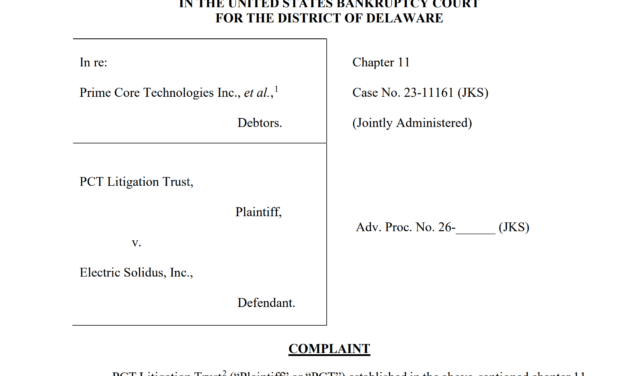
The post-bankruptcy trust for Prime Trust has filed suit against Swan Bitcoin, alleging the Bitcoin services company exploited insider knowledge to pull nearly $1 billion in assets from the custodian days before its collapse.The complaint, filed in Delaware bankruptcy court, accuses Electric Solidus, the corporate entity behind Swan, of receiving over $24.6 million in cash, 11,994 Bitcoin (BTC) currently worth around $923 million, roughly 5 million USDt (USDT) and smaller amounts of other digital assets before Prime Trust’s August 2023 bankruptcy.At the center of the allegations is an unidentified Prime Trust senior executive who, while working at the company, was also a paid adviser to Swan through a side arrangement dating back to July 2019.Four days before Prime Trust met with Nevada regulators on May 26, 2023, the executive allegedly opened an encrypted chat with Swan CEO Cory Klippsten and set messages to auto-delete every 24 hours. The feature was allegedly turned off the day after the meeting, when Swan withdrew more than 10,000 Bitcoin from Prime Trust.Source: CourtListenerThe lawsuit is part of a broader effort by Prime Trust’s post-bankruptcy litigation trust to recover assets transferred out of the custodian in the weeks leading up to its collapse. The trust alleges Swan used insider access to move funds ahead of other customers as Prime Trust’s financial condition deteriorated.“Swan knew to transfer fiat and crypto from Prime immediately prior to Prime filing for bankruptcy to avoid catastrophic losses,” the complaint wrote.Cointelegraph reached out to Swan for comment, but did not receive an immediate response.Related: House Committee pushes Trump to fill CFTC seats as crypto regulation ramps upSwan allegedly emptied Prime Trust accountsThe complaint further alleges that Swan abruptly expanded a partial asset transfer into a full evacuation of all funds, one day before the Nevada meeting. Prime Trust staff scrambled to comply before the close of business that day, according to Slack communications cited in the filing.The complaint alleges Prime created an internal ledger labeled “PT FBO Swan Customers” on May 25, an account that did not previously exist, to make it appear Swan’s funds had always been held in a separate trust, which would have made them harder to claw back in bankruptcy. “In substance, however, those assets had not been and were not held in trust for the benefit of Swan’s customers,” the suit claims.The plaintiff is seeking recovery under preferential transfer and actual fraudulent transfer provisions of the Bankruptcy Code, and is asking the court to disallow any future claims Swan might assert against the estate until restitution is made.Magazine: Guide to the top and emerging global crypto hubs — Mid-2026

Čítaj viac

SBI, Rakuten, Nomura line up to launch crypto investment trusts: Report

Japan’s major brokerages are preparing to bring crypto investment trusts to retail investors, with SBI Securities and Rakuten Securities already developing products in-house, while others like Nomura plan to enter the space once regulations are finalized.SBI Securities plans to sell funds developed by group company SBI Global Asset Management, with products spanning both ETFs and investment trusts focused on liquid assets like Bitcoin and Ethereum, according to a Sunday report by Nikkei. The group intends to handle everything from product development to distribution in-house.Rakuten Securities is taking a similar approach, working with Rakuten Investment Management to build products tradeable directly through smartphone apps, the report revealed.The move would mark a significant shift in how ordinary Japanese investors access crypto. Currently, buying digital assets requires opening a dedicated exchange account or setting up a wallet. Investment trusts would allow crypto exposure through existing securities accounts, removing a key barrier for retail participation.Related: Japan tells real estate and crypto sectors to tighten AML checks on property dealsNomura, Daiwa, SMBC moving toward crypto fundsAmong the larger names, Nomura and Daiwa have both announced plans to develop crypto investment trusts within their respective groups, Nikkei reported. SMBC Group, including SMBC Nikko, has set up a cross-group task force to evaluate its options, while Asset Management One, under Mizuho Financial Group, has begun preliminary exploration.The move comes as Japan’s Financial Services Agency is moving to revise the enforcement order of the Investment Trust Act by 2028, which would formally add cryptocurrencies to the list of specified assets investment trusts can hold.Last month, Japan formally reclassified crypto assets as financial instruments under an amended Financial Instruments and Exchange Act, bringing them under the same regulatory umbrella as stocks and bonds. The bill, if passed in the current parliamentary session, is expected to take effect in fiscal 2027.Related: SBI eyes Bitbank deal as Japan’s crypto exchange market consolidatesJapan to allow spot crypto ETFsJapan is also reportedly considering rule changes that could allow crypto ETFs as early as 2028, with major financial groups including Nomura Holdings and SBI Holdings among the first expected to develop such products.SBI Holdings has already outlined plans for a Bitcoin-XRP dual ETF and a gold-crypto ETF, pending regulatory approval.Magazine: Guide to the top and emerging global crypto hubs — Mid-2026

Čítaj viac

OpenAI partners with Malta to give all citizens free ChatGPT Plus access

OpenAI and the Maltese government have announced a world-first partnership to roll out ChatGPT Plus to all Maltese citizens, marking the first time a government has struck such a deal with the AI company.Under the programme, citizens who complete a government-backed AI literacy course will receive free access to ChatGPT Plus for one year, OpenAI announced on Saturday. The course, developed by the University of Malta, covers what AI is, what it can and cannot do and how to use it responsibly at home and in the workplace.“Malta is the first country to launch a partnership of this scale because we refuse to let our citizens stay behind in the digital age,” Maltese minister for economy, enterprise and strategic projects Silvio Schembri said, adding that the goal is to turn AI “from an unfamiliar concept into practical assistance for our families, students, and workers.”The Malta Digital Innovation Authority will manage distribution to eligible participants when the first phase launches this month, with the programme set to expand as more residents and citizens abroad complete the course.Related: Robinhood Invests $75M in OpenAI to Provide Equity Tokens for UsersOpenAI partners with governments worldwideThe deal is the latest under OpenAI’s broader OpenAI for Countries initiative, through which the company works with governments to move from early AI interest to national-level adoption. Unlike a standardised model, the programme is tailored to each country’s priorities, including areas like education, workforce training and public services.Last year, OpenAI partnered with Estonia’s government to provide all secondary school students and teachers with access to ChatGPT Edu, a customized version of ChatGPT built for education systems. The firm has also launched “OpenAI for Greece” in partnership with the Greek government.As Cointelegraph reported, OpenAI has also struck a deal with the US Department of Defense to deploy its AI models on classified military networks.Magazine: AI-driven hacks could kill DeFi — unless projects act nowCointelegraph is committed to independent, transparent journalism. This news article is produced in accordance with Cointelegraph’s Editorial Policy and aims to provide accurate and timely information. Readers are encouraged to verify information independently.

Čítaj viac

THORChain confirms $10M exploit, rolls out recovery portal for affected users

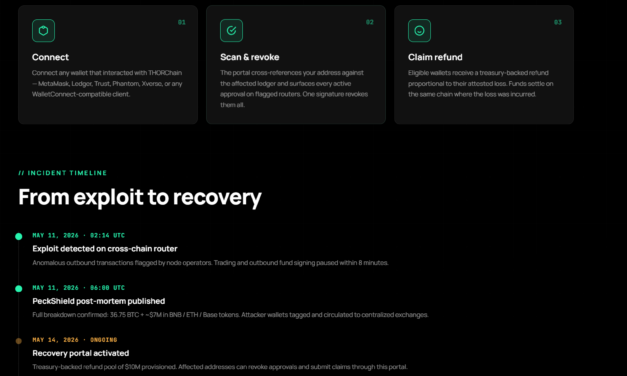
THORChain has confirmed a $10 million exploit and launched a recovery portal, giving affected users a self-custodial path to revoke malicious token approvals and submit refund claims backed by a treasury-provisioned refund pool of equal size.In a Saturday post on X, THORChain Foundation introduced the recovery portal, saying that “affected users are now able to check what they will be paid as compensation following the exploit.”The portal, citing a PeckShield post-mortem, claims that the attack was detected at 02:14 UTC on May 11, when node operators flagged anomalous outbound transactions. Trading and outbound signing were paused within eight minutes. In total, attackers drained 36.75 BTC, worth around $3 million, and approximately $7 million in tokens across BNB Chain, Ethereum and Base, hitting 12,847 wallets across four chains.THORChain’s recovery portal. Source: THORChainAffected users have 21 days to submit claims. The refund window closes on June 4, after which any unclaimed allocation rolls over to the protocol’s insurance fund.Related: Russia-linked crypto exchange Grinex halts trading after $14M hackHow THORChain was drainedIn an incident update, THORChain said the leading theory is that the attacker exploited a vulnerability in the GG20 threshold signature scheme (TSS) implementation, which allowed sensitive vault key material to leak gradually. By accumulating enough of this leaked data over time, the attacker was able to reconstruct the vault’s private key and authorize unauthorized outbound transactions.The protocol also noted that a newly churned node entered the network several days before the attack and is currently believed to be associated with it, with onchain links identified between the node’s bonding addresses and the wallets that received the stolen funds.“The Treasury is actively collecting forensic data and coordinating with Outrider Analytics and relevant law enforcement agencies in an effort to identify the attacker and pursue recovery of stolen funds where possible,” the protocol wrote.Related: Law enforcement freezes $41M connected to $150M crypto Ponzi collapseCrypto hack losses hit $630 million in AprilCrypto hacks surged in April, with total losses reaching $629.7 million, the worst month for the industry since February 2025, when $1.47 billion was stolen. KelpDAO’s $293 million exploit and Drift Protocol’s $280 million hack drove the bulk of the damage, together representing 82% of April’s losses and cementing DeFi as the most targeted sector.The pattern of attacks points to a shift in how protocols are being compromised, with bridges, privileged access and operational failures increasingly at the root of major incidents rather than straightforward smart contract bugs.Magazine: AI-driven hacks could kill DeFi — unless projects act now

Čítaj viac

Získaj BONUS 8 € v Bitcoinoch

nakup bitcoin z karty

Registrácia Binance

Burza Binance

Aktuálne kurzy