
Autor Cointelegraph by Amin Haqshanas

Spot Bitcoin ETFs see record 10-day outflow streak, analyst calls it ‘contrarian indicator’

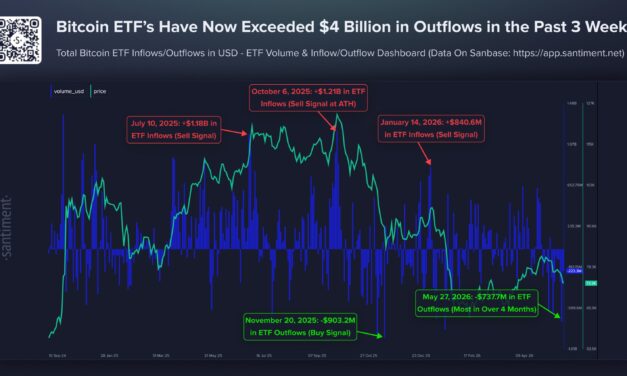
Spot Bitcoin exchange-traded funds (ETFs) have logged outflows for ten consecutive trading days, with total net redemptions exceeding $2.97 billion since May 15, a streak that one analyst says may signal a market bottom is near.According to data from SoSoValue, daily outflows ranged from $70 million to $733 million across the period, with the steepest single-day exodus recorded on Wednesday at $733.43 million. Total net assets held across spot Bitcoin (BTC) ETFs have dropped from $104.29 billion on May 15 to $94.17 billion as of Friday, a decline of roughly $10 billion in two weeks.The current streak broke the previous record of eight consecutive outflow sessions, which was recorded in early last year and saw $3.2 billion in withdrawals, on Thursday, before extending to 10 days on Friday.Spot Bitcoin ETFs have become a major gauge of institutional demand since their US launch. Large inflows have historically signaled growing optimism and increased demand, while heavy outflows reflect fear and de-risking.Related: Bitcoin ETFs Turn Negative as IBIT Posts Near-Record LossesBitcoin ETF outflows signal ‘peak fear’Crypto analytics firm Santiment Intelligence said the sustained outflows may suggest the market bottom is nearing an end. “History has shown that extreme ETF outflows typically work well as a contrarian indicator, since prices move opposite to trader expectations,” Santiment wrote on X.In a Friday post on X, the platform argued that when large amounts of money leave Bitcoin ETFs over a short period, it reflects ‘peak fear, frustration, or risk aversion’ among investors.Source: Santiment IntelligenceThe firm pointed to the nearly $904 million single-day outflow recorded in November 2025, which occurred close to a major market low before prices recovered. “Consider the massive level of money moving out as a sign that we are getting closer to the local bottom some patient investors have been waiting for,” it added.Related: Bitcoin ETFs on Brink of Net Outflow Territory For 2026Spot Ether ETFs see 14-day outflow streakSpot Ether (ETH) ETFs have also been caught in the broader selloff, logging outflows across 14 consecutive trading sessions from May 11 to Friday. Daily redemptions ranged from $5.65 million to $130.62 million, with the steepest single-day exit recorded on May 12 at $130.62 million. Total net assets fell from $13.85 billion on May 11 to $11.27 billion on May 29, a decline of roughly $2.6 billion over the period.Meanwhile, spot Hyperliquid (HYPE) ETFs bucked the trend, logging inflows every single session since launching on May 12. Cumulative net inflows crossed $100 million by May 28, with total net assets climbing from $1.87 million at launch to $122.20 million in just over two weeks.Magazine: Guide to the top and emerging global crypto hubs — Mid-2026

Čítaj viac

US has seized nearly $1 billion in Iranian crypto, Treasury secretary says

The United States has seized roughly $1 billion in Iranian crypto assets, Treasury Secretary Scott Bessent said Friday, adding that some of the wallet owners may not yet know the funds are gone.“I believe that we have seized about a billion dollars of their crypto,” Bessent said while speaking at the Reagan National Economic Forum. “Just outright grabbed the wallets. Some of them may be typing in right now and not have realized that their wallet had been grabbed,” he added.Bessent said the seizures are part of the US financial pressure campaign against Iran, known as Operation Economic Fury. Launched in March 2025, the operation has targeted Iranian assets across multiple fronts, seizing cryptocurrency, freezing bank accounts and working with European allies to confiscate properties.Scott Bessent at the Reagan National Economic Forum. Source: YouTube“I think between five and a half to six weeks of an incredibly successful military campaign and Operation Economic Fury, where we have really cut them off. They are at the end of their Tether now financially,” he said.Related: Crypto markets shed $80B after fresh US strikes on IranIran’s financial state is direThe Treasury secretary said the regime had been siphoning $400 to $500 million a month and dividing the proceeds among roughly 80 leaders before the US intervened. He said inflation in Iran has likely surpassed 200%, food vouchers are being distributed, the internet has been shut down and 40 to 50% of Iranian troops are not getting paid.Bessent also addressed ongoing negotiations with Iran, noting the complexity of dealing with a fractured leadership structure following US and Israeli strikes on senior regime figures.The newly disclosed $1 billion figure is roughly double the $500 million in Iranian cryptocurrency assets the Treasury Department announced it had seized in late April, and much higher than the $344 million in seized crypto assets disclosed earlier in the month.Related: Bitcoin bounces as Trump prepares to announce ‘negotiated’ Iran dealIran eyes Bitcoin-powered insurance scheme for HormuzAs Cointelegraph reported, Iran is weighing a plan to monetize control of the Strait of Hormuz through a Bitcoin-based insurance model. A state document cited by Fars News Agency, an outlet closely affiliated with the Islamic Revolutionary Guard Corps, outlined a platform called “Hormuz Safe,” which would sell digital marine insurance paid in Bitcoin and settled on the blockchain, potentially generating over $10 billion in revenue for the country.In early April, a spokesperson for Iran’s Oil, Gas and Petrochemical Products Exporters’ Union said certain ships would be able to pass through the strait provided that they pay a tariff of $1 per barrel of oil in Bitcoin.Magazine: Guide to the top and emerging global crypto hubs — Mid-2026

Čítaj viac

CFTC officials who questioned prediction markets were suspended: NYT

Senior officials at the Commodity Futures Trading Commission who raised concerns about prediction market companies were suspended, investigated and eventually pushed out of the agency.According to a New York Times investigation published Sunday, the officials had flagged concerns about Polymarket, Crypto.com and a Gemini affiliate, each with alleged business ties to the Trump family. Career staff worried that Crypto.com was not treating small bettors fairly, that Polymarket lacked adequate fraud protections and that Gemini’s affiliate had not completed the required regulatory review to operate.Despite those concerns, then-acting CFTC chair Caroline Pham and her senior counsel intervened to help the firms get what they wanted, sources told the NYT. By the end of 2025, two officials who had raised questions were placed on administrative leave and under internal investigation. Three others who had enforced crypto laws faced the same fate. None were told what they had done wrong.“But current and former agency staffers said in interviews that the commission’s work force took away a clear message: Don’t cause trouble for those industries,” the report wrote.Related: US Senate Banking Committee votes to advance CLARITY ActCFTC pulls back on crypto enforcementThe report noted that the CFTC has significantly pulled back on crypto enforcement. The agency dropped at least five crypto investigations and went from filing more than 80 crypto enforcement actions under Biden to just two under Trump. Both of the recent cases targeted individual operators, not major firms.Pham left the agency to join MoonPay, a crypto firm partnered with Polymarket. Her senior counsel, Brigitte Weyls, became general counsel at Gemini Titan, the same company whose application she helped approve, the NYT claimed. Current chair Michael Selig, the agency’s sole commissioner, previously represented crypto firms as a corporate lawyer.Crypto.com is a business partner of Trump Media. Polymarket received investment from Donald Trump Jr-backed venture capital firm 1789 Capital. Gemini’s founders are financial backers of American Bitcoin Corp, a crypto firm co-founded by Eric Trump.“President Trump only acts in the best interests of the American public,” Davis Ingle, a White House spokesman, told the outlet. “There are no conflicts of interest.”Cointelegraph reached out to Polymarket, Crypto.com and Gemini for comment, but had not received a response by publication.Relateed: CFTC no-action letter eases event contract reporting rulesCFTC sues states over prediction marketsAs Cointelegraph reported, the CFTC has filed lawsuits against over their legal proceedings against prediction market platforms, launching action against regulators in Wisconsin, Minnesota, New York, Arizona, Connecticut and Illinois.Source: FairplaygovLast week, the House Agriculture Committee urged Trump to nominate four commissioners to the CFTC, warning the agency is ill-equipped to handle its growing responsibilities with only one member in place.Magazine: Guide to the top and emerging global crypto hubs — Mid-2026​

Čítaj viac

Blockchain researcher defends Ethereum Foundation, says it’s ‘exactly’ doing its job

A blockchain researcher has pushed back against growing criticism of the Ethereum Foundation, arguing that the organization is doing “exactly” what it was designed to do, which the critics keep getting wrong.In a post on X titled “Leave the Foundation Alone,” William Mougayar, a Toronto-based blockchain investor, researcher and best-selling author, argued that the EF is a protocol steward, not a marketing engine.Mougayar said that ETH, Ethereum and the Ethereum Foundation are three separate entities with three separate trajectories. “The asset is money. The infrastructure is shared compute. The Foundation is a non-profit that is steering the protocol toward irrelevance for its own founders,” he wrote, adding that confusing the three leads to bad predictions and misplaced anger.Source: William MougayarThe post comes as the foundation has faced a wave of criticism from the crypto community in recent months. ETH sales, unstaking moves and public silence have drawn repeated accusations that the organization is harming ETH’s price performance.Related: Ethereum is still a good long-term buy, according data: AnalystEF is hardening the protocolMougayar said the EF is on a “subtraction path,” working to become less central to Ethereum over time. “ It is hardening the protocol so the world does not need it so much. It is shipping upgrades. It is funding the research that nobody else funds,” he wrote.He suggested that the criticism comes from people who want a king. He claimed that expecting the EF to market ETH or court institutions is “like expecting the IETF to run Super Bowl ads for TCP/IP.”ETH is currently trading at $2,117.09, up by 4.67% over the past day. However, the token is down more than 57% compared to its all-time high of $4,953 recorded in August last year, according to data from CoinMarketCap.Related: Harvard dumps entire ETH position after just one quarterEF sells, unstakes ETHEarlier this month, the foundation completed its third OTC sale of ETH to BitMine Immersion Technologies, offloading 10,000 ETH at an average price of $2,292, worth roughly $22.9 million. Combined with two earlier transactions, 5,000 ETH in March and another 10,000 ETH the previous week, the Foundation has sold approximately $47 million worth of ETH to BitMine in recent weeks.The sale also came shortly after the foundation unstaked 17,035 ETH worth around $40 million. The EF also unstaked another 21,270 Ether from Lido, worth nearly $50 million, earlier this month.Market Moves: Why is Ethereum Foundation selling? BTC futures warning signs

Čítaj viac

Binance denies new WSJ report alleging $850M in Iran-linked transactions

Binance CEO Richard Teng has pushed back against a new Wall Street Journal investigation claiming the exchange processed $850 million in transactions tied to a sanctioned Iranian financier, which eventually flowed to Iran’s Islamic Revolutionary Guard Corps.In a Friday post on X, Teng called the reporting “fundamentally inaccurate,” saying that Binance never permitted transactions with sanctioned individuals and that any flagged activity occurred before those individuals were placed under US sanctions. He also claimed Binance had investigated the issues before the Journal contacted the company, and that facts it provided were not included in the story.The Journal’s report, published on Thursday, identified Babak Zanjani, who was re-sanctioned by the US in January, as the central figure in a secret crypto payment network that ran $850 million through Binance accounts over two years. Zanjani’s firm Zedcex, along with accounts belonging to his sister, romantic partner and a company director, all operated from the same devices, per the report.Source: Richard TengThe Journal claimed that Binance’s internal compliance reports flagged the Zedcex account after detecting access from Tehran in late 2024. The account stayed open for more than a year, triggering over a dozen further internal alerts. Binance’s own investigators recommended the accounts be shut down and reported to authorities, but the Journal says the accounts remained active.Related: Binance launches SpaceX-linked perpetual futures ahead of IPOBinance allowed Iranian funds after settlement: WSJBinance pleaded guilty in 2023 to anti-money laundering and sanctions violations and paid a record $4.3 billion fine, pledging to overhaul its compliance systems. However, according to the Journal, the alleged Iranian fund flows resumed shortly after.In March, the Journal also reported that the Justice Department is now investigating Iran’s use of Binance to evade sanctions in the wake of that guilty plea. Following the report, Binance filed a defamation lawsuit against the publication, seeking damages and a jury trial. The exchange denied knowledge of any DOJ investigation, telling Cointelegraph it continues to cooperate with regulators and law enforcement.Beyond Zanjani’s network, the Journal claimed that Iran’s central bank moved $107 million in crypto into Binance accounts in 2025, and a foreign law-enforcement agency tracked roughly $260 million in direct transactions between Binance accounts and Iranian terrorist financiers during 2024 and 2025.“Binance has zero-tolerance for illicit activity and has built and operates a best-in-class industry-leading compliance program that continues to grow,” Teng wrote on X.Related: Binance says AI-powered security has thwarted $10B in fraud since 2025Binance denies shutting down internal Iran probeIn February, another Journal report alleged Binance shut down an internal investigation into roughly $1 billion that flowed through the platform to networks linked to Iranian proxy groups. Binance denied dismantling any compliance investigation, saying its internal probe continued and uncovered a sophisticated, multi-jurisdictional pattern of financial activity across Asia, the Middle East and beyond.The exchange also published a blog post addressing what it called false claims, and separately responded to a Senate inquiry in March, denying it facilitated transactions to Iranian entities.Magazine: Guide to the top and emerging global crypto hubs — Mid-2026

Čítaj viac

Získaj BONUS 8 € v Bitcoinoch

nakup bitcoin z karty

Registrácia Binance

Burza Binance

Aktuálne kurzy

