

Autor Cointelegraph by Amin Haqshanas

South Korea seeks 20-year sentence for Delio CEO over $169M crypto fraud

South Korean prosecutors have requested a 20-year prison sentence for the CEO of crypto deposit service Delio, calling the scale of alleged fraud against thousands of investors “massive.”During closing arguments at the Seoul Southern District Court on Thursday, prosecutors asked the court to sentence Jeong Sang-ho under the Act on Aggravated Punishment of Specific Economic Crimes, citing what they described as deliberate deception and false promotion that left nearly 2,800 victims without access to their funds, according to the Korean news agency Yonhap.“The defendant’s active deceptive acts and false promotion have resulted in numerous victims, and the scale of the damage is massive,” prosecutors reportedly said, adding that Jeong was “exacerbating their suffering by evading responsibility and maintaining an uncooperative attitude.”Delio operated a crypto deposit service that promised investors high-interest returns on coins deposited for a fixed period. On June 14, 2023, the platform abruptly suspended withdrawals, freezing customer assets worth 250 billion Korean won ($169 million). A Seoul court declared the company bankrupt in November 2024.Related: Dunamu, Hana Financial take blockchain remittance system live with POSCODelio CEO acknowledges harm done to investorsJeong’s legal team acknowledged the harm caused. “We are aware of the victim’s suffering and feel a deep sense of responsibility,” his attorney reportedly said, adding that Jeong would seek to compensate victims if acquitted.Jeong was indicted in April 2025 on charges of embezzling $169 million in crypto assets from victims over roughly two years, between August 2021 and June 2023.The first-instance verdict is scheduled for July 16.Related: Kbank teams with Ripple on overseas blockchain remittance trialSouth Korea launches crackdown on exchangesThe news comes amid South Korea’s launch of a regulatory crackdown on crypto exchanges. Earlier this month, the country fined Coinone, the country’s third-largest exchange, and ordered a partial business suspension over Anti-Money Laundering failures.The action marks the second such crackdown in a few months, following a $24 million fine and six-month partial suspension handed to Bithumb in March for similar Anti-Money Laundering failures. The pressure on exchanges intensified after Bithumb mistakenly sent customers 620,000 Bitcoin, worth around $42 billion at the time, instead of 620,000 Korean won.Magazine: South Korea gets rich from crypto… North Korea gets weaponsCointelegraph is committed to independent, transparent journalism. This news article is produced in accordance with Cointelegraph’s Editorial Policy and aims to provide accurate and timely information. Readers are encouraged to verify information independently.

Čítaj viac

US seized $500M in Iranian crypto assets, Treasury secretary says

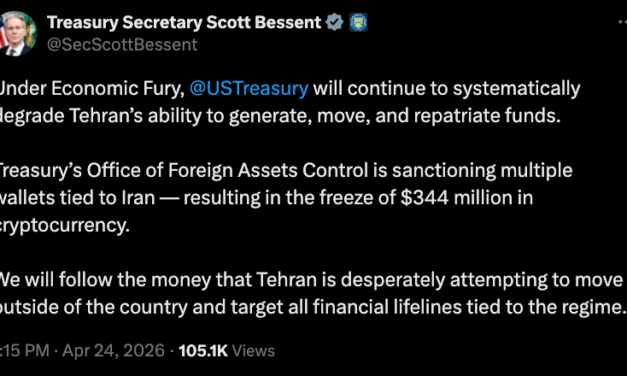
The United States has seized nearly $500 million in Iranian cryptocurrency assets as part of a sweeping economic pressure campaign against Tehran, Treasury Secretary Scott Bessent said Wednesday.Bessent made the comments during an appearance on Fox Business’s “Kudlow,” where he outlined the scope of Operation Economic Fury, a campaign ordered by President Donald Trump in March 2025 aimed at cutting off Iran’s financial lifelines through asset seizures, bank account freezes and secondary sanctions on countries that continue to buy Iranian oil.“We are freezing bank accounts everywhere. More importantly, we are making people less willing to deal with the regime,” Bessent said, adding that retirement funds and overseas real estate held by Iranian officials are also being targeted.The $500 million figure is much higher than the $344 million in seized crypto assets previously disclosed. Last week, Bessent announced that the Treasury’s Office of Foreign Assets Control had sanctioned several crypto wallets tied to Iran, with stablecoin issuer Tether confirming it had frozen more than $344 million in USDt (USDT) at the request of US authorities.Source: Scott BessentCointelegraph reached out to the US Treasury and Tether for an explanation on the gap between the two figures, but had not received a response by publication.Related: Iran views BTC as strategic asset, but USDt still dominates oil tolls: BPIIran’s economy under pressureBessent said Operation Economic Fury has taken a toll on Iran’s economy. One of the country’s largest banks collapsed in December, and its currency has fallen 60 to 70% against the US dollar. “They’re in the middle of a currency crisis,” he said.Treasury has also intensified pressure by ramping up sanctions across multiple fronts. On Tuesday, OFAC sanctioned 35 entities and individuals tied to Iran’s shadow banking network. Separately, it targeted a Chinese oil refinery and roughly 40 shipping firms operating as part of Iran’s shadow fleet, which moves Iranian crude to buyers in China and elsewhere in violation of sanctions.The actions also hit Iran’s missile and drone supply chain, with 14 individuals and entities sanctioned for procuring components for Shahed-series attack drones and ballistic missile propellants. Since February 2025, OFAC has sanctioned over 1,000 Iran-related persons, vessels, and aircraft as part of Operation Economic Fury.Related: Binance.US cuts spot trading fees to near zero in push to undercut rivalsIran weighs crypto tolls for Hormuz passageEarlier this month, reports emerged that Iran was considering charging ships Bitcoin tolls for passage through the Strait of Hormuz, with empty tankers allowed free passage and loaded ones charged around $1 per barrel of oil. Forbes reported that Iran had already collected revenue from such tolls, though Tehran has not publicly confirmed the claims.Separately, maritime risk firm Marisks warned that fraudulent actors were impersonating Iranian security services and contacting stranded shipowners, demanding payment in Bitcoin or USDt in exchange for clearance through the strait.Magazine: Will the CLARITY Act be good — or bad — for DeFi?Cointelegraph is committed to independent, transparent journalism. This news article is produced in accordance with Cointelegraph’s Editorial Policy and aims to provide accurate and timely information. Readers are encouraged to verify information independently.

Čítaj viac

Crypto becomes most muted topic on X, and AI slop may be the culprit

Crypto has topped the list of most-muted topics on X since the platform rolled out its snooze feature, with spam and artificial intelligence content, or “AI slop,” likely playing a major role.On Thursday, Nikita Bier, X’s head of product, revealed that crypto has become the most-muted topic ahead of politics, the Iran conflict, sports and business and finance, a notable shift in a platform that was once the heartbeat of Crypto Twitter.The snooze feature, which lets Premium subscribers hide topics from their For You feed for 24 hours, was launched on April 22. At the time, Bier described the tool as a way for users to “crank up or turn down the slop,” apparently a nod to the flood of low-quality content that has increasingly plagued the platform.Source: Nikita BeirCrypto content on X has come under growing scrutiny, with the platform changing its API policies in January to cut off apps that paid users to post. The move was aimed at curbing the wave of AI-generated spam and low-quality content flooding crypto feeds through so-called “InfoFi” apps that rewarded engagement.Related: Senator Elizabeth Warren questions Elon Musk about X MoneyBeir’s run-in with Crypto TwitterEarlier this year, Bier said in a now-deleted post that Crypto Twitter’s visibility problems were largely self-inflicted, arguing that many accounts burn through their daily reach by overposting or flooding replies with low-value messages like repeated “gm” greetings, leaving little room for substantive content to land.The remark drew a sharp response from the crypto community. CryptoQuant founder Ki Young Ju pushed back, arguing that the real problem is a flood of AI-generated spam that X’s algorithm cannot distinguish from legitimate accounts. “It is absurd that X would rather ban crypto than improve its bot detection,” Ju wrote.Bier joined X as head of product in June 2025, shortly after taking an advisory role at the Solana Foundation in March, where he focused on helping consumer-facing apps built on the network scale and reach mainstream mobile audiences.X also launched Smart Cashtags on April 15, allowing iPhone users in the US and Canada to view real-time price charts for stocks and crypto, including Bitcoin, Ether, XRP, and stocks like Coinbase and MicroStrategy, without leaving the app. The rollout came days after Bier teased that X would “launch something to fix” crypto’s rough year.Related: X mulls new rules for first-time crypto posts amid tortoise scamCrypto sentiment and search interest remain lowCrypto market sentiment remains subdued, with the Fear & Greed Index sitting at 29, or in “Fear” territory. While it is a notable recovery from last month’s Extreme Fear reading of 11, it still signals a state of investor anxiety.Google Trends data tells a similar story. Worldwide search interest in crypto has trended sharply lower since peaking in early 2026, with interest in terms like “crypto,” “cryptocurrency” and “Bitcoin” declining heading into April.Magazine: AI-driven hacks could kill DeFi — unless projects act nowCointelegraph is committed to independent, transparent journalism. This news article is produced in accordance with Cointelegraph’s Editorial Policy and aims to provide accurate and timely information. Readers are encouraged to verify information independently.

Čítaj viac

ZetaChain dismissed bug report that could have prevented $334K exploit

The vulnerability that led to ZetaChain’s recent exploit had been flagged through its bug bounty program before the attack, but was dismissed as intended behavior.In a post-mortem published Wednesday, the team said the incident has prompted a review of how it handles bug bounty submissions, particularly reports involving chained attack vectors that may appear harmless in isolation but are dangerous in combination.“This bug was reported and they simply ignored it,” one user wrote on X. “That’s how bug bounty programs work with these protocols currently; they incentivize losses for the protocol, the TVL, and the user’s balance instead of paying the researcher for discovering and fixing the bug,” they added.ZetaChain lost approximately $334,000 to a premeditated exploit on Sunday that targeted its cross-chain gateway contract. The exploit drained funds across nine transactions on four chains, including Ethereum, Arbitrum, Base and BSC, all from ZetaChain-controlled wallets. No user funds were affected.Related: Crypto hackers stole $17B over past 10 years: DefiLlamaAttacker exploits small design flawsZetaChain said in its post-mortem that the attacker exploited three design flaws that, individually, might have seemed minor, but together opened the door to a full drain. First, the gateway allowed anyone to send arbitrary cross-chain instructions with no restrictions. Second, on the receiving end, it would execute almost any command on any contract, with a blocklist so narrow it missed basic token transfer functions.Third, wallets that had previously used the gateway had left unlimited spending permissions in place that were never cleaned up. By combining all three, the attacker simply told the gateway to transfer tokens from victim wallets to their own, and the gateway complied.Source: ZetaChain“This was not an opportunistic attack,” ZetaChain said in its post-mortem. The attacker funded their wallet through Tornado Cash three days before the exploit, deployed a purpose-built drainer contract on ZetaChain and ran an address poisoning campaign before seeding it into their transaction history via dust transfers.ZetaChain added that a patch permanently disabling the arbitrary call functionality is being rolled out to mainnet nodes. The platform also removed unlimited token approvals from its deposit flow, replacing them with exact-amount approvals going forward.Related: Ethical hacker intercepts $2.6M in Morpho Labs exploitAI DeFi exploit success rate increasesA new study by a16z tested whether an off-the-shelf AI agent could go beyond identifying DeFi vulnerabilities and actually produce working exploits. Using OpenAI’s Codex against a dataset of 20 real Ethereum price manipulation incidents, researchers ran the agent in a sandboxed environment with no access to future transaction data and no guidance on how the attacks worked. The agent succeeded in just 10% of cases.However, when researchers fed the agent structured knowledge about common attack patterns and exploit workflows, the success rate jumped to 70%.Magazine: How to fix suspected insider trading on Polymarket and KalshiCointelegraph is committed to independent, transparent journalism. This news article is produced in accordance with Cointelegraph’s Editorial Policy and aims to provide accurate and timely information. Readers are encouraged to verify information independently.

Čítaj viac

Dunamu, Hana Financial take blockchain remittance system live with POSCO

South Korea’s Hana Financial Group, POSCO International and Dunamu, the operator of the crypto exchange Upbit, have signed a trilateral memorandum of understanding (MoU) to launch their blockchain-based remittance system, with POSCO International serving as the first real-world test case.The agreement, signed Tuesday at Hana Financial Group’s Seoul headquarters, follows a successful proof-of-concept (PoC) completed earlier this year by Hana and Dunamu, which showed that blockchain could reduce settlement times and costs compared to the traditional SWIFT framework. That pilot used Dunamu’s proprietary GIWA Chain to replace SWIFT’s messaging network for cross-border transfers.The new MoU allows the system to be tested on real trade transactions for the first time, with POSCO International handling the actual fund flows, the company said in a Wednesday announcement.Traditional cross-border payments use SWIFT, where sending the payment instruction and actually moving the money are two separate steps, which slows things down and adds costs. The blockchain system combines both into a single real-time process, making transfers faster and cheaper.Related: South Korea to pilot tokenized deposits for government spendingDunamu’s GIWA Chain to power blockchain remittance systemUnder the deal, POSCO International’s trading arm will handle business application using real transaction flows, Hana Financial will manage remittance processing, fund settlement and foreign exchange, while Dunamu provides the blockchain infrastructure through GIWA Chain and maintains the transaction record.“We have established a foundation for mid-to-long-term partnerships with leading domestic companies in the fields of digital finance and digital assets,” Lee Gye-in, president of POSCO International, said.From left to right: Hana Financial Group vice chairman Lee Eun-hyung, POSCO International president Lee Gye-in, and Dunamu CEO Oh Kyung-seok. Source: POSCOThe three companies plan to establish a working model for real-time blockchain remittances before the end of the year.Related: Naver-Dunamu filing sets IPO committee, listing timeline for fintech groupPOSCO International deepens crypto pushThe deal adds to POSCO International’s broader push into digital finance. The company recently issued blockchain-based foreign currency digital bonds worth approximately 140 billion won (about $95 million) with HSBC, and last year introduced a blockchain-based global payment system with JP Morgan.As Cointelegraph reported, South Korean internet-only bank Kbank has also partnered with Ripple to test blockchain-based cross-border remittances.Magazine: South Korea gets rich from crypto… North Korea gets weaponsCointelegraph is committed to independent, transparent journalism. This news article is produced in accordance with Cointelegraph’s Editorial Policy and aims to provide accurate and timely information. Readers are encouraged to verify information independently.

Čítaj viac

Získaj BONUS 8 € v Bitcoinoch

nakup bitcoin z karty

Registrácia Binance

Burza Binance

Aktuálne kurzy