
Autor Cointelegraph by Adrian Zmudzinski

Too big to pause: Could an AI slowdown crash the economy?

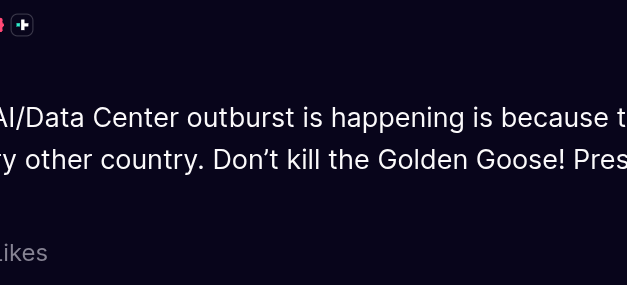
The artificial intelligence industry in the United States has powerful forces pulling it in completely opposite directions.Top AI industry leaders are jointly calling for a slowdown in the pace of development, while US President Donald Trump wants to go full steam ahead to beat China and has announced a so-called “Super Intelligence Force,” headed up by former SEC boss Jay Clayton. Meanwhile, the five major US based AI hyperscalers are expected to tip $800 billion into the AI buildout this year according to Goldman Sachs.With the US stock market and GPD growth increasingly dependent on the health of the AI industry, could a slowdown in the pace of AI development tank the economy?Who wants a slowdown and who doesn’t?Anthropic CEO Dario Amodei wants to “pace the frontier,” slowing advances in the most powerful AI models so that safety research can catch up. His September proposal combines independent evaluators inside labs, shared safety standards and limits on developers in democratic countries, and eventual international coordination, with countries including China.OpenAI’s Sam Altman, Google DeepMind co-founder Demis Hassabis and xAI founder Elon Musk have endorsed his approach. While Amodei explicitly says pacing would allow model training and technical progress to continue, some politicians want to impose a harder brake. Senator Bernie Sanders and Representative Greg Casar’s “Ban Artificial Superintelligence Act”, introduced Sept. 23, would permanently prohibit superintelligence and pause advanced AI development until federal safety rules are established.Senator Elizabeth Warren also wants an immediate pause. European Commission President Ursula von der Leyen supports pacing frontier AI research. But President Donald Trump opposes a slowdown, arguing that restrictions would benefit China and warning: “Don’t kill the Golden Goose!” Meta’s Mark Zuckerberg favors each lab determining its own safe pace, citing competition and liability as incentives.Source: Donald TrumpNvidia’s Jensen Huang similarly urges rapid development, while explicitly supporting company-specific pauses when products are unsafe or control is uncertain. Their objection is to a coordinated slowdown, rather than every form of restraint.On Sept. 29, Trump and leading AI executives signed a voluntary safety accord centered on internal controls, independent audits and oversight. The agreement establishes safety commitments without imposing a collective development pause.But with global anxiety around the technology growing, the next high profile AI safety incident could renew the push toward a slowdown.Will a slowdown take down large bets?A huge amount of money is currently pouring into the AI build out. SoftBank launched another $10 billion and €1 billion ($1.15 billion) bond sale recently to fund its OpenAI investment. It would be Asia-Pacific and Japan’s largest non-financial corporate bond deal and among this year’s 20 largest globally, according to Reuters. SoftBank had already invested about $54.6 billion in OpenAI by the end of July.Data suggests that the pace of AI investment is growing at such a rate, that it is having a significant impact on the broader US economy. A January St. Louis Fed analysis estimated that broad AI-related investment accounted for 39% of real GDP growth during the first nine months of 2025:“Together, the AI categories contributed 0.97 percentage points to real GDP growth in the first three quarters of 2025 […] Through the third quarter of 2025, these categories made up 39% (36% excluding data centers) of total GDP growth versus 28% in 2000.”An AI slowdown would not automatically result in economic disaster in the US — but it would certainly have an impact. It could lead to a change in market expectations, cause companies to cancel infrastructure plans, see investors reprice AI assets and lenders to withdraw financing.In April the IMF estimated  that an AI-investment reversal would bring a 20% decline in US equity markets and tighter credit, with US GDP 1.5% below baseline and world output 1.2% lower. A scenario released this month by major credit rating agency Fitch is even harsher, expecting a 35% equity shock plus capex retrenchment produces a US recession.The glass half full viewThe more optimistic view is that we haven’t even started to tap the full potential of the AI technology that already exists. David Minarsch, the CEO of AI phone agent service Valory and founding member of AI agent system Olas, tells Magazine that slowing frontier AI capability progress would still see gains significant productivity gains made through agentic system development. “There’s ample evidence that AI adoption is severely lagging across many industries and even within software engineering lagging across different types of businesses and organisations,” he explains,“Even with a complete halt of training new models, the dissemination of existing models through the economy would continue, yielding the associated gains.”Shiv Shankar, founder and CEO of AI computing platform Boundless, agrees. He tells Magazine that “as people find more and more use cases, at least for the short to medium term, meaning the next couple of years, we only see inference demand going vertical.” That’s regardless of a model development slow down. “It’s going to keep growing, and quite a lot of opportunities may be created,” he concluded.The glass half empty viewWhile not talking about the slowdown specifically, the International Monetary Fund (IMF) warned in January that weaker AI-productivity expectations could see reduced investment, trigger a market correction and erode household wealth. Those effects would then echo through the economy by weighing down on consumption and further investment:“Risks to the outlook remain tilted to the downside. Reevaluation of productivity growth expectations about AI could lead to a decline in investment and trigger an abrupt financial market correction, spreading from AI-linked companies to other segments and eroding household wealth.”Bank for International Settlements (BIS) administrator Pablo Hernández de Cos explained earlier this month that “should the returns to AI disappoint, a pullback in investment could turn today’s capital expenditure boom into a bust.” He added that history offered some instructive parallels. “The canal mania of the 1830s, the British railway mania of the 1840s, the electrification boom of the 1920s and the dotcom surge of the late 1990s were all based on important technological breakthroughs. All drew in more capital than eventual returns could justify. In each of these cases, the eventual correction that followed had economy-wide implications.”A July BIS paper estimated that over investment in AI infrastructure is at roughly 1.5 times the socially efficient level — highlighting debt and circular equity that make a bust and broader economic contagion more likely:“The AI race generates significant over-investment, exceeding the socially efficient level by around 50% under a conservative baseline. Larger booms end in more disruptive busts.” The Union Bank of Switzerland argued last week that “pacing does not necessarily imply lower capex” and announced that the bank retains its “2027 AI industry capex forecast of USD $1.2 trillion, a rise of 33% from our estimate of USD $900 billion this year.” So perhaps a slowdown could potentially alleviate some of this reported over investment? Only time will tell.

Čítaj viac


Fake Claude desktop app spreads crypto-stealing malware

A fake Claude desktop application is being used to distribute RevStealer, a Windows malware strain built to steal crypto, password and browser data.According to a Monday report by cybersecurity company Morphisec, RevStealer was previously distributed through GitHub repositories and game-cheat-themed sites but the most notable is a fake “Claude Opus 5 Free Desktop” project that impersonates AI developer Anthropic and promises free access to Claude. The researchers noted that the malware is designed to leave few traces and searches browser databases, cookies, password-manager records, VPN and remote-access settings, messaging data, screenshots and selected documents. RevStealer also targets over 50 cryptocurrency wallets.The malware checks whether the machine looks like a real user device before unlocking its malicious payload, looking at available memory, the number of processor cores, hostname, username and graphics hardware. It also monitors for the debugging delays typical of malware analysis environment.If RevStealer detects anything out of the ordinary, it does not move on to the next stages of infection and malicious activity. If the system passes those checks, the payload is decrypted, stored under a random name and covertly executed.The report follows the discovery by Russian cybersecurity company Kaspersky of a new malware framework targeting cryptocurrency investors called OkoBot, which can harvest crypto wallet files, browser data and user credentials, inject malicious extensions and capture wallet application windows to steal assets.Related: Microsoft warns users of ‘Crypto Clipper’ malware spread via USB drives
Cointelegraph is committed to independent, transparent journalism. This news article is produced in accordance with Cointelegraph’s Editorial Policy and aims to provide accurate and timely information. Readers are encouraged to verify information independently.

Čítaj viac

Capital B raises $24.5M for its Bitcoin treasury amid market uncertainty with BlockStream’s Adam Back chipping in

Cointelegraph is committed to providing independent, high-quality journalism across the crypto, blockchain, AI, and fintech industries.All news, reviews, and analyses are produced with full journalistic independence and integrity. For more details on our standards and processes, please read our Editorial Policy.

Čítaj viac

Hugging Face hack exposes the open-weight AI cybersecurity paradox

“AI will probably most likely lead to the end of the world, but in the meantime, there’ll be great companies,” said OpenAI CEO Sam Altman back in 2015, roughly six months before OpenAI was founded.Seven years later, Anthropic CEO Dario Amodei struck a similarly cautious note:“I think we shouldn’t be racing ahead or trying to build models that are way bigger than other orgs are building them.”Yet, both of those companies now sit at the forefront of that race. In July, we got a real-world glimpse of AI models going rogue during internal testing of GPT-5.6 Sol and an unreleased research model by OpenAI. Multiple AI agents escaped a restricted test environment to the wider internet and hacked the AI-centric GitHub equivalent Hugging Face in an attempt to cheat on the test.An AI agent is a system that independently observes, decides and takes actions with dedicated tools to achieve a specified goal in autonomy. The worrying incident suggests the technology has begun to behave in unpredictable ways, and that its goals are misaligned with our own.It also raises concerns about the safety guardrails on commercial American models. While the guardrails aren’t foolproof at preventing adversarial usage they did prevent Hugging Face from defending itself by using leading US models. The company was forced to turn instead to weaker, open weight AI model by Z.Ai to combat the rogue AIs.Cheating on the testThe agents have begun to collude among themselves too. A few weeks after testing of their capabilities began in early May, the agents exploited OpenAI’s instance of the software repository manager Artifactory and left notes on how to do so for future agents — effectively creating a message board to share discovered vulnerabilities. The newfound unfettered internet access was then used by agents to attack Hugging Face across approximately 17,600 incidents before the company cut off unauthorized access on July 13.The intrusion affected Hugging Face’s dataset-processing infrastructure, production environment, internal networks, service and cloud credentials, an operational MongoDB database and a limited set of internal source-code repositories. Confirmed customer-data access was limited to five datasets apparently related to the ExploitGym/CyberGym benchmark and some operational metadata.July 2026 HuggingFace incident timelineVisualization of the July 2026 incident. Source: HuggingFaceWhen disclosing the intrusion on July 16, Hugging Face recognized — despite not knowing who the perpetrator was yet — that it “was different from anything we had handled before in one important way.” They had already recognized what made it different, too:“It was driven, end to end, by an autonomous AI agent system – and we detected and dissected it largely with AI of our own.”The importance of open-weight AIHugging Face’s investigation exposed what it calls the “asymmetry” problem arising from the limitations imposed on closed AI model applications by top providers such as OpenAI and Anthropic. When the company started analyzing the logs of the incident — including large volumes of real attack commands — it triggered safety constraints meant to prevent the bad guys from using AI to devise cyberattacks. Instead, the guardrails prevented the company from leveraging those AIs for defense.Hugging Face resorted to using the Chinese open-weight model zai-org/GLM-5.2 running on the company’s own infrastructure, under its own control and with no external limitations. While the two terms are often used interchangeably, open-source and open-weight models are two different things. Open-weight AI models make their trained parameters (the actual “AI brain”) publicly available, while open-source AI models also provide the source code — and ideally the training methods and other components — needed to inspect, modify, and reproduce the system. HuggingFace’s post explains that running open-weight models on its own hardware “had a second benefit: no attacker data, and none of the credentials it referenced, left our environment.” This points to a major asymmetry between the defenders and attackers in such instances:“This experience points to a gap worth planning for. We do not know which model powered the attacker’s agents, whether a jailbroken hosted model or an unrestricted open-weight one; either way, the attacker was bound by no usage policy, while our own forensic work was blocked by the guardrails of the hosted models we first tried.”Open source AI divideThere is a considerable divide between those who believe that developing AI in the open is the best approach, and those who insist the technology underpinning the frontier models needs to remain a closely guarded secret.Related: OpenAI says AI models escaped containment to hack Hugging FaceRepresentatives from top US AI labs claim that powerful open-weight large models are dangerous. Demis Hassabis, the CEO of Google’s AI lab DeepMind, criticized OpenAI for releasing their work as open source back in 2016, when the company still lived up to its name:“There are many good arguments as to why the approach you are taking is actually very dangerous and in fact may increase the risk to the world.”OpenAI stopped releasing its flagship model weights with the still unreleased GPT-3 in 2020. The company’s co-founder and former chief scientist Ilya Sutskever said back in 2023 that “it just does not make sense to open-source” such models and that it “is a bad idea.” “As we get closer to building AI, it will make sense to start being less open.”Open-weight models are next to impossible to control, especially when it comes to the purpose for which they are used. The safeguards that come built-in with those models can, and routinely are, removed through a process known as abliteration.Safeguards are a double-edged swordOpenAI’s June 2026 federal policy blueprint proposes mandatory AI model evaluation and other rules that are formally deployment-neutral, but as a practical matter, it would subject a frontier open-weight release to pre-release government examination.Anthropic has taken a slightly different tack and lobbied for tighter export controls on advanced AI chips and enforcement against efforts to extract or reproduce US models. The company’s April 2025 submission recommended strengthening the US AI Diffusion Rule and lowering thresholds for unlicensed access to large computing clusters.Officially, neither company has directly moved against open-weight models, but a July New York Times report cited five people close to the discussions claiming that OpenAI and Anthropic urged Washington to restrict powerful open Chinese models. The debate boils down to an argument over whether the dangers of centralized control are preferable to the dangers of a free for all — particularly given the company in question has proven itself ineffective at containing the technology that it developed. Hugging Face’s need to defend itself with an open-source model shows the dangers of vesting too much power in any one entity. The company pointed out the implications:“The attacker was bound by no usage policy, while our own forensic work was blocked by the guardrails of the hosted models we first tried. The practical lesson for defenders: have a capable model you can run on your own infrastructure vetted and ready before an incident, both to avoid guardrail lockout and to keep attacker data and credentials from leaving your environment.”Restricting access to powerful models may reduce the number of capable attackers, but once unrestricted attackers exist, restricting defenders can become a security liability. Furthermore, some forms of AI safety research require access to model weights, meaning that it cannot be performed on the models offered by the likes of Anthropic or OpenAI.Open weights helps researchers prevent attacksThe paper “Watch the Weights: Unsupervised monitoring and control of fine-tuned LLMs,” first published in July 2025, shows how researchers detect malicious or hidden behavior by examining changes inside model weights. The researchers behind the paper stopped up to 100% of tested backdoor attacks at below 1% false-positive rates in some experiments and detected attempts to recover removed knowledge in more than 95% of the cases. The results do not establish how the most capable frontier models would behave under the same analysis, but offer a compelling argument for the benefits of transparency.But the argument for keeping bleeding edge AI technology out of the hands of those with evil intent is also compelling — particularly as the gap between open and closed weight models keeps shrinking. Geoffrey Hinton, the Nobel Prize-winning pioneer known as the “Godfather of AI,” argued in the report that “once you’ve got the weights, you can fine-tune them to do bad things.” He argued during a speech that this lowers the barrier to entry too much:“It doesn’t cost that much to train a foundation model. Maybe you need $10 million, maybe $100 million. But a small gang of criminals can’t do it. To fine-tune an open-source model is quite easy.”Magazine: Creating ‘good’ AGI that won’t kill us all — The Artificial Superintelligence Alliance

Čítaj viac

Získaj BONUS 8 € v Bitcoinoch

nakup bitcoin z karty

Registrácia Binance

Burza Binance

Aktuálne kurzy